

The sealed bidding process is a structured way to source suppliers where bids remain locked until a set deadline, then opened and scored against agreed criteria. In this walkthrough, we show how an AI‑assisted platform turns a plain brief into requirements, ensures governance, checks responses, and keeps human decision‑makers in control from first draft to award.
A Hypothetical Scenario: A 40‑Person Buyer Needs a New IT Helpdesk
Imagine a 40‑person professional services firm. Their current IT helpdesk contract is ending, and the leadership wants a fair, documented competition. The team has limited time and mixed procurement experience, but they care about confidentiality, auditability, and a robust outcome. They choose an online platform to run a sealed event so pricing and responses remain unseen until the deadline. The aim is not speed for its own sake, but a defensible, efficient path to value.
In this scenario, the project lead drafts a short, plain‑English brief: user support for 40 staff, business hours coverage, response time targets, remote assistance, light device management, and monthly reporting. They also note a preference for UK‑based data handling, basic cyber controls, and a smooth onboarding plan. They want practical demonstrations of how incidents will be triaged and resolved.
Because the organisation is small, the evaluation team is compact: three people covering operations, finance, and technical assurance. The platform will help them convert the brief into weighted requirements, assign scorers, and keep everything locked until the deadline. As a discipline, the sealed bidding process prevents informal price‑peeking and encourages suppliers to submit their best, most honest proposals without tactical last‑minute manoeuvring.

Where Does a sealed bidding process Fit Into Modern Procurement?
Open competition and equal treatment are core to public and private procurement. A sealed approach sits well when comparability matters and you want to minimise gamesmanship. It is strong for services with clear measurable outputs, such as helpdesk support with defined service levels, and for commodities where price and compliance can be evaluated consistently.
In modern practice, digital tools remove friction: requirements can be modelled in software, weighting applied transparently, and governance embedded by design. This is not about weakening human judgement. Instead, the software assists with structure and checks while the named evaluators make the calls. The sealed bidding process becomes easier to execute at scale when the platform enforces timelines, permissions, and audit trails.
Transparency and fairness are also regulatory themes. If you work in or with the UK public sector, policy guidance emphasises competition, equal treatment and record‑keeping. See the UK government’s overview of public sector procurement policy for high‑level context. Even in private organisations, applying similar standards improves defensibility and stakeholder confidence.
How Do We Translate a Plain‑English Brief Into Weighted Requirements?
Our scenario team logs into the TenderLock platform and pastes the draft brief. The system proposes a structured set of requirements grouped by themes: service scope, service levels, security, transition, reporting, and pricing. For each requirement, it suggests an evaluation method (scored narrative, evidence attachment, or factual declaration) and a default weight. The team can tune these based on what matters most.
For example, incident response time might be weighted at 20%, onboarding at 10%, and security controls at 15%. Price could sit at 35%, with the balance spread across reporting quality and account management. The platform highlights any ambiguous language and flags overlaps. A short “Red Team” pass invites colleagues to comment specifically on clarity, not content, which reduces the risk of bidders misinterpreting the intent.
When clarity issues arise (“fast response” or “robust security”), the system recommends measurable alternatives (e.g., “P1 response in 15 minutes, restore within 4 hours,” or “ISO/IEC 27001 certification or equivalent controls”). Clear, measurable requirements reduce post‑award disputes and sharpen evaluation. The team also confirms this is a sealed bidding process, setting a firm closing time with automatic lock and a permissions scheme that prevents early access.

What Governance Do We Put In Place So Decisions Are Defensible?
Good governance starts early. The team names a procurement lead, identifies evaluators for each criteria group, and appoints an approvals contact for final sign‑off. The platform enforces who can see what, when. Evaluators cannot access price until non‑price criteria are scored, reducing bias. Evidence‑locked scoring ensures that every score is linked to the exact supplier content that justified it.
Supplier vetting is prepared up‑front. Basic company due diligence will include checks against official sources like Companies House and a credit reference agency. The checks are not about eliminating healthy risk, but about spotting red flags. If a bidder’s filings show late accounts or the credit assessment highlights unusual risk, this triggers a proportionate review of contract protections rather than an automatic disqualification.
Policy references are useful. While private buyers have flexibility, many adopt public‑sector‑style principles for fairness and audit. The Procurement Policy Notes collection offers relevant context about transparency and social value expectations. A well‑run event which documents criteria, scoring, and approvals makes audit simpler in any sector. Framing the project with these controls honours the competitive intent while keeping the process manageable and time‑bounded.
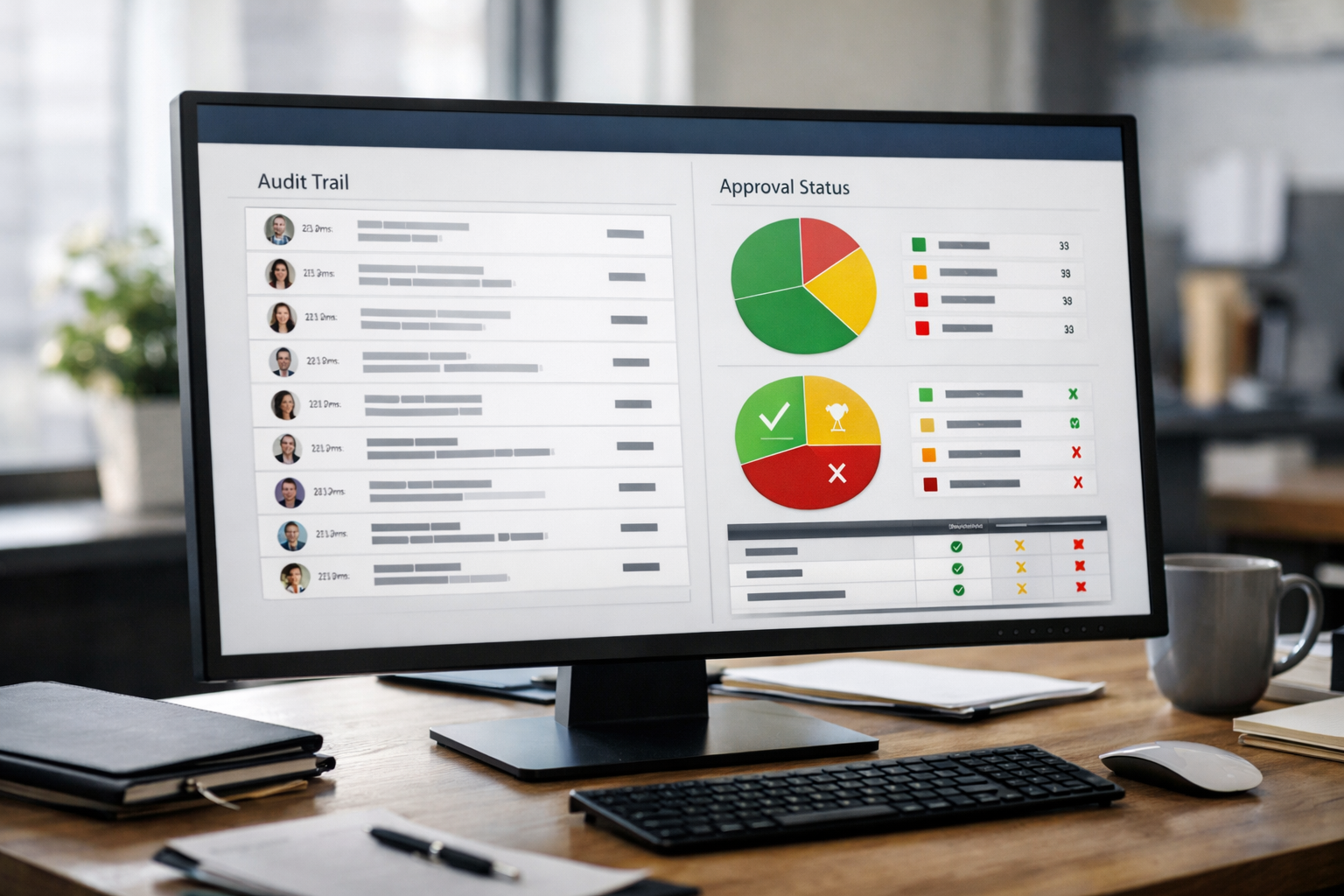
Finally, the approvals workflow is mapped: once evaluations close, a summary report travels to a sponsor for review. The platform records all comments, changes, and timestamps. If challenged later, the organisation can show the chain of reasoning, the artefacts reviewed, and who made which decision, when. That is the essence of good governance: demonstrable fairness backed by records.
Step‑By‑Step: Building the Event, Inviting Suppliers, Locking Bids
With governance in place, the team builds the event. The structure mirrors the criteria: suppliers will answer each requirement in a guided form, attach evidence, and provide pricing in a sealed commercial section. The system handles communications in‑platform so clarifications become part of the record, with any response shared equally to all participants.
- Create the event shell and set the deadline, with automatic locking at the chosen minute and time zone.
- Import or write the requirements. Apply weights, set pass/fail gates, and mark which responses require attachments.
- Assign evaluators to criteria. Restrict price visibility until technical scoring is complete.
- Configure due diligence checks (Companies House and credit risk) to run upon submission.
- Load the supplier list and invitations; the platform tracks acceptances and withdrawals.
- Enable recorded supplier briefings with AI summaries, inviting all participants to maintain equal access to information.
Supplier questions are handled transparently: the team answers once, and the reply is shared. If a query exposes an ambiguity, the requirement is clarified for everyone, with the revision logged. This reduces uneven interpretations.
For buyers who want the discipline and fairness of a sealed bidding process without the admin burden, this orchestration is a relief: the system keeps the clock, permissions, and documentation aligned, while the humans focus on content. Ready to try it? Start your first tender free and see the workflow end‑to‑end with no card required.

How Are Supplier Responses Checked Requirement by Requirement?
When suppliers submit, the platform runs checks at the requirement level. If a question demands a specific piece of evidence (for example, a policy document or a certification), the system confirms an attachment is present and flags if it appears unrelated. Narrative answers are scanned for directness, completeness, and potential contradictions with earlier statements or linked artefacts.
Automated checks are clearly labelled as suggestions, not verdicts. The evaluation team remains in control: they read the responses, open the evidence, and score against the rubric. Where the AI highlights potential ambiguity or missing detail, evaluators can request a clarification round. These clarifications are recorded, time‑stamped, and shared uniformly, with changes tracked so late edits cannot quietly rewrite core answers.
Because this is a sealed bidding process, pricing is still locked while technical and quality responses are reviewed. Only when the non‑price criteria are scored and locked will the price tab open to authorised viewers. This sequencing helps prevent anchoring bias (shifting a quality score because someone glimpsed a low price) and keeps the evaluation team honest to their agreed scheme.
What Happens on Deadline Day, and How Are Conflicts Avoided?
On the deadline, the platform automatically moves the event into evaluation. Late submissions are handled per the rules set at the start (typically, they are not accepted). No one can open commercial data until the controls release it. Each evaluator sees only their assigned criteria and cannot influence peers with comments until everyone has submitted initial scores.
To handle potential conflicts, the system can flag where an evaluator’s score is a notable outlier compared to peers. That does not mean it is wrong; it is a prompt to re‑read the evidence and, if needed, discuss. If a conflict of interest is declared (e.g., a team member realises a prior association), their access is removed or restricted, with a note recorded.
Practical transparency matters: the platform generates an evaluation log that shows when each step occurred and by whom. If challenged later, the organisation can show that the timetable was followed, that bids remained sealed until the right moment, and that decisions weren’t swayed by premature exposure to price or brand reputation.
Evaluating Fairly: Scoring, Evidence, and Recorded Clarifications
Scoring works best when evidence is at your fingertips. Evaluators open each requirement, read the supplier’s response, and attach a score aligned to the rubric. Because evidence is “locked” to the score, future readers can see precisely what justified a decision. Where a response is strong on claims but light on proof, the rubric guides a moderate score rather than an optimistic one.
Clarification calls can be run through the platform and recorded, with AI summaries attached to the relevant requirement. This is crucial: clarifications should not introduce new solutions; they should explain what is already offered. By keeping recordings and notes with the affected criteria, the process remains transparent and proportionate.
After the team locks quality scores, the commercial section opens to authorised roles. Normalised price scoring is then applied as configured. In a sealed bidding process, this two‑stage opening maintains integrity: the technical merits are judged without price pressure, then price is considered with a consistent formula. The combined scores feed the recommendation, which is then reviewed and approved according to the governance plan.

Dashboards, Audit Trails, and Preparing the Award Report
Dashboards provide a single view of progress: who has scored, which items are pending, and whether any clarifications remain open. A change log records edits to requirements, supplier responses, and deadlines, with timestamps. This continuity matters for audit and for internal lessons learned: what took time, where ambiguity crept in, and how to improve next round.
The award report is built from the ground up: it includes the original brief, finalised requirements, the scoring summary, price evaluation method, due diligence outcomes, any clarifications, and the approval trail. This package is what stakeholders will see—finance, leadership, and, if needed, auditors. Because it is assembled from structured data, it is consistent and easy to review.
To make roles and artefacts clear, here is a simple mapping for our scenario:
| Role | Key Responsibility | Artefact/Output | Platform Feature |
|---|---|---|---|
| Procurement Lead | Design the event, set rules, maintain schedule | Event plan, clarified requirements | Event builder, Red Team review, change log |
| Technical Evaluator | Score service and security criteria | Evidence‑linked scores | Requirement‑level scoring, evidence locking |
| Finance Evaluator | Validate pricing and commercial model | Normalised price score | Sealed price tab, formula application |
| Sponsor/Approver | Review recommendation and approve | Award report, approval log | Read‑only review, e‑sign approval |
| Supplier | Respond to requirements and supply evidence | Completed response pack | Guided forms, recorded Q&A, AI summaries |
With this structure, the mechanics serve the substance. The sealed bidding process is not a bureaucratic hoop; it is the guardrail that lets teams focus on the quality of the solution while keeping records bulletproof.
Common Pitfalls and How This Scenario Steers Around Them
Ambiguity is the classic trap. Vague requirements invite glossy prose that is hard to score fairly. The scenario tackles this by converting the brief into measurable criteria and running a targeted clarity review. Another pitfall is information asymmetry—suppliers getting different answers. Centralising Q&A and issuing uniform clarifications resolves that.
Timing risks matter, too. If deadlines slip or evaluators score in different windows, pressure can mount at the wrong time. The platform’s schedule and permissions reinforce cadence: quality first, then price, with automatic locks. This sequencing protects the team from bias and preserves the competitive nature of a sealed bidding process.
Finally, weak documentation can undermine even a fair outcome. If the “why” behind a score is not visible, stakeholders may doubt the result. Evidence‑locked scoring and recorded clarifications provide the chain of reasoning. Combined with company and credit checks, the award recommendation becomes a clear narrative: what was asked, what was received, how it was scored, and why the chosen supplier represents the best fit under the published rules.
Frequently Asked Questions
Is this scenario based on a real buyer?
No. It is a hypothetical example to illustrate steps, artefacts, and decisions without naming any real organisation or outcomes. The detail reflects typical small‑to‑mid market needs and good‑practice controls you can adapt to your own governance and risk tolerance in 2026.
How many suppliers should be invited to compete?
Enough to ensure competition without diluting evaluation quality. For small services, three to six is common. If interest is high, consider a light pre‑qualification step to focus on capable bidders before the main event so evaluators can score thoroughly and consistently.
What if a supplier requests an extension to the deadline?
Handle extensions by rule, not by exception. If one supplier requests more time for a material reason, consider extending for all and document why. Communicate the change through the platform so every participant gets the same update and the audit trail reflects the decision.
Can we include demonstrations or interviews without introducing bias?
Yes, as long as they are scheduled, scored against published criteria, and recorded. Use structured prompts, consistent evaluators, and evidence‑linked notes. Summaries should be attached to the relevant criteria and available to the approvals role as part of the final report.
How do we handle commercially sensitive attachments?
Classify attachments by sensitivity and restrict access to the minimum necessary evaluators. Keep all file access within the platform so downloads are controlled and tracked. Consider redacting non‑essential personal data and ensure retention policies match contractual and legal requirements.
If you want to put this scenario into practice, explore the full feature overview and start your first tender free. Build a structured event, keep bids locked, and move from brief to award with a complete audit trail on TenderLock.