Construction Tender Evaluation Criteria: What Buyers Need to Know
26 November 2026 · 11 min read

Construction tender evaluation criteria are the standards buyers use to compare contractors fairly and choose the bid that offers the right balance of cost, quality and delivery confidence. Good criteria reflect the actual project, explain what evidence bidders should provide and make clear how responses will be scored. They also separate minimum requirements from the factors that distinguish stronger bids.
What Are Construction Tender Evaluation Criteria?
Evaluation criteria turn a construction project's needs into a consistent decision framework. Rather than asking whether a contractor seems capable, the buyer defines what capability means for the work: perhaps a credible programme, relevant experience, a practical approach to safety or a transparent price.
Criteria are not the same as the specification. The specification describes what the buyer wants built or delivered. The evaluation criteria explain how the buyer will assess the bids against those needs. The two should connect: if working around an occupied building is a major project risk, the evaluation should ask bidders how they will manage it.

It helps to distinguish three types of requirement before inviting bids:
- Minimum conditions: requirements a bidder must meet to remain in the process, such as providing a required declaration. State what happens if a response is missing or unacceptable.
- Scored criteria: factors used to compare acceptable bids, such as methodology, programme and price.
- Contract requirements: obligations the successful contractor must deliver, such as reporting or site controls. Explain which are mandatory and how the tender response will be assessed against them.
For a private buyer, the process should still follow the rules set out in the invitation and any applicable law. Public buyers must also check the procurement regime and guidance relevant to their organisation and procedure; the UK Government's Procurement Act guidance is a useful starting point. Do not assume every contract or procurement falls under the same rules.
Which Criteria Matter Most in a Construction Tender?
There is no universal set of weights. A straightforward refurbishment and a complex live-site project may need very different emphasis. Start with the project's consequences: what would cause delay, disruption, unsafe work, poor performance or avoidable cost? Then ask for evidence that helps the panel judge those risks.
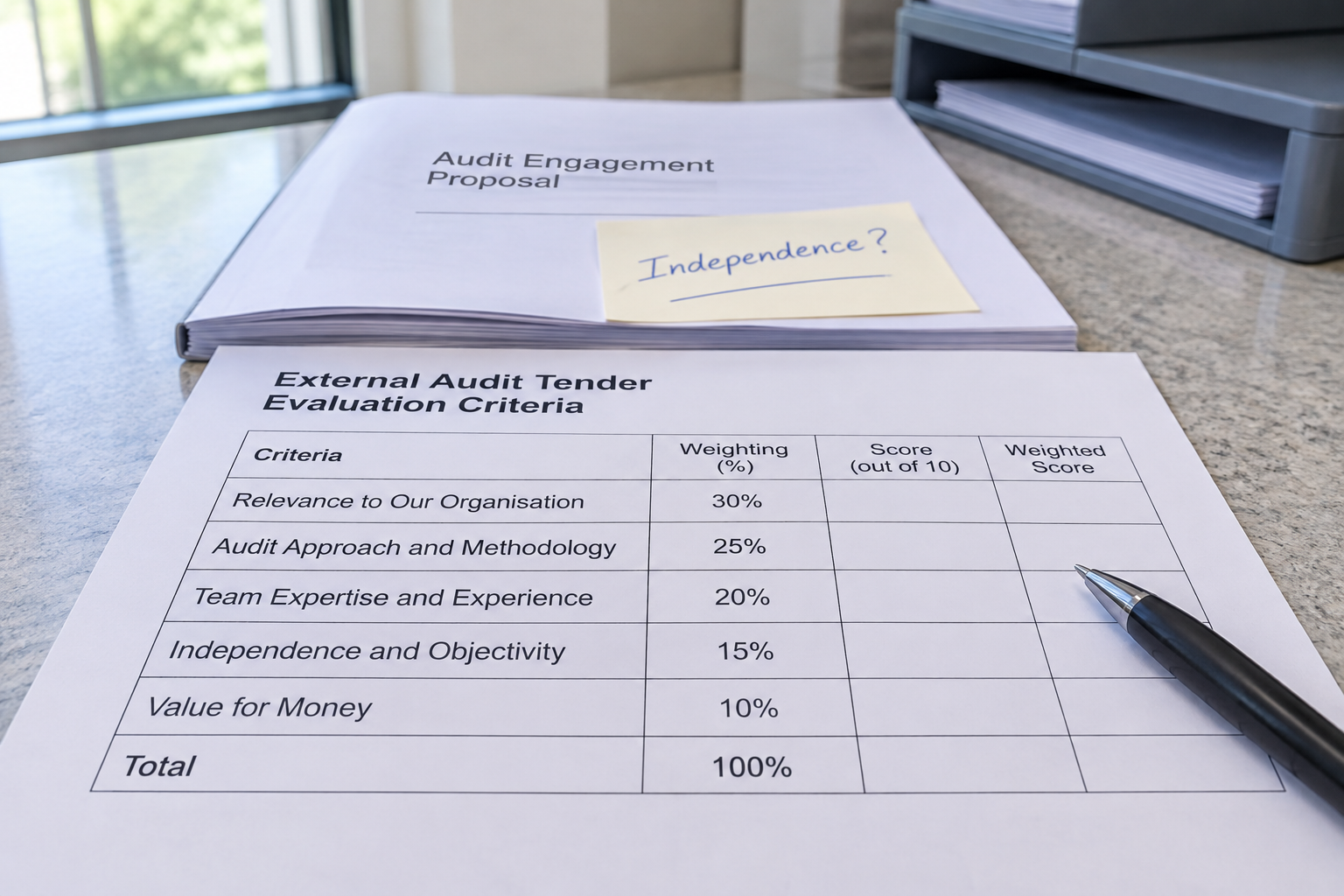
The following is an illustrative starting point, not a prescribed model. Adapt the questions, weights and thresholds to the contract, and tell bidders how you will assess their answers.
| Criterion | What to assess | Example evidence to request | Illustrative weight |
|---|---|---|---|
| Price and commercial clarity | Affordability, pricing assumptions and the basis for comparison | Completed pricing schedule, exclusions and stated assumptions | 30% |
| Methodology and quality | How the contractor will carry out the work and control quality | Project-specific method statement and inspection approach | 25% |
| Programme and logistics | Whether sequencing, access and resources support the required dates | Programme, site logistics plan and key dependencies | 20% |
| Health and safety | Understanding of significant project hazards and proposed controls | Relevant risk-management approach and responsibilities | 15% |
| Team and relevant experience | Whether proposed people have suitable experience for the work | Roles, availability and comparable project examples | 10% |
The weights add up to 100% so the panel can combine weighted scores. They are not a recommendation for every construction project. A buyer might include environmental performance, social value, supply-chain resilience or maintenance implications where those factors are relevant and can be assessed consistently. If you change the model, explain the new criteria and scoring approach in the tender documents.
Avoid double counting. For example, if the same named site manager's experience appears under both team capability and delivery methodology, explain the distinct aspect being assessed in each place. Otherwise, the panel may reward the same evidence twice.
Do the Lowest-Priced Bids Always Offer the Best Value?
Myth: Choosing the lowest tender price is the safest way to demonstrate value.
Fact: Price matters, but the cheapest figure may not represent the lowest overall cost or the best fit for the project. A bid can appear inexpensive because it excludes work others have included, relies on uncertain quantities or assumes access that the buyer cannot provide.
Ask all bidders to complete the same pricing schedule, with clear instructions for labour, materials, preliminaries, allowances and any requested rates. Identify which costs are included in the evaluated price and how you will treat taxes, optional items and provisional sums. If whole-life costs matter, state which costs and assumptions will be used rather than adding them after bids arrive.

Hypothetical example: A buyer requests bids for a roof replacement on an occupied building. One response lists scaffolding separately, while another includes it in the main price. Before comparing totals, the buyer should apply the published pricing rules and, where permitted, seek clarification of the bids. The point is to compare the same scope, not to give a bidder an opportunity to rewrite its offer.
Set out a price-scoring formula before issue. One possible approach is to divide the lowest eligible evaluated price by each bidder's evaluated price, then multiply the result by the available price points. Check that the formula is suitable for the contract and that unusually low, incomplete or non-comparable prices will be handled under the stated process. Public buyers should follow the rules applicable to their procurement.
For a wider discussion of comparing cost and quality, see how to write a tender UK buyers can use to compare value.
Can a Generic Safety Statement Prove a Contractor Is Ready?
Myth: A standard safety policy is enough to distinguish a strong construction bid.
Fact: A policy may establish a baseline, but it does not necessarily show how the contractor will manage this site's hazards. Ask for a proportionate explanation of the risks that matter to the work and how the proposed team will control them.
Depending on the project, relevant topics could include work at height, vehicle and pedestrian separation, temporary works, interfaces with occupants, hazardous materials or coordination between trades. The buyer should identify the information it can provide about the site and ask bidders to explain their approach using that information. Avoid expecting a final, fully developed construction-phase plan where the tender stage and available information do not support one.
The Health and Safety Executive's guidance on the Construction (Design and Management) Regulations 2015 explains dutyholder responsibilities. Check which duties apply to your project and who will fulfil them; scoring a safety answer does not transfer or discharge those duties.
Consider separating a minimum requirement from a scored response. For instance, the buyer might require a relevant policy as a condition of participation, then score the proposed approach to managing interfaces on an occupied site. State the difference clearly so bidders know what to submit and evaluators know what to look for.
Does Experience on Any Large Project Guarantee Delivery?
Myth: The contractor with the biggest portfolio or the longest company history must be the strongest choice.
Fact: Relevant experience is more useful than an impressive but unrelated list. A small project in a constrained building may demand different skills from a much larger new-build scheme. Look for a clear connection between the bidder's examples, the proposed team's responsibilities and the project risks.

Ask bidders to identify who will lead the work, what each person will do, their expected availability and which parts of any cited project they personally handled. If specialist subcontractors are important, request their proposed roles and the basis on which they will be managed. Avoid treating a company case study as proof that a particular person will be available.
Company and financial checks can support the decision, but they do not replace project-specific evaluation. Decide what you need to check, when you will do it and what action follows a concern. TenderLock supports Companies House and Creditsafe checks alongside the tender process; buyers should interpret the information and make the final decision. For a broader approach, use the UK supplier vetting checklist.
Ready to put your criteria into practice? Start a free tender with TenderLock. Your first live tender is free, with no card required.
How Should You Score and Weight Construction Tender Evaluation Criteria?
Myth: Once the weights are published, evaluators can use their own judgement without a shared scoring guide.
Fact: Weights establish relative importance; they do not explain what a good answer looks like. A scoring guide helps reviewers apply the same standards and record why they reached a conclusion.
For example, a buyer could use a zero-to-five quality scale, defining each level in the invitation. A zero might mean no relevant response, while a five might mean a comprehensive, project-specific response that addresses the question and provides convincing evidence. Define the intermediate levels too, including how material gaps affect the score. If a minimum score is required for any criterion, state it and the consequence of not meeting it.
To calculate a weighted score, divide the score awarded by the maximum available score and multiply by the criterion's weight. On a five-point scale, a score of four for a criterion weighted at 25% produces 20 weighted points. Apply the same method to every eligible bid. Keep price scoring separate if it uses a different formula, then combine the results as described in the tender.

Before bids are opened, agree who will evaluate each criterion, how individual assessments will be moderated and who has authority to approve the outcome. Give panel members the same instructions and ask them to record evidence references, strengths, weaknesses and reasons for their scores. A moderation discussion should resolve differences against the published criteria, not introduce new preferences.
Be careful with vague descriptors such as “excellent” or “acceptable” on their own. Tell bidders what the panel will consider: for a programme, that might include sequencing, access assumptions, dependencies and the proposed response to disruption. The guide to setting tender evaluation criteria step by step explains how to build a consistent framework.
Can Clarifications and AI Replace Evaluator Judgement?
Myth: A clarification can fix any weak bid, and an AI tool can choose the winner objectively.
Fact: Clarifications and AI can help reviewers understand submissions, but neither removes the buyer's responsibility for a fair, documented decision. A clarification should be handled consistently, within the published process and applicable rules. Distinguish an explanation of an existing answer from a material change to the bid; seek appropriate advice if the distinction is unclear.
Keep a record of the question, the reason for asking it, the response and how it affected the assessment. Do not ask leading questions that reveal competitors' positions or allow a bidder to improve its offer unfairly. If a missing answer has a stated consequence, apply that rule rather than inventing a remedy after opening.
AI can assist with drafting criteria, checking a brief for ambiguity and finding whether a submission addresses each requirement. It can also miss context, misread evidence or present an unsupported conclusion. Evaluators should inspect the source response, challenge the suggested finding and record their own reasons.

TenderLock supports this workflow by turning plain-English briefs into structured requirements and weighted criteria, keeping bids locked until the deadline and checking responses requirement by requirement. Its Red Team reviews can flag ambiguity, and evidence-locked evaluation and an audit trail help reviewers connect decisions to the material submitted. Named people remain responsible for final decisions.
See Construction Tender Evaluation in Practice
A walkthrough can help a new evaluation panel see how a specification, scoring guide and evidence notes fit together. The search below is a starting point; check that any video's jurisdiction, procurement rules and scoring method match your own process.
Use any example as a discussion aid rather than a template to copy unchanged. The most useful question is whether the suggested approach would produce a fair, traceable comparison for your particular construction project.
Frequently Asked Questions
Should construction tender criteria be shared with bidders?
Yes. Set out the criteria, their relative importance, scoring method and any minimum thresholds in the tender documents, along with instructions on the evidence required. Bidders need to know how their responses will be assessed. Public buyers should also check the disclosure requirements of the regime and procedure that apply to their procurement.
How many evaluation criteria should a construction tender have?
Use enough to cover the factors that could materially affect the award, but not so many that the panel repeats itself or bidders must submit unnecessary information. A modest set of clearly differentiated criteria is often easier to apply than a long list of overlapping questions. Adjust the detail to the project's complexity and risk.
Should environmental performance be scored separately?
It can be, when it is relevant to the project and the buyer can define a fair way to assess it. For example, ask for a project-specific approach to waste or materials where those issues matter. State the evidence and scoring expectations, and avoid rewarding general promises that are not tied to deliverable contract requirements.
What if two construction bids receive the same score?
Follow the tie-break procedure stated in the tender documents and any applicable procurement rules. Decide that procedure before inviting bids rather than creating one after seeing the results. Keep a record of the tied scores, the rule applied and the authorised decision, so the outcome can be explained consistently.
Can a buyer change the criteria after tenders are submitted?
Changing the basis of evaluation after submission can undermine a fair comparison and may conflict with applicable procurement rules. If an error or necessary change emerges, assess your options under the published process and relevant law, and seek advice where needed. Do not quietly introduce a new criterion during moderation.
Make your next construction tender easier to compare and document. Start your first live tender free with TenderLock; no card is required.