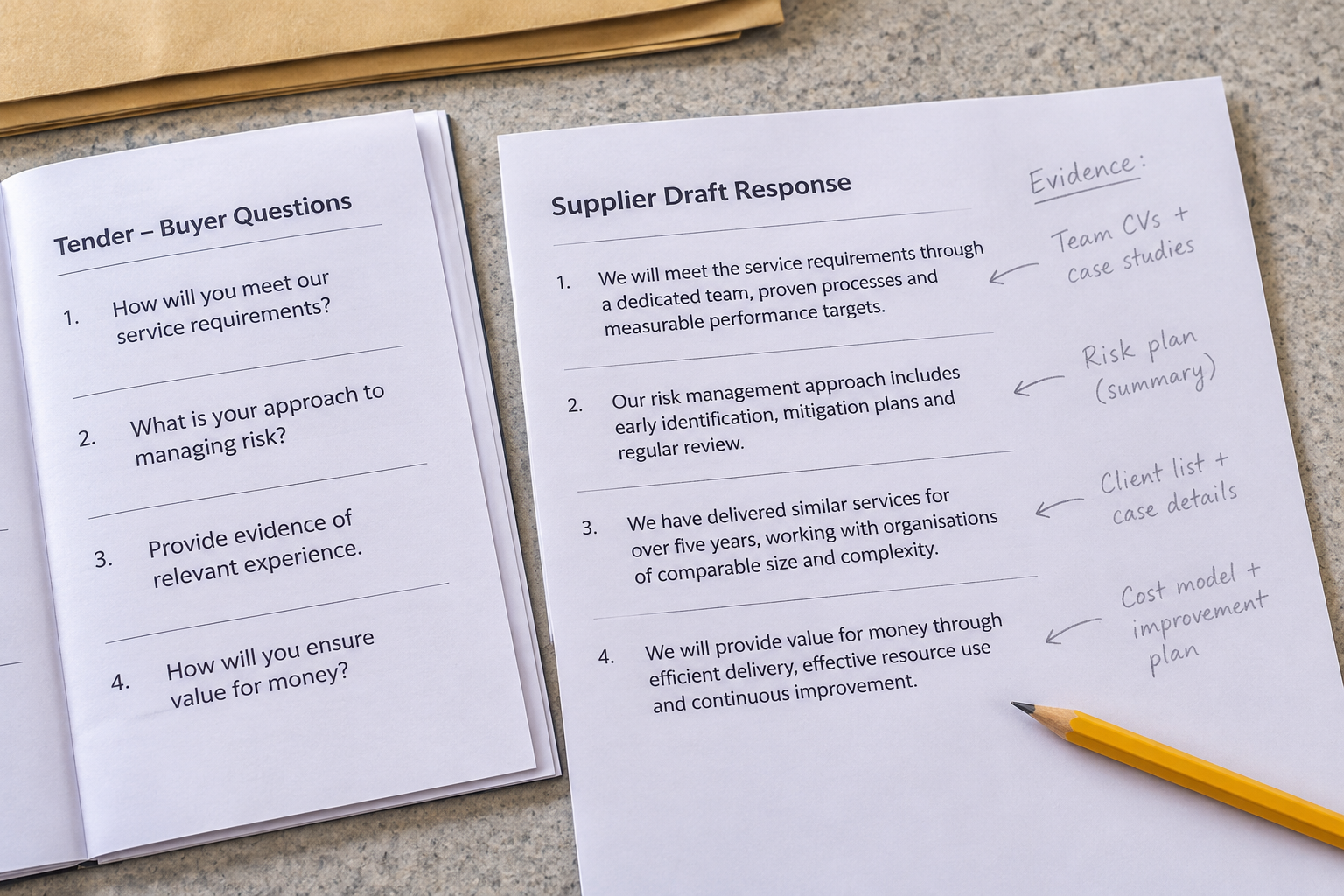
Criteria for Tender Evaluation: A Step-by-Step Guide Buyers Can Use Today
5 November 2026 · 13 min read

The criteria for tender evaluation are the structured, weighted measures you use to score supplier bids fairly and consistently. Build them by translating your brief into scorable requirements, choosing proportionate weighting, setting evidence-led scoring guides, and enforcing sealed, independent scoring with a clear audit trail.
The Criteria for Tender Evaluation: A Step-by-Step Build
Before you draft a single question, define the purpose of your evaluation. Your goal is to select the supplier most likely to deliver outcomes, not just the lowest price. That means turning your outcomes into scorable statements, agreeing how much each outcome matters, and deciding how to test them. When people talk about the criteria for tender evaluation, they are talking about the rules of that game: what matters, how much it matters, and how you’ll prove it.
Start by mapping outcomes to requirements. If your outcome is “reduce time-to-resolution”, your requirements might be “provide a 24/7 triage process”, “evidence average response time”, and “describe escalation paths with named roles”. Each becomes a question with specific evidence requested. Then, set a weighting that reflects risk and value. If resilience is mission-critical, it should outweigh nice-to-have features—even if the latter looks glossier in a proposal.
Finally, agree the evaluation method. Will you use a 0–5 scale with behavioural anchors? Will price be evaluated via a normalised formula? Who scores independently, and who moderates? Decisions here decide whether you can defend your award. A consistent, evidence-locked process prevents back-and-forth arguments later and keeps your team aligned.

How Do You Translate a Plain-English Brief into Scorable Requirements?
Most briefs start life as narrative: “We need a reliable cloud-based helpdesk that integrates with our CRM.” That’s readable, but it’s not scorable. Break it into discrete, testable requirements that suppliers can answer with evidence. For instance, ask for named product versions, integration methods (native, API, middleware), and proof points such as security certifications or uptime reports.
Good scorable requirements share three traits: they are unambiguous, they request evidence at the source, and they are measurable using your chosen scoring scale. “Describe your security” is a magnet for boilerplate; “Provide ISO/IEC 27001:2013 certificate number and scope, and outline incident response RACI in 200 words” prompts targeted, comparable responses. If it’s critical, set a pass/fail gate rather than a soft score—for example, “Cyber Essentials Plus: Mandatory”.
AI can help here by converting your prose brief into structured sections, flagging ambiguities, and pre‑filling a question bank. Tools like TenderLock support “Red Team” reviews that highlight vague wording and missing acceptance criteria, so you avoid disputes later. This also promotes accessibility for suppliers: clear questions with clear evidence requests reduce wasted effort and improve quality.
What Weighting Model Should You Choose, and Why?
Weighting focuses attention where it matters. Overweight the trivial and you’ll reward polish over substance; underweight risk and you may buy the cheapest problem. A sensible approach starts with your objectives and risks. If service quality drives outcomes, it should command the lion’s share of points. If price volatility threatens budgets, put rigour into commercial evaluation and sensitivity analysis.
Typical categories include Technical/Quality, Price/Commercials, Implementation/Service, Compliance/Risk, and Social Value or Sustainability. The split should be defensible. In a safety‑critical service, Quality may be 60–70% with strict pass/fail gates for accreditation. In commodity goods, Price may rise to 50% with narrow technical baselines. Document your rationale to support governance and later audits.
Below is a comparison table to help you frame weightings and the sorts of evidence you might demand. Use it as a starting point and calibrate to your context; treat it as a living model during planning and sign‑off.
| Category | What You’re Measuring | Typical Weighting Band | Evidence to Request | Scoring Tip |
|---|---|---|---|---|
| Quality/Technical | Fitness for purpose, method, capacity | 40–70% | Method statements, case studies, CVs, demos | Use anchored scales with observable behaviours |
| Price/Commercial | Total cost, price stability, terms | 20–50% | Pricing schedules, breakouts, indexation rules | Normalise to best price; test scenarios for realism |
| Implementation/Service | Plan credibility, resources, SLAs | 10–30% | Project plan, resourcing matrix, RACI, SLAs | Score plan quality and risk mitigations, not promises |
| Compliance/Risk | Standards, security, financial health | Pass/Fail + 0–10% | Certs, policies, financial checks | Gate mandatory items; score added assurance |
| Social Value/Sustainability | Community benefit, carbon, EDI | 5–15% | KPIs, impact plans, verified baselines | Score deliverable, time‐bound commitments |
As you choose, remember public‑sector guidance emphasises proportionality and transparency. See the UK government’s overview of public sector procurement policy for principles you can mimic in private settings.

Step-by-Step: Build and Run Your Evaluation
Here’s a practical flow you can adopt and adapt. Treat it as your workbench from planning to award. The steps assume a sealed process with independent scoring and documented moderation for governance in 2026 and beyond.
- Define outcomes and risks. State the outcomes you must achieve and the project risks you must avoid. This anchors your whole approach.
- Turn outcomes into scorable requirements. Write specific questions with explicit evidence requests and word limits. Add pass/fail gates for non‑negotiables.
- Choose categories and weighting. Allocate points to reflect risk and value. Document why, before you publish.
- Draft an anchored scoring guide. For each question, define what 0, 2, 3, 4 and 5 look like, using observable behaviours and concrete evidence.
- Set governance roles. Name owners for drafting, red‑teaming, commercial checks, independent scoring, moderation and approval. Record conflicts of interest.
- Publish and keep bids sealed. Use a platform that locks submissions until the deadline and time‑stamps access. Communicate timelines clearly.
- Score independently, then moderate. Require named evaluators to score question‑by‑question against evidence, then moderate differences to a final score.
- Run vetting in parallel. Conduct identity, company and financial checks to weed out risk early without biasing scores.
- Finalise, approve and award. Produce an audit pack: rationale, scores, notes, clarifications, and the signed decision.
- Debrief and capture lessons. Provide constructive feedback to suppliers and refine your bank of questions and anchors.
TenderLock streamlines this flow. It converts your brief into structured questions, provides Red Team ambiguity checks, keeps bids locked until deadline, and enforces evidence‑locked, requirement‑by‑requirement scoring with a full audit trail. If you want a quick primer on sealed bidding mechanics, our sealed bidding process walkthrough covers the essentials.
Try it on a real project: you can start your first live tender free with TenderLock—no card required—so your team can practise the method on a low‑risk brief.
How to Keep Bids Sealed, Fair and On Time?
Sealed bidding isn’t just ceremony; it blocks early access that can bias decisions or leak commercial information. Practically, this means strict controls: submissions locked until the deadline, audit logs of who accessed what and when, and named roles for clarifications separate from scorers. Deadlines should be clear, consistent and communicated in your timetable and portal notifications.
Fairness also depends on consistent supplier communications. Share all clarifications publicly (or to all invited suppliers in private competitions), time‑stamp them, and set cut‑offs for questions. Where you host supplier briefings or demos, record them to avoid inconsistent messaging. Platforms like TenderLock capture calls and produce AI summaries, so evaluators see the same facts regardless of who asked the question live.
Finally, be alert to collusion signals. The UK Competition and Markets Authority offers practical bid‑rigging advice for procurers. Train your team to spot suspicious patterns—identical typos, rotational winning, or shared IP addresses—and to escalate concerns. Document your mitigation steps; a clean process today saves headaches at award and post‑award challenges.

Designing the Scoring Guide: Scales, Anchors and Evidence
A scoring guide converts subjective impressions into consistent numbers. Pick a scale (e.g., 0–5) and define each point with behavioural anchors. For instance: 0 = no response or off‑topic; 2 = partial response, lacks specifics; 3 = meets requirements with relevant evidence; 4 = exceeds requirements with detailed, credible evidence; 5 = exemplary, thoroughly evidenced, low risk. Anchors turn opinions into repeatable judgments.
For each question, ask for evidence you can verify: certificate numbers and scopes, customer contact references, links to public documentation, or anonymised sample deliverables. Where possible, specify format and length to avoid marketing fluff. Keep your scoring notes focused on what you saw, not who you prefer. Evidence‑locked comments—stored against each score—make moderation and debriefs cleaner.
To avoid gaming, align the scoring guide with your weighting. If a criterion carries heavy points, your anchors must discriminate clearly between adequate and excellent. Avoid giving free points for mere compliance; reserve top marks for superior methods, lower risk and stronger outcomes. For more illustrations, see our walkthrough of comparing evaluation criteria examples.
Governance: Roles, Conflicts and an Audit Trail That Stands Up
Governance is the difference between a sound decision and a contestable one. Define roles clearly: an owner for the specification; a Red Team that challenges ambiguity and bias; independent evaluators for each section; a moderator who facilitates consensus; and an approver who signs the award. Keep scorers away from supplier communications to avoid subconscious cues creeping into the numbers.
Conflict‑of‑interest declarations should be explicit and recorded before invitations go out. Name alternates in case conflicts emerge mid‑process. Audit trails matter too: time‑stamped changes to the spec, clarification logs, versioned scoring sheets, and a record of all discussions that led to the final score. This is standard good practice in public bodies and a smart habit in the private sector. The UK government’s public procurement policy overview underlines transparency and accountability—principles you can adopt even outside regulated environments.
Data protection is part of governance. If you process personal data in bids (CVs, references), consider whether a Data Protection Impact Assessment applies. The Information Commissioner’s Office maintains accessible guidance on DPIAs under the UK GDPR. Platforms like TenderLock help by centralising access controls, recording who viewed what, and retaining immutable records for later review.
Supplier Vetting Without Guesswork
Evaluation isn’t only about scoring narratives. You also need to know who you’re buying from. Basic checks include identity, directors, company status, and financial health. In the UK, start with Companies House for incorporation and officer details, then use a credit risk provider (such as Creditsafe) for financials. Request insurance certificates and check their currency and scope. For delivery teams, validate qualifications and right‑to‑work where relevant.
Build vetting into your process, not as an afterthought. Gate mandatory items at the start (pass/fail) and capture “nice‑to‑have” assurance points under risk or quality. Avoid duplicating requests; if a certificate already covers the requirement, don’t ask for equivalent evidence twice. Keep a consistent baseline per category of spend so that vetting is predictable and non‑discriminatory.
If you’re building your vetting library, our Supplier Vetting Checklist for the UK sets out a comprehensive list you can tailor to your risk appetite. TenderLock integrates Companies House and Creditsafe checks and stores verification results alongside evaluation scores, so decisions reflect capability and risk together—without muddying the independence of scorers.

From Moderation to Award: Making the Decision Defensible
Independent scoring is only half the journey. Moderation aligns perspectives and resolves outliers. Come prepared: each evaluator should bring their scores, notes and any questions for clarification. The moderator’s role is to test rationale, not personalities—“What evidence justified your 4?”—and to record the consensus with reasons. Avoid averaging without discussion; it hides disagreements that may matter.
Commercial evaluation deserves equal rigour. Use a clear formula—for example, normalising price so the lowest compliant tender scores full marks and others receive proportionate points. Run sensitivity checks on key assumptions (indexation, volumes, forex) and record them. If you conduct Best and Final Offers, apply rules consistently and document deltas between submissions.
Finally, assemble your award pack: the specification, the published weighting and scoring guide, the scores and notes, clarification logs, vetting evidence, the moderation record, and the signed approval. This package is your defence if challenged and your source for supplier debriefs. For further thinking on seeing criteria in action, try our scenario walkthrough on an AI‑assisted evaluation example.

Why This Matters to Small Teams as Much as Enterprises
It’s tempting to assume only large, regulated bodies need heavyweight process. In reality, smaller organisations benefit just as much. Clarity accelerates buying, reduces meetings, and prevents disputes. A single source of truth lets new colleagues step in mid‑process without re‑explaining context. And when you hit a snag—supplier delays, missed scope—you’ll thank your earlier self for an audit trail.
A modern platform lowers the admin overhead. TenderLock converts briefs into structured questions, applies Red Team checks to eliminate ambiguity, locks bids until the deadline, and forces requirement‑by‑requirement scoring with evidence‑anchored notes. It also records supplier calls with AI summaries, runs identity and company checks, and produces dashboards plus a full audit trail for governance. That’s enterprise‑grade hygiene, without enterprise‑grade hassle.
If your team wants more on writing stronger supplier responses, we’ve compiled practical advice in our guide to writing a tender bid step‑by‑step. The better the questions, the better the answers—and the faster your evaluation.
Putting It Together: Examples of Proportionate, Defensible Criteria
Let’s translate the theory into two hypothetical scenarios and show how you might apply the criteria for tender evaluation in a proportionate way—balancing quality, price and risk while keeping the process clear and fair.
Scenario A: 40‑Person Firm Buying Managed IT Support
Outcomes include stability, rapid response and predictable costs. Weighting: Quality 45%, Price 35%, Service 15%, Risk 5% (with pass/fail for Cyber Essentials Plus). Questions target incident response times, escalation, patching cadence and onboarding plan. Evidence requests include named team CVs and sample runbooks. Price is scored on a normalised TCO over 36 months with scenario tests for growth.
Scoring anchors distinguish “states a target” from “shows recent MTTR with independent references”. Vetting checks confirm company solvency and insurance. Moderation focuses on risk of single‑point‑of‑failure staffing. Decision notes capture why Supplier B’s more expensive offer won—lower operational risk evidenced by richer runbooks and higher‑tier SLAs.
Scenario B: Enterprise Renewing a SaaS Platform
Outcomes emphasise security, integration and migration. Weighting: Quality 55%, Price 25%, Implementation 15%, Sustainability 5% (trackable carbon KPIs). Questions require ISO/IEC 27001 scope, SOC 2 Type II, SSO and SCIM integration details, and a migration plan with rollback. Price evaluated across licence, storage and exit costs. Sustainability asks for baseline, targets and measurement method.
Anchors reward verifiable certifications and working integrations over promises. Risk gates include penetration testing within six months of go‑live. Moderation tackles differing views on migration credibility. The award pack captures rationale tied to anchors, not brand recognition.
Only One Thing to Remember Mid-Process
When the wheels start turning—questions arrive, demos get booked, deadlines loom—it’s easy to drift. Keep one principle front and centre: do what you said you would do. That means stick to published weighting, enforce your anchors, and document deviations with reasons. If you must change scope or timelines, communicate to all bidders at once, with a clear audit trail.
Consistency preserves fairness and protects you. It also saves time; re‑explaining ad hoc decisions to stakeholders is a hidden tax on busy teams. If you use TenderLock, the platform helps by pinning decisions to timestamps and users, and by locking evidence to scores so your moderation tells a coherent story long after the award.
If you need to revisit your model during live evaluation, consult a pre‑agreed governance path: who can approve a change, who must be informed, and how you’ll handle suppliers already in motion. Capture the why, not just the what.
Frequently Asked Questions
How many criteria should we use in a typical tender?
Use as few as needed to discriminate meaningfully—often 6–12 questions per major section. Too many fragments attention and invites superficial answers; too few hide nuance. Group related prompts under a single question when the same evidence proves multiple points, and keep a balance between technical, commercial and risk areas.
What’s a sensible score scale—0–3, 0–5 or 0–10?
0–5 is a practical middle ground: enough headroom to distinguish good from excellent, while keeping anchors manageable. Larger scales can look precise but often increase variance between scorers. Whatever you choose, define behavioural anchors for each point and train evaluators together before scoring begins.
How do we treat price without letting it dominate?
Separate technical compliance from commercial scoring. Normalise prices so the lowest compliant bid gets full marks, and others score proportionally. Consider scenario testing for volume or indexation to probe realism. Document your chosen formula and keep the weighting proportionate to the risk of over‑ or under‑specifying quality.
Should we allow demonstrations or interviews?
Yes—if they’re structured and scored against published anchors. Share the same agenda and data to all bidders, record sessions, and attach notes to the relevant question. Avoid “chemistry” points that bias toward charisma. If something wasn’t in the submission, note how the demo evidence changed your score—and why.
What governance artefacts should we keep for audit in 2026?
Keep the specification, published weighting and scoring guide, clarifications log, independent scores with evidence‑locked comments, moderation records, vetting results, final approvals and communications. Time‑stamp everything. This supports robust debriefs and protects you if challenged, aligning with transparency principles common in UK public procurement.
Ready to run a fair, sealed and auditable process?
Turn your brief into structured questions and run a live, sealed tender with full governance. You can start your first live tender free on TenderLock today—no card required.