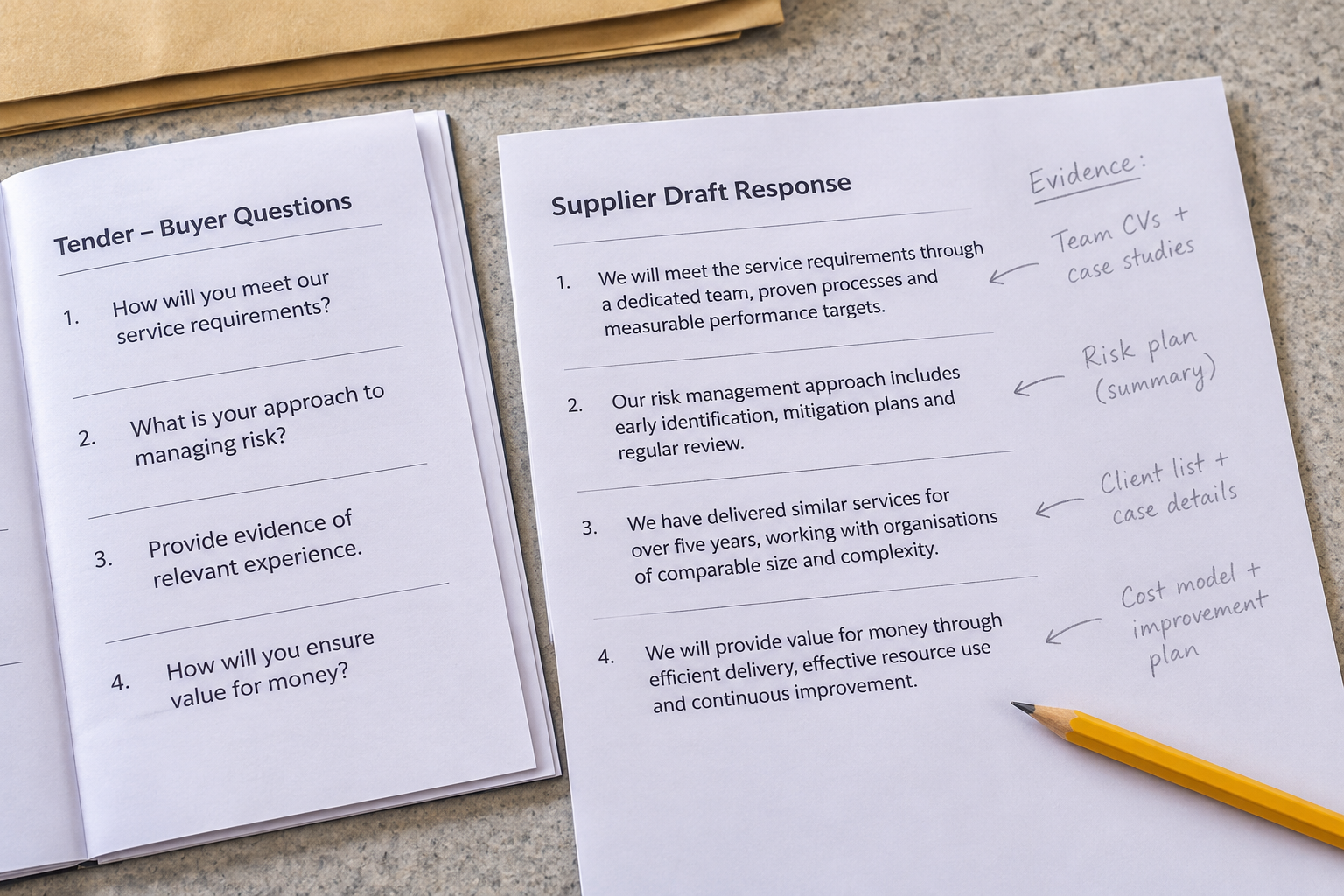

To write a tender in the UK, define what you need, explain the contract and pricing requirements, and tell suppliers how their bids will be evaluated. Give everyone the same information and enough time to respond. This guide focuses on the buyer’s invitation to tender, including how to make costs comparable without losing sight of quality and long-term value.
How to Write a Tender UK Suppliers Can Price
A useful tender gives suppliers enough detail to decide whether they can deliver the work and to prepare comparable offers. Start with the outcome you want, not a list of questions copied from an unrelated project. Then set out the scope, timetable, contract terms, response instructions and evaluation method.
For example, a buyer seeking office cleaning could describe the sites, opening hours, areas to be cleaned, expected service standards and any access restrictions. Suppliers can then explain their approach and price against a shared baseline. If the scope leaves visit frequency open, ask each bidder to state its proposed frequency and explain the implications for price and service.
Before drafting, identify the person responsible for the procurement and the colleagues who need to contribute. Finance may help with the pricing model, while the people using the service can identify practical requirements. Agree who will make the award decision and how it will be recorded.

Check whether your organisation is a public authority or otherwise subject to procurement rules. The applicable regime depends on the buyer, contract and circumstances; do not assume that a private company’s process is suitable for a regulated procurement. The government’s Procurement Act 2023 guidance collection is a starting point for checking current requirements. Seek specialist advice where needed.
For a fuller drafting sequence, use the buyer’s tender writing checklist alongside this cost and value guide.
What Should a UK Tender Include?
Your invitation can be a single document or a pack of schedules. Either way, suppliers should be able to find the following information without guessing:
- Background and objective: why you are buying and what a successful service or delivery should achieve.
- Scope and specification: locations, quantities, deliverables, standards, dependencies and any known constraints.
- Contract details: proposed duration, start date, extension options, payment terms and relevant draft terms.
- Supplier questions: the information and evidence you need to assess capability and delivery.
- Pricing schedule: the units, assumptions, optional items and tax treatment suppliers should use.
- Evaluation method: the criteria, weightings, scoring approach and any mandatory requirements.
- Process instructions: how to ask questions, submit a bid and meet the deadline, including any file or word limits.
Separate mandatory requirements from preferences. For instance, a required delivery location is different from a preferred reporting format. Explain how you will treat a failure to meet a mandatory requirement, and use requirements that are proportionate to the contract rather than asking for evidence you do not intend to review.
Use plain language and define terms that could be interpreted differently. If you ask for an emergency response, specify what counts as an emergency, when the clock starts and whether you expect a telephone response or someone on site. These details affect both the service and the price.
How Much Does It Cost to Prepare and Run a Tender?
There is no single price for preparing a tender. Your cost depends on the complexity of the requirement, the amount of internal work needed and whether you use external help or software. The figures below are illustrative planning assumptions, not market rates or supplier quotes. Replace them with your own estimates before seeking approval.
| Cost element | Illustrative allowance | What it covers or depends on |
|---|---|---|
| Internal preparation | 20 hours × £40 = £800 | Scope, pricing schedule and review; use your organisation’s appropriate staff cost. |
| Supplier questions and administration | 8 hours × £40 = £320 | Issuing the pack, coordinating clarifications and managing submissions. |
| Evaluation and approval | 24 hours × £40 = £960 | Reading bids, moderation, due diligence and recording the decision. |
| External specialist support | £0–£1,500 | Optional example allowance for legal or technical input; obtain a quote for your needs. |
| Platform | £0 for the first live tender on TenderLock | First live tender is free with no card required; check current terms for any later use. |
| Illustrative total | £2,080–£3,580 | Preparation and process costs only, not the supplier’s contract price. |
These allowances are not a recommended budget. A straightforward purchase may need less work; a complex or regulated procurement may need considerably more. If evaluation involves several reviewers, include each person’s time rather than counting only the procurement lead’s hours.

Distinguish the cost of running the tender from the cost of the contract. The first is what your organisation spends preparing, evaluating and awarding. The second is what you expect to pay the successful supplier, plus relevant costs of using and managing the service. Mixing the two can make a contract appear affordable when the full commitment has not been considered.
Allow time for questions and revisions, not just drafting. A scope review before issue can uncover missing quantities or conflicting instructions. Fixing those gaps early is generally easier than trying to compare bids based on different assumptions.
How Do You Set a Budget and Pricing Schedule?
Begin with the likely contract term and an estimate of demand. Check existing expenditure, usage records and internal forecasts where available. If the purchase is new, speak to relevant stakeholders and use appropriate market research to test your assumptions. Keep a record of what remains uncertain.
Decide what the budget includes. For a service contract, that may mean mobilisation, routine delivery, reporting, management time and exit support. For equipment, it may also include installation, training, maintenance and disposal. State whether the tender budget is inclusive or exclusive of VAT and use the same treatment in the pricing schedule.
Ask every supplier to complete the same fields. A practical schedule might request a fixed annual charge, a one-off setup fee, rates for additional work and the price of optional services. Specify the units and volumes to be used for evaluation. If actual volumes could vary, explain that the evaluation scenario is for comparison and is not necessarily a purchase commitment.
For a hypothetical cleaning contract, the buyer might ask for a monthly price for the stated sites, a separate mobilisation fee and a per-visit rate for additional cleaning. The buyer could then evaluate each bid against the same assumed contract duration and number of extra visits. This makes the arithmetic transparent without pretending future demand is certain.
Tell suppliers how to identify assumptions, exclusions and proposed alternatives. If alternatives are permitted, ask for a compliant base bid first, so you can compare like with like. Clarify whether unusually low or incomplete prices will be questioned and apply your published process consistently.
How Can You Compare Cost and Long-Term Value?
The lowest initial price is not always the lowest cost over the contract. Consider the costs that are relevant and reasonably estimable: setup, recurring charges, expected additional work, internal management, transition and exit. Do not add speculative costs simply to make one bid look better. Tell suppliers in advance which costs will be evaluated and how.
Use a common calculation. For example, an evaluated price might be the mobilisation fee plus the monthly charge multiplied by the assumed number of months, plus the extra-visit rate multiplied by an assumed number of visits. Check each submission for arithmetic errors and omissions using the rules stated in your tender.
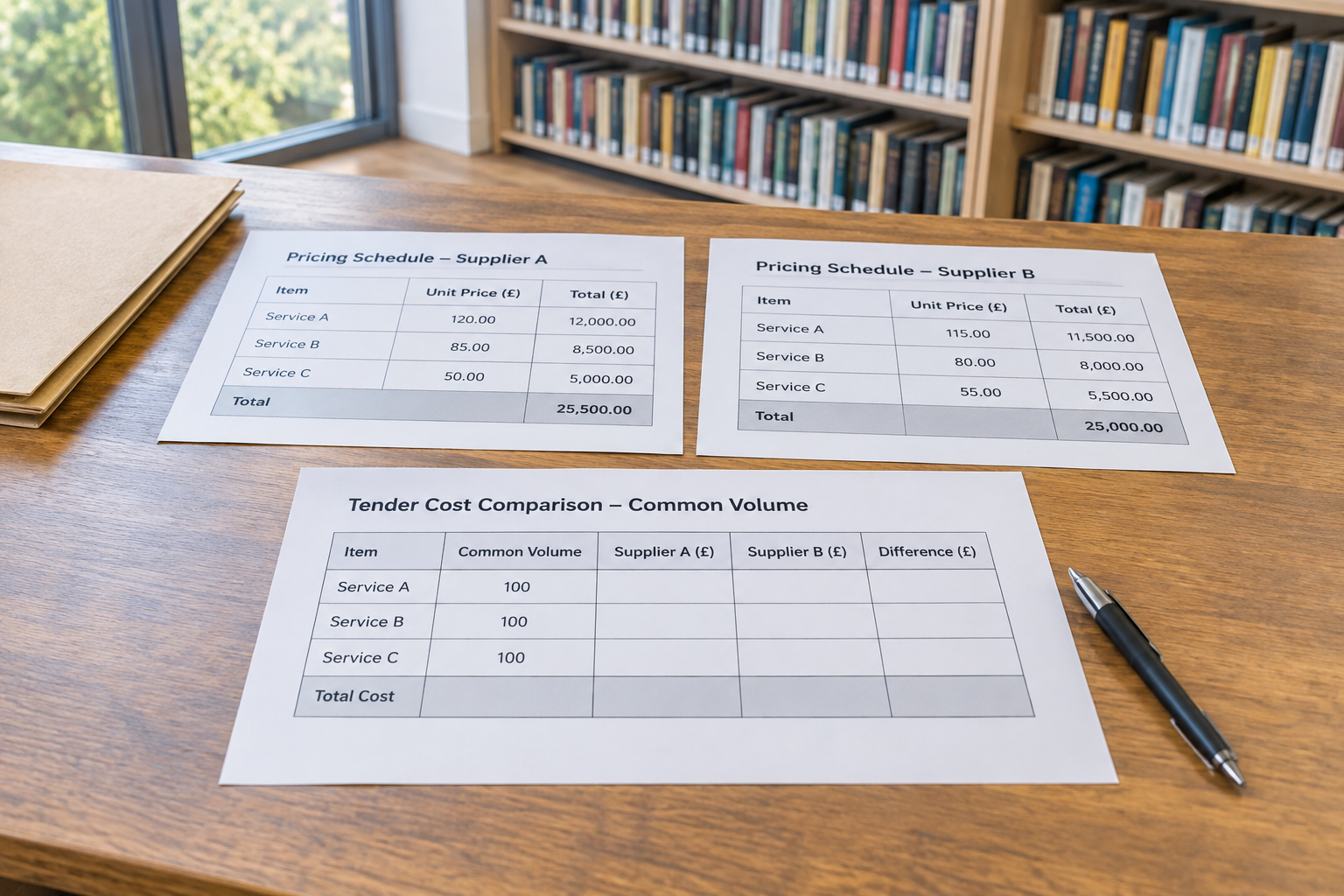
Value also depends on whether the supplier can deliver the required outcome. A lower price may be attractive, but a proposed service model that does not cover required hours or locations may not meet the specification. Evaluate delivery evidence against your published criteria rather than relying on a general impression of the bid.
For a private-sector tender, you can choose an evaluation model that reflects your needs and document it before bids arrive. Regulated buyers must follow the rules applicable to their procurement. In either case, avoid changing the basis of comparison after seeing prices.
Start a free tender with TenderLock to turn a plain-English brief into structured requirements and weighted criteria. Your first live tender is free, with no card required; named people remain responsible for the final decisions.
How Should You Score Bids Fairly?
Choose criteria that reflect what matters in delivery and ask questions that give suppliers a fair opportunity to provide evidence. For a hypothetical service tender, a buyer might assess price, delivery approach, relevant experience and contract management. The exact criteria and weights should follow the risks and priorities of the purchase.
Set the weightings before issuing the invitation and make sure they add up to the whole evaluation. Explain the scoring scale, what a strong answer should demonstrate and how scores will be combined. If a criterion contains subcriteria, explain their role and relative importance rather than leaving evaluators to invent a method later.
Be explicit about price scoring. For example, a buyer might divide the lowest compliant evaluated price by each bidder’s evaluated price and multiply the result by the available price points. This rewards lower prices, but it may not suit every procurement. Test the formula using hypothetical bids first, check that it behaves as intended and publish the method you will actually use.
Ask evaluators to record the evidence behind each quality score. A note should identify the relevant answer and explain how it meets the published standard, not simply say that the response is good. Where several people score independently, hold a moderation discussion and record the agreed score and rationale.
Clarifications can resolve ambiguity, but they should not become an undisclosed opportunity to rewrite a bid. Follow your stated process and any applicable rules. Keep a record of questions, answers, conflicts of interest, scores and approvals. For more detail, see how to set tender evaluation criteria.
What Supplier Checks and Evidence Should You Request?
Decide what you need to know before inviting bids. Depending on the work, checks might cover legal identity, financial standing, relevant experience, insurance, delivery capacity or safeguarding arrangements. Ask for evidence that is relevant and proportionate; an extensive questionnaire is not automatically a better vetting process.
For a UK company, check the legal entity named in the bid and compare it with the proposed contracting party. The public Companies House company information service can help you find basic company details and filings. A listing or filing is information to investigate, not a guarantee that a supplier is suitable or financially sound.
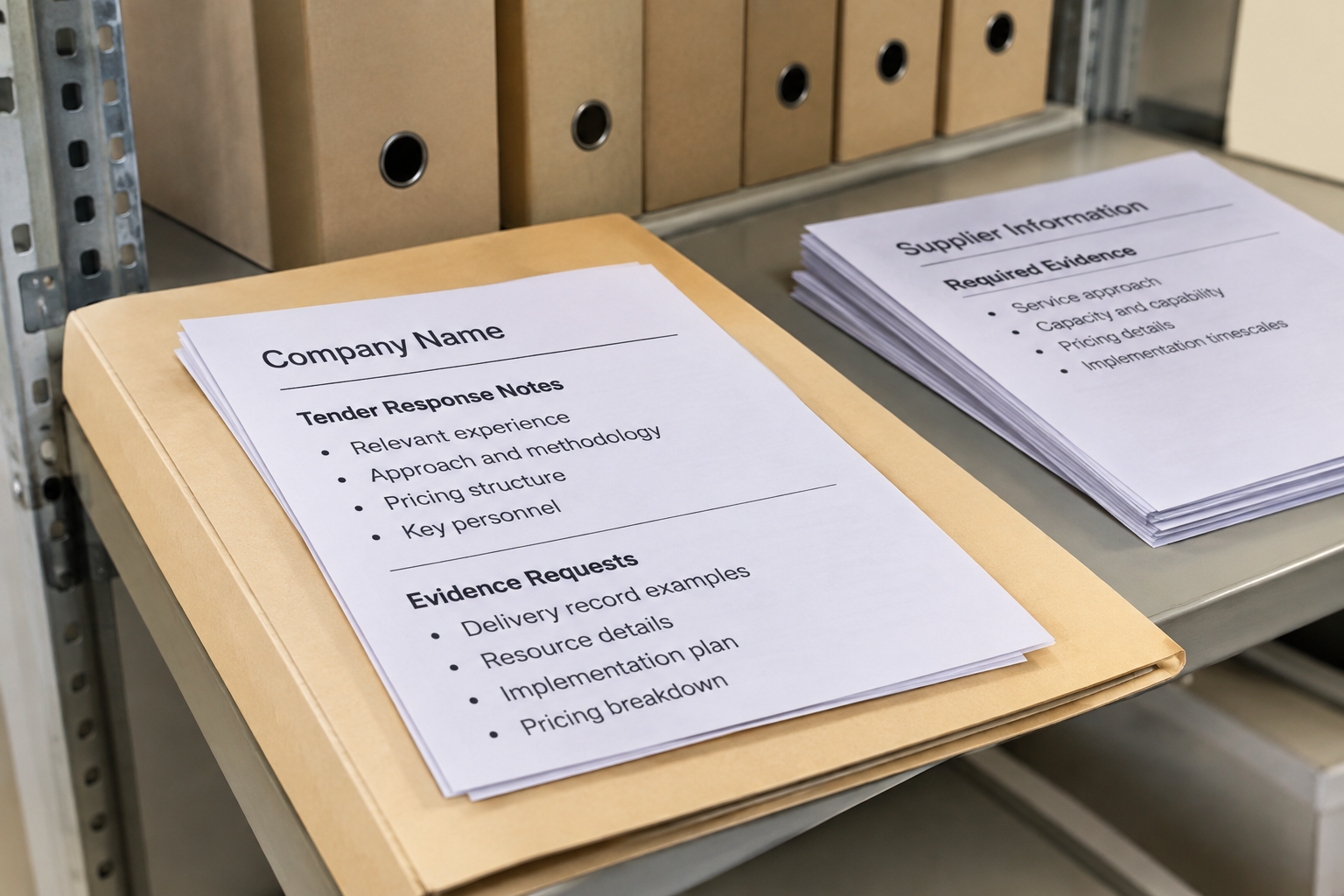
Explain when checks will take place and whether they are pass/fail or assessed as part of a weighted criterion. Be clear about acceptable evidence, particularly where suppliers may reasonably use different documents to demonstrate the same capability. Protect commercially sensitive information and limit access to those who need it.
TenderLock supports Companies House and Creditsafe checks and evidence-locked evaluation. Reviewers should still interpret the information in context, resolve discrepancies and make the decision themselves. Use the UK supplier vetting checklist to plan the checks for your own purchase.
How Do You Issue, Clarify and Award the Tender?
Before issue, read the pack as a supplier would. Check that dates match, pricing fields cover the stated scope, mandatory requirements are clearly labelled and the evaluation criteria correspond to the questions. A Red Team review can help identify ambiguity or missing information before the invitation goes out.
Give invited suppliers the same core documents and a clear route for questions. Set a deadline for clarifications and explain how answers or changes will be shared. If a clarification materially changes what suppliers need to price, consider whether the timetable and documents need updating, subject to the rules governing your process.
Sealed bidding means submissions remain inaccessible for evaluation until the stated deadline. TenderLock keeps bids locked until that point, supporting a consistent opening process. Record who has access, when bids are opened and how late submissions will be handled under your stated rules.

After evaluation and any necessary approvals, communicate the outcome in line with your process and any applicable legal requirements. Keep the final decision, its rationale and supporting evidence together. Plan the handover to the contract manager so that the awarded price, commitments, reporting requirements and mobilisation actions carry through into delivery.
Watch a Practical Tender Writing Guide
For another perspective on drafting a buyer’s invitation, look for a UK-focused walkthrough and check its advice against your organisation’s current requirements and applicable procurement rules.
Frequently Asked Questions
Is writing a tender the same as writing a tender bid?
No. In this guide, writing a tender means preparing the buyer’s invitation and requirements. Writing a bid means responding as a supplier, explaining how you will meet those requirements and what you will charge. The two documents should work together: a clear invitation helps suppliers submit answers the buyer can evaluate.
Should a buyer disclose its budget?
That depends on your procurement strategy and any applicable rules. A budget or range can help suppliers judge whether the opportunity is realistic, but it may also influence how they price. Whatever you disclose, define whether it covers VAT, optional services and the full contract term so suppliers do not make inconsistent assumptions.
How long should the tender process take?
Allow enough time for drafting, internal approval, supplier questions, responses, evaluation and award. The appropriate period depends on complexity, supplier availability and the rules that apply to the buyer and contract. For regulated procurement, check the relevant requirements rather than adopting an arbitrary timetable from another project.
Can AI write and evaluate a tender?
AI can help structure a brief, flag ambiguous wording and support requirement-by-requirement review. It does not replace accountable human judgement. Check generated requirements and scores against the source evidence, correct mistakes and record the rationale. TenderLock is designed so named people make the final decisions.
What if suppliers cannot give a fixed price?
Ask for a consistent rate card, clear assumptions and a common scenario for evaluation. You might request unit rates against estimated volumes or a fixed price for a defined core service with separately priced options. Explain how the evaluated total will be calculated and distinguish assumed volumes from guaranteed orders.
Ready to put your requirements into practice? Start your first live tender free with TenderLock, with no card required.