Invitation to Tender Evaluation Criteria: Cost, Value and How to Score Fairly
9 November 2026 · 14 min read

The fastest way to set fair, defensible invitation to tender evaluation criteria is to decide outcomes first, split pass/fail from scored quality, weight price versus value explicitly, and use consistent scoring bands. Then lock everything before bids open and keep the audit trail intact through award.
What Are We Really Evaluating When We Say Value for Money?
Value for money is not synonymous with lowest price. It is the composite of whole-life cost, fitness for purpose, risk, delivery confidence, and impact on your organisation’s objectives. In practice, value emerges from three layers: (1) things a supplier must prove to be eligible, (2) things you will score because they differ between suppliers, and (3) the price and commercial terms you will live with for the contract’s duration.
To make value tangible, start by writing three to five outcomes that matter. For example: Reduce incident response time by 30% within six months, Achieve zero high-severity non-conformances in quarterly audits, or Cut energy consumption of the deployed hardware by 15% versus baseline. If you struggle to write outcomes, your specification is probably still a list of inputs, not results. This quickly causes incoherent scoring because evaluators reward detailed prose rather than measurable benefit.
Next, map outcomes to evaluation dimensions. Typical dimensions include technical solution, implementation and transition, service management, information security, social value or sustainability, and commercial model. Each dimension should contribute meaningfully to outcomes. If you cannot draw a line from a dimension to an outcome, drop or merge it. Finally, decide which evidence (plans, designs, certificates, references) shows each dimension is met and how you will verify it across suppliers without bias.

The Role of Weighted Criteria and Scoring Bands
Weighting translates your priorities into numbers. If implementation risk is your headache, it deserves a bigger slice of the score. A common mistake is allocating neat, round percentages that look fair but do not reflect where failure would hurt. Instead, weight by consequence: if a weak service model is likely to cause downtime and reputational damage, give it 25% rather than a cosmetic 10%.
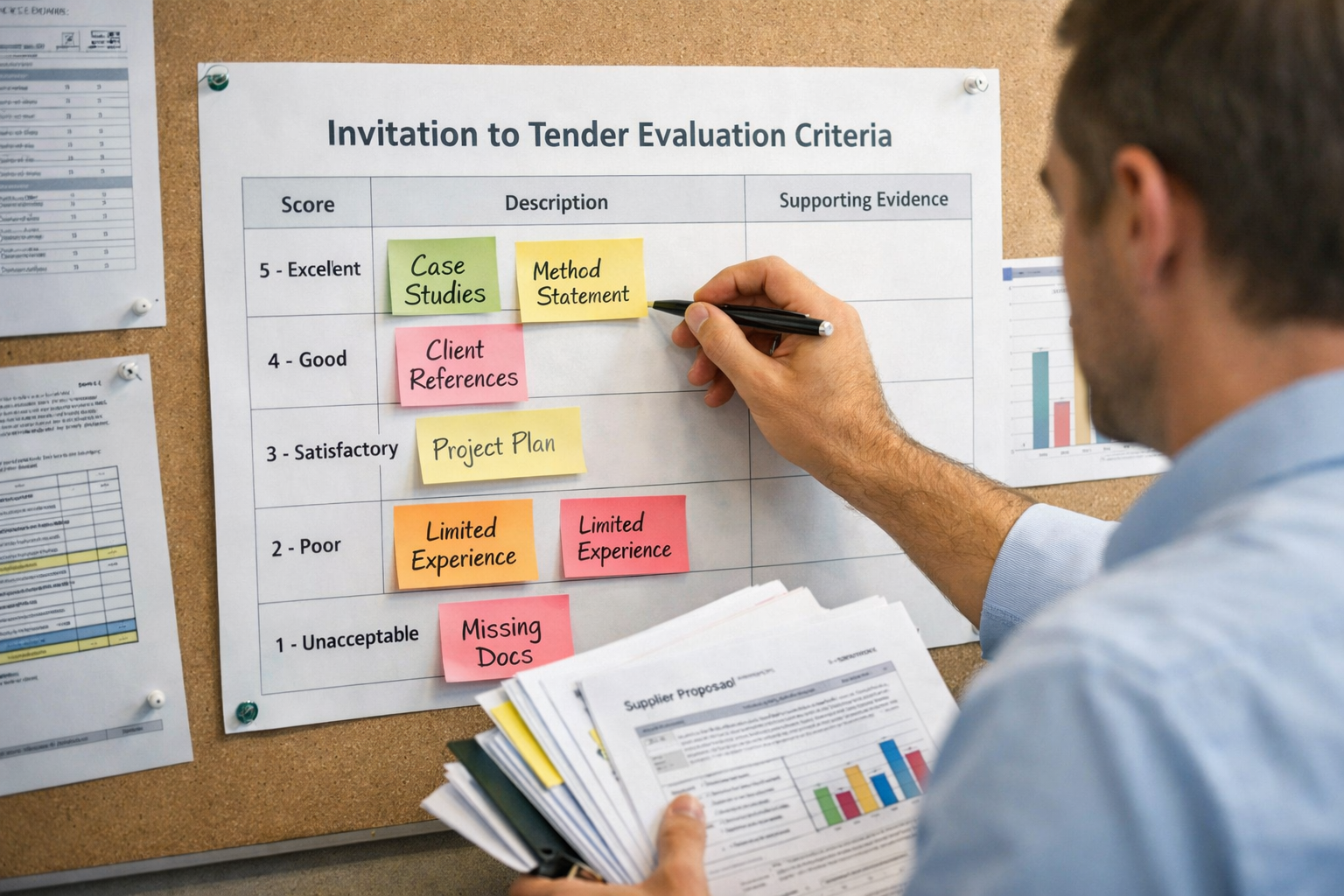
Scoring bands do the heavy lifting inside each criterion. A robust 0–2 scale (or 0–5) with clear descriptors prevents score compression and personal preferences from creeping in. Define what merit looks like before you see a single bid: what earns a 4? What proves exceptional delivery confidence? What lack of evidence forces a 0? Evidence-led descriptors stop debates from drifting into how nice a document felt. They also make moderation faster because you anchor disagreements to pre-agreed definitions, not opinions.
Always align scoring verbs with evidence. Example descriptors for a 0–5 scale: 0 = fails to address; 1 = addresses in part with material gaps; 2 = adequate with minor gaps; 3 = good, complete response; 4 = very good with credible enhancements; 5 = excellent with quantified, verifiable improvements. Keep the language concrete. For instance, quantified throughput uplift evidenced by test report X is stronger than very compelling. Use cross-check questions to keep assessors honest: What did you see? Where was it evidenced?
When written well, weighted scoring plus clear bands transform tender evaluation framework from a compliance checkbox into a high-signal decision tool that balances price with delivery confidence.
Which Costs Matter Most�a0�1�0�a0�50�a0�a0or�a0�a010%?
Price weight is a strategy lever, not a tradition. Choosing 10%, 30% or 50% should depend on market maturity, risk tolerance, substitutability, and how much of the outcome is driven by supplier craftsmanship. In commoditised categories (e.g., basic consumables), higher price weight makes sense because quality variance is limited by standards. In transformative projects, the wrong partner costs more than a slightly higher day rate ever will.
A practical way to decide is to simulate scenarios. Imagine a 40-person firm procuring a managed cybersecurity service. If a weak responder slips through, the cost of data breach dwarfs a 7% unit-rate saving. Here, 20–3% for price and 67–80% for quality/risk is sensible. Conversely, for a bulk stationery call-off, price might comfortably sit at 60% once you have pass/fail assurances (e.g., FSC certification, delivery SLAs) locked in.
Below is a pricing-style breakdown you can adapt. It links weighting choices to likely trade-offs, evidence focus and the kinds of supplier behaviour you will incentivise.
| Scenario | Typical Price Weight | Quality/Risk Weight | What You�a0�a0�a0�a0�a0�a0Buy | Evidence Emphasis | Risk Signal |
|---|---|---|---|---|---|
| Highly commoditised goods (e.g., paper) | 50–60% | 40–50% | Lowest sustainable unit prices once standards are met | Certifications, delivery performance data | Low; substitution easy |
| Managed services with continuity risk | 20–3% | 67–80% | Delivery confidence and resilient operations | Method statements, staffing plans, incident logs | Medium to high; outages are costly |
| Specialist consulting/innovation | 10–5% | 75–90% | Impact, expertise, accelerated outcomes | Case studies, CVs, prototypes, references | High; talent and fit matter |
| Framework mini-competition | 30–5% | 55–70% | Known suppliers; emphasis on approach and terms | Delivery approach, commercials, mobilisation | Medium; governance can mitigate |
If you are unsure, pilot the weightings on two hypothetical bids and examine how small price deltas swing the overall score. If 1–% price changes keep flipping your winner in a risk-heavy project, price is overweighted for your context.

The Exact Anatomy of invitation to tender evaluation criteria
Strong criteria are structured and layered. Think in four levels that flow from intent to evidence:
- Outcome statements: The results you must achieve (e.g., Reduce average response time to under 10 minutes within six months).
- Evaluation dimensions: Technical solution, implementation, service, security, social value, commercial.
- Specific criteria per dimension: Each has a weight, a clear question, and a scoring band.
- Evidence requirements: What the supplier must attach or describe, and how you will verify it.
Example structure for a managed service lot: Technical Solution (20%), Implementation and Transition (20%), Service Management (15%), Security and Compliance (10%), Social Value/Sustainability (5%), Commercial Model Excluding Price (10%), Price (20%). Inside Service Management, you might score incident processes, SLAs, tooling integration and reporting. Each has a question such as, Explain and evidence your incident triage workflow, including RACI and escalation timelines.
Importantly, separate pass/fail from scored items. Certifications (e.g., ISO 27001), Companies House registration, and financial health checks should be gatekeepers, not scored differentiators. This keeps your score focused on delivery confidence and outcomes. Lock the entire structure before you publish. In platforms like TenderLock, that lock stays on until the deadline so you can prove nothing moved mid-competition and bids remained sealed.
How Do You Separate Pass/Fail Checks from Scored Quality?
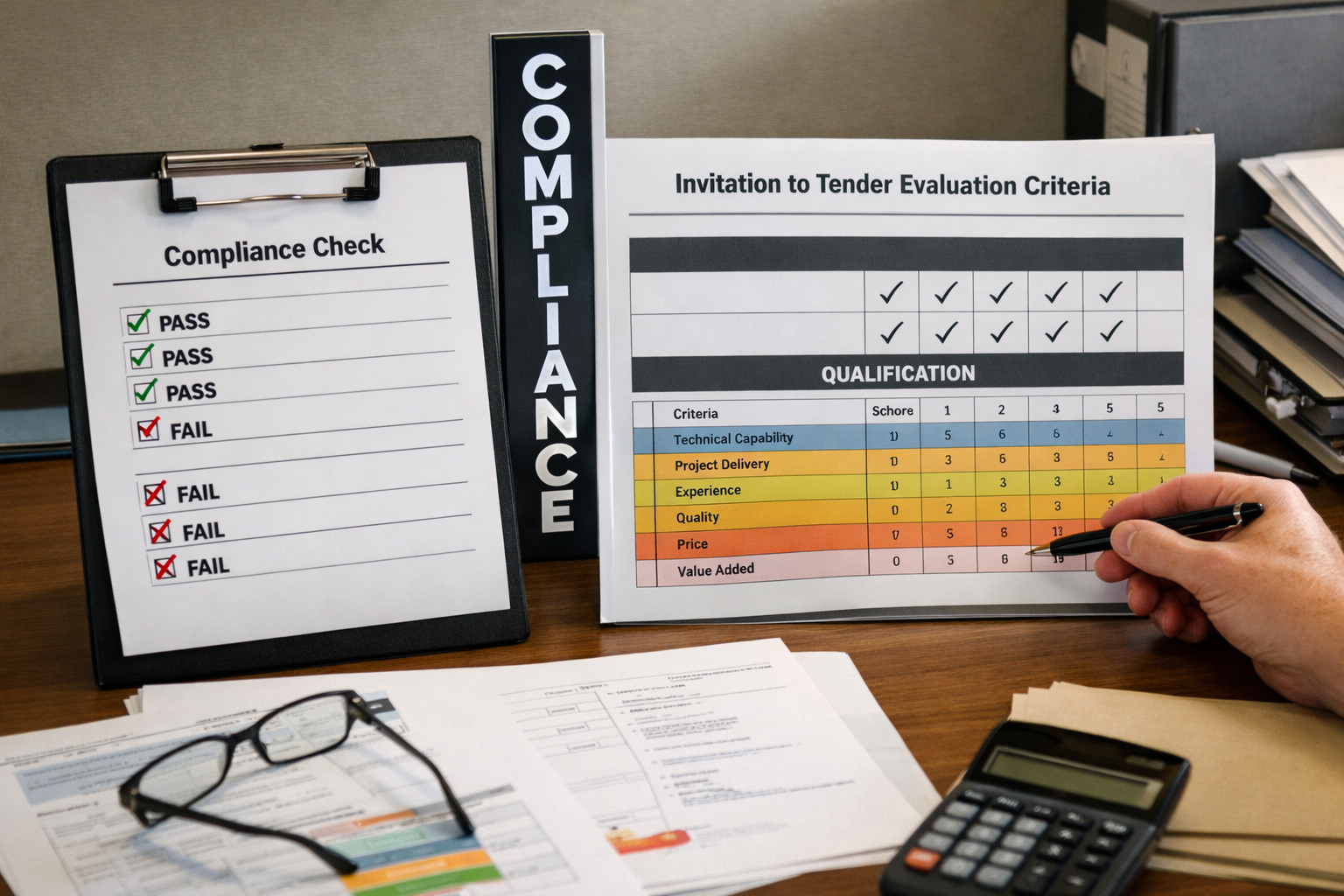
Start with a threshold stage: eligibility, legal and mandatory compliance. Examples include tax compliance, data protection basics, conflict of interest declarations, insurance levels, and critical certifications. These are binary. If a supplier fails, they should exit the process before any evaluator scores quality. This protects time and removes pressure to find points for an ineligible bidder.
Only then should you move to scored dimensions. Here, design questions that let capable suppliers demonstrate method, control and results. Ask for succinct evidence, not marketing claims. For instance: Provide a three-page implementation plan with milestones, resources, dependencies and a risk register excerpt. You can cap page counts to make evaluation manageable and fair.
Finally, apply commercial evaluation: price, payment terms, indexation, incentives and service credits. Consider how you will normalise price for comparison (e.g., total cost of ownership over three years, with standardised volumes and assumptions). Where helpful, state the pricing model template you will use so suppliers fill it consistently. This layered approach gives you clean audit checkpoints and makes moderation simpler because each stage answers a different question: Can they? Will they? At what total cost?
When Should Cost Be 30%, 50% or 10%?
Cost weight should reflect substitutability, downside risk and maturity of the solution space. Use this decision tree:
- If the item is commoditised with well-understood specs and service is minimal (e.g., paper, basic peripherals), start at 50–60% price. Guard against false economies by setting firm SLAs and penalties.
- If service quality directly impacts operations (e.g., network management, cleaning in clinical spaces), lean towards 20–3% price. Stability and compliance trump marginal savings.
- If outcomes depend on expertise and change delivery (e.g., digital transformation, complex integration), a 10–5% price weight is often right. The cheapest capable team rarely delivers the best business result.
Test your assumption with a dry run: apply your weights to two hypothetical tenders�a0�4one strong quality/medium price, one medium quality/low price�4and see which wins. If the low-price option keeps winning despite clear delivery risks, re-balance. The UK government’s Sourcing Playbook encourages commercial strategies that factor outcomes and risk, not just headline unit rates, which supports lower price weightings where delivery risk is high.
Document your choice. In your published method, explain why price is, say, 25% for this contract: The contract delivers security improvements where service failure risks data loss; therefore, quality weightings prioritise resilience and proven methods. This transparency helps suppliers pitch appropriately and strengthens your governance trail. It also aligns with public sector procurement policy guidance on clarity and fairness.
In moderation sessions, refer back to these reasons. If someone argues for price to dominate late in the day, your pre-published rationale is the anchor. That keeps the spirit of your criteria intact through to award.
A Practical Scoring Walkthrough Buyers Can Run Today
Imagine you are buying a managed network service. Your outcomes: 99.9% availability, 30-minute critical incident response, and verifiable security controls. You set weights: Technical (20%), Implementation (20%), Service Management (15%), Security (10%), Social Value (5%), Commercial Model (10%), Price (20%). You also define a 0–5 scoring scale with evidence-led descriptors.
Step 1: Gatekeeping. You verify Companies House details and run a Creditsafe-style check. You reject bidders that fail mandatory insurance or refuse data processing terms. No scoring yet.
Step 2: Individual scoring. Each evaluator reads the technical section, tags evidence and assigns provisional scores against pre-written descriptors. They note one to two evidence citations per score (See incident log sample, page 7). No discussion at this stage.
Step 3: Moderation. Evaluators explain which descriptor matched and point to evidence. You resolve deltas by returning to the descriptor text, not general impressions. Scores move only when evidence or descriptor alignment changes.
Step 4: Commercial normalisation. Prices are compared on a standardised three-year TCO sheet with your stated consumption assumptions. You apply the 20% price weight using a linear or inverse scoring formula you published upfront.
Step 5: Record and lock. You retain annotated evidence and notes, plus the final moderated score. This creates an audit-ready decision pack should there be a challenge.
Do you want to shortcut the admin while keeping governance tight? TenderLock checks supplier responses requirement-by-requirement, keeps bids sealed until the deadline, runs Red Team reviews for ambiguity, and locks evidence and decisions for audit. You can start a live tender free with no card required and plug this scoring model straight in.
Risk, Governance and Auditability: What Must Be Locked?
Three locks protect fairness: your method, your content and your data. First, lock the evaluation method before bids open. No changes to weights, bands or formulas mid-process. Second, lock the questions and requirements so late edits cannot advantage incumbents or favourites. If you must clarify, publish to all suppliers at once with a visible audit trail. Third, lock how bids are accessed. Sealed bidding reduces leakage risk and keeps decision-makers honest about deadlines.
Governance goes beyond the lock. Ensure conflict of interest declarations are signed and stored, named evaluators are accountable for decisions, and communications with bidders are centralised. Record clarification calls and keep the summaries part of the evidence base. The National Audit Office regularly highlights the need for robust records when procurement decisions are scrutinised; see the NAO overview of procurement in government for context.
TenderLock was built for this discipline: sealed submissions until the deadline, evidence-locked evaluation, named decision checkpoints, Red Team reviews to remove ambiguity that could bias scoring, Companies House and Creditsafe checks, recorded calls with AI summaries, and dashboards with a full audit trail. If your organisation is scaling procurement, these controls help you apply your evaluation criteria consistently across dozens of events without burning out your team.

What Should Suppliers Know to Earn Points Without Guesswork?
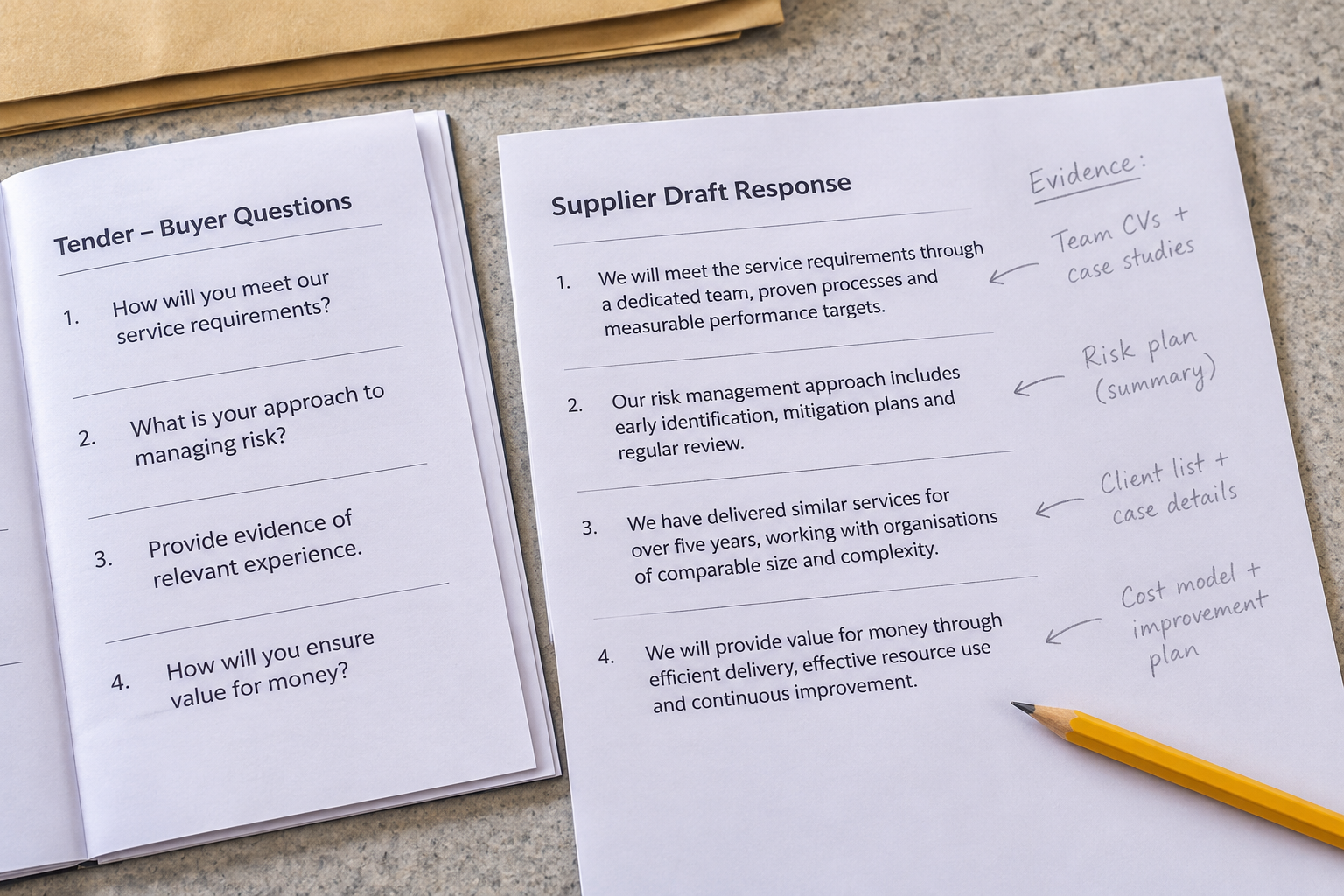
Suppliers do best when they treat the evaluation method as a design spec for their bid. Reverse-engineer each criterion: identify the verb (prove, evidence, explain), supply the exact artefact requested, and signpost it clearly. If the buyer says provide a two-page risk register excerpt, do not substitute a glossy brochure. Use headings that mirror the question and include a short evidence table with links to appendices. Moderators reward alignment and clarity.
Address price formation transparently. If the buyer normalises on three-year TCO, show the assumptions and what moves cost up or down. Provide options only if invited; otherwise, you risk complicating like-for-like comparison. For service-heavy contracts, emphasise delivery mechanics and risk controls, not just outcomes. A claim like always on time scores lower than S-curve resourcing plan, named roles, 2-week hypercare, and variance thresholds with corrective actions.
Want more supplier-side detail? We gathered practical tips in how to write a proposal for a tender and debunked common myths in tender proposal myths vs facts. Sharing these with invited bidders can reduce clarifications and lead to higher quality, easier-to-score responses for your team.
Cost and Value: A Side-by-Side Breakdown You Can Reuse
Here is a reusable pricing-style matrix for whole-life value. Adjust the weights and examples to your category and risk profile. The aim is to make trade-offs visible and consistent for both buyers and suppliers.
| Dimension | Weight | What Good Looks Like | Evidence to Score High | Common Failure Mode |
|---|---|---|---|---|
| Technical Fit | 15–25% | Meets all must-haves; adds measurable performance headroom | Architecture diagrams, benchmarks tied to your volumes | Vague claims with no scale/context |
| Implementation & Transition | 15–25% | Credible plan with critical path and named team | Milestone plan, RACI, dependency log | Generic plan recycled from another project |
| Service Management | 10–20% | Clear SLAs, tooling integration, proactive reporting | Runbooks, SLA breach process, sample reports | Marketing prose, no operational artefacts |
| Security & Compliance | 5–15% | Relevant certifications and control testing | ISO certs, pen test summaries, DPIA approach | Certificates named but not supplied or in scope |
| Social Value/Sustainability | 0–10% | Specific, locally relevant commitments | KPIs, delivery partners, measurement plan | Generic pledges with no metrics |
| Commercial Model (excl. price) | 5–15% | Aligned incentives, practical terms | Risk/reward, service credits, exit plan | One-sided terms that shift risk without controls |
| Price | 10–60% | Transparent TCO; fair rates for scope/market | Costed BOM, indexation, sensitivity table | Fragmented, hard-to-compare pricing |
Wherever your final numbers land, publish your model and hold to it. This is the simplest way to keep your tender criteria fair and reproducible across business units and years.
Moderation and Red Teaming: How Do You Remove Ambiguity?
Ambiguity is the enemy of fair scoring. Pre-publication, run a Red Team review whose only job is to break your documents: find double meanings, undefined acronyms, and questions that invite storytelling instead of evidence. Have them propose precise rewrites: replace Describe your service with Provide a one-page incident flow with timestamps for P1–P3 tickets and a sample weekly report.
During moderation, appoint a chair to keep debate anchored to descriptors and evidence. Record rationales for any score changes. If a response is strong but off-brief, resist the urge to award for effort. You are scoring fitness against published needs, not general capability. If two responses are close, revisit the top two or three discriminating criteria and verify evidence. Avoid averaging away decisive differences; moderation should clarify, not dilute.
Tools can help. TenderLock flags ambiguous wording pre-issue, checks each supplier answer against each requirement, and locks the evidence trail so your final report mirrors what was actually submitted. That kind of traceability matters if challenged and keeps confidence high inside the business that your award truly reflects your method.
Where Do External Standards Fit In Without Overcomplicating Things?
External references are guardrails, not substitutes for thinking. Use policy and standards to frame your baseline and inform evidence requests, then tune to your outcomes. The UK’s Sourcing Playbook is a strong starting point for commercial strategy, while public procurement policy notes provide principles on transparency and fairness. When governance bodies ask why this weighting?, cite your outcomes and market risk, supported by those references.
For internal assurance, align with your risk framework: financial resilience checks, information security baselines, and sustainability thresholds. Treat these as pass/fail unless true differentiation exists. If you do score them, make bands evidence-led and avoid double counting. For example, do not award points for ISO 27001 in security and again in service management.
Finally, write your debrief plan before tenders arrive. Commit to evidence-based feedback linked to descriptors, not subjective language. This reduces escalations and builds supplier trust in your process and in the integrity of your evaluation criteria.
Frequently Asked Questions
How many criteria are too many?
Most tenders work best with 5–8 core scored criteria plus price. Go beyond that and you risk diluting focus and creating evaluator fatigue. Merge overlapping items and keep each criterion large enough to matter (5–15%+). If you need detail, use sub-questions but roll their scores into the parent criterion.
What scoring formula should I use for price?
Two common methods are linear (lowest price gets full marks; others scale proportionally) and inverse (reward diminishing returns as price drops). Publish your choice and an example. Pick one that reflects your appetite: inverse can reduce the dominance of tiny price gaps when quality matters.
Should social value be pass/fail or scored?
It depends on your policy and market. If your organisation mandates specific commitments, set clear pass/fail thresholds. If there’s meaningful differentiation (e.g., local apprenticeships with defined KPIs), score it at 5–10% with evidence-led bands. Avoid vague pledges that are hard to measure or enforce.
How do I prevent bias in evaluation panels?
Brief assessors on descriptors, anonymise responses where possible, and split reading so each person scores areas of expertise. Use independent moderation led by a chair, require evidence citations for scores, and keep an audit trail. Declared conflicts and sealed bids help maintain impartiality and trust in the process.
What documents should I keep for audit in 2026?
Keep the published method, Q&A clarifications, individual and moderated scores, evidence references, conflict declarations, communications, and the award rationale. If you used calls, store recordings and summaries. A platform that locks these artefacts lets you prove your criteria were applied as published.
Run Your First Tender Free
Ready to put this into practice with sealed bids, Red Team reviews and an audit trail that stands up to scrutiny? TenderLock helps you set, check and run tenders from brief to award, including publishing clear invitation to tender evaluation criteria. Start your first live tender free today�no card required.