
How to Write a Successful Tender: A Practical Guide for Suppliers
15 November 2026 · 11 min read
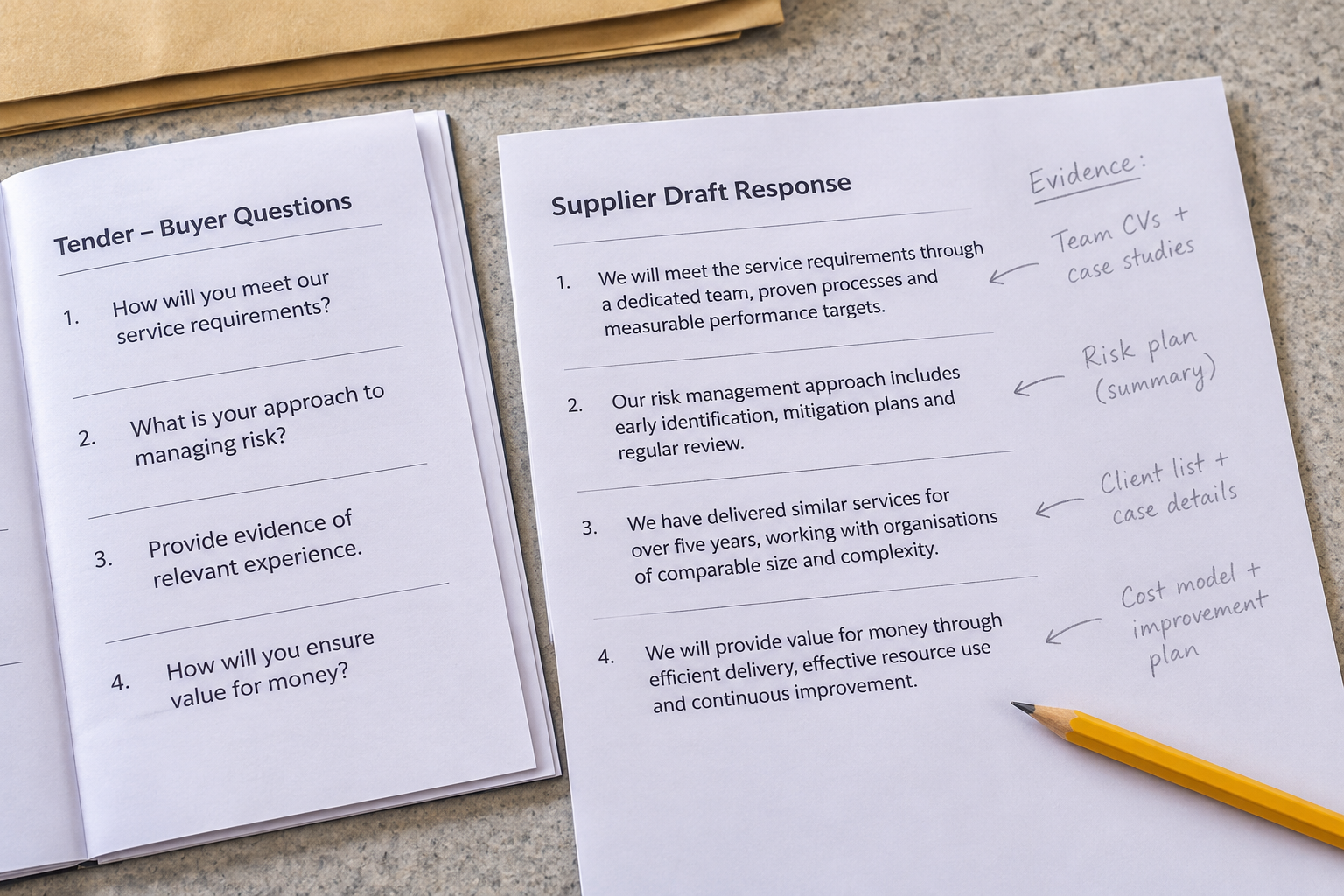
Knowing how to write a successful tender starts with understanding what the buyer needs, checking that you can meet the requirements and answering each question with relevant evidence. A strong submission follows the instructions, explains a credible delivery plan and makes its price clear. It is not a guarantee of winning, but it gives evaluators a fair basis for assessing your offer.
What Is a Successful Tender Response?
A tender response is your offer to supply goods, services or works against a buyer’s stated requirements. A successful response does more than describe your business: it shows how you will meet the specific brief, on what terms and at what price. It also gives the buyer evidence they can use to compare your offer with others.
Start by distinguishing the buyer’s invitation to tender from your response. The invitation sets out what the buyer wants and how suppliers should respond; your submission answers it. This guide is primarily for suppliers preparing that submission. Buyers can also use it to see where clear questions and evaluation criteria help suppliers provide useful answers.
Success depends on the published process and the competing offers. A compliant, well-evidenced bid can still lose, so focus on what you can control: choosing suitable opportunities, responding accurately and submitting on time. For a broader supplier-side process, see our guide to writing a tender bid step by step.
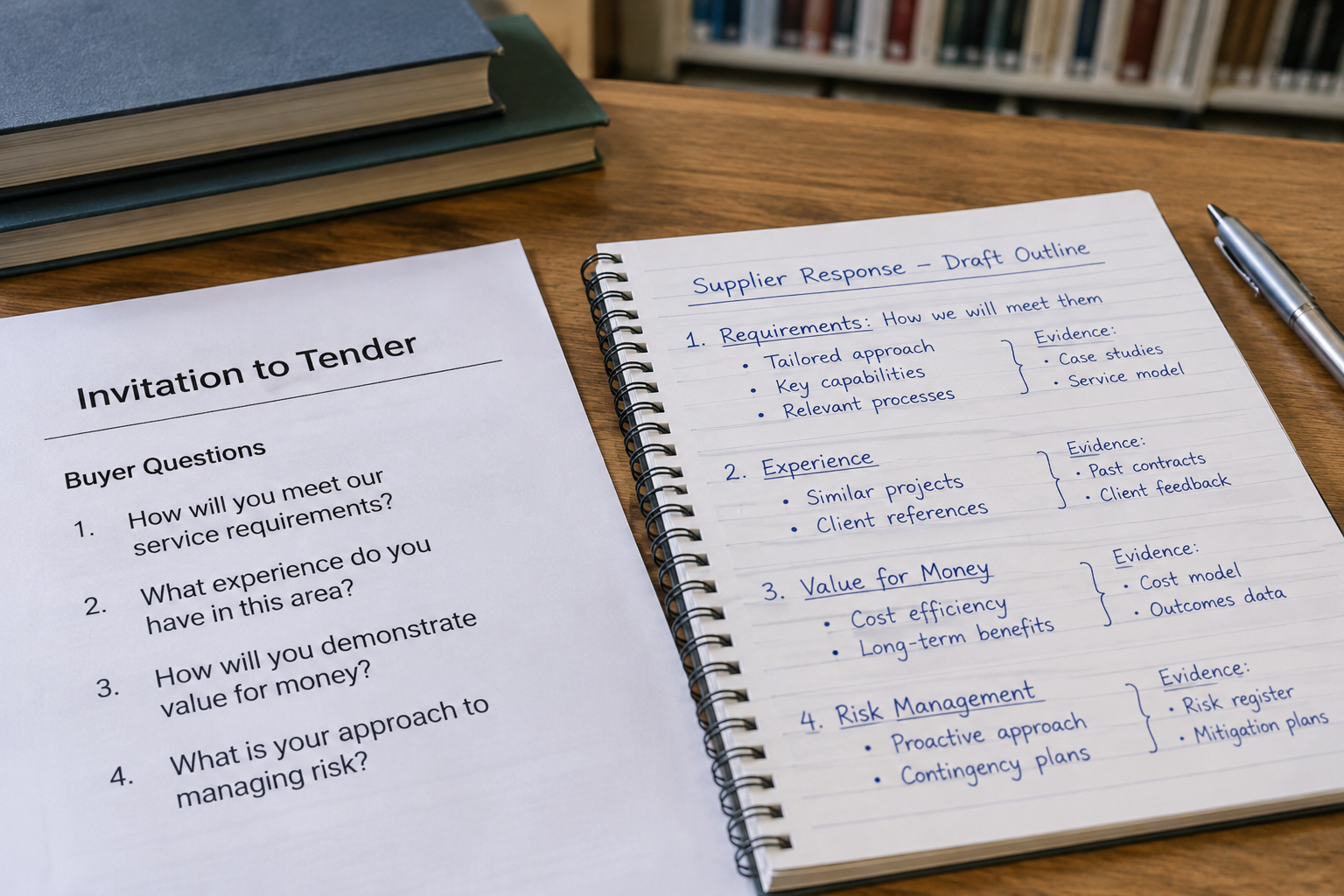
Before drafting, identify the final submission deadline, the required route and the person responsible for each part of the response. Keep the buyer’s documents together, including clarifications and any revised versions, so the team is working from the same information.
Should You Bid for This Opportunity?
A good tender begins with a bid-or-no-bid decision. Read the whole invitation, specification, proposed contract and pricing documents before committing significant writing time. Check whether the opportunity fits your capabilities, resources and commercial priorities, rather than assuming you can resolve a major gap after award.
- Eligibility: Can you meet the stated conditions and supply the requested documents?
- Scope: Do you understand the locations, volumes, service levels and expected outcomes?
- Capacity: Can you deliver alongside existing commitments, including during mobilisation?
- Commercial fit: Are the payment terms, liabilities and proposed allocation of risk workable?
- Competition: Can you explain a relevant difference in your approach, supported by evidence?
- Bid resources: Do you have time to obtain approvals, check prices and submit properly?
Record uncertainties and assign an owner to each one. If an essential condition is unclear, use the buyer’s permitted clarification process rather than relying on an assumption. If you cannot meet a mandatory requirement, check the invitation’s rules before proceeding; a persuasive narrative elsewhere may not compensate for it.
For UK public contracts, the applicable rules depend on the procurement and its timing. The government’s supplier guidance on the Procurement Act 2023 is a useful starting point. It does not replace the instructions or legal terms for the particular opportunity.
How Do You Turn the Invitation Into a Writing Plan?
Build a response matrix before writing prose. List every question, mandatory condition, requested attachment and pricing instruction. Add the relevant document reference, owner, evidence source and review status. This gives your team a single working list and helps prevent a small administrative omission from undermining a substantial response.
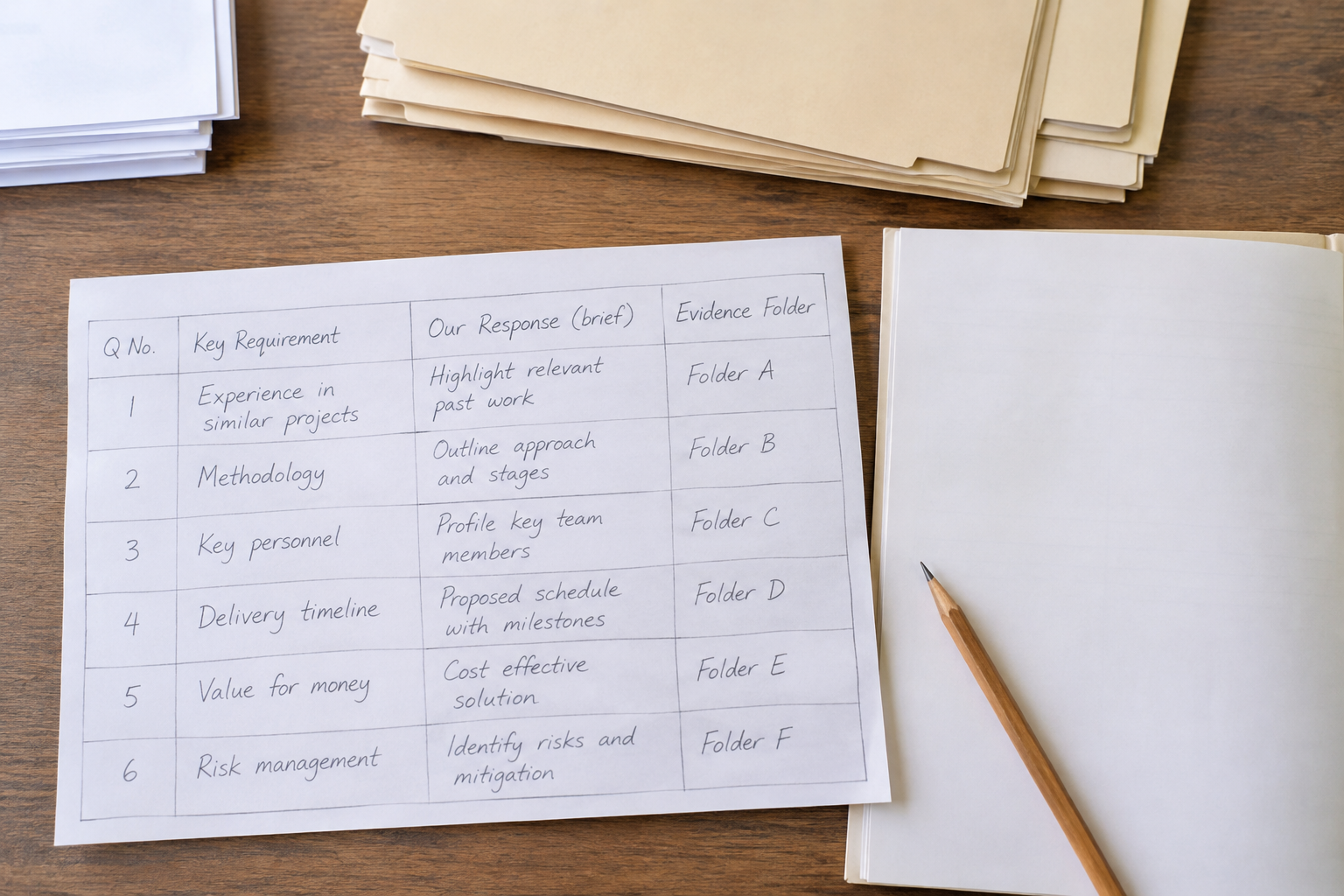
Separate requirements into those you must meet and those that will be scored. A mandatory condition may require a simple confirmation and supporting document; a scored question usually needs an explanation that addresses the published criterion. Follow the invitation if it uses different terminology or specifies another approach.
| What to capture | Question to ask | Practical action |
|---|---|---|
| Requirement | What exactly has the buyer requested? | Record the question and reference; preserve any sub-questions. |
| Response rules | Where and in what form must we answer? | Note the template, word limit, file type and submission route. |
| Evaluation | How will this answer be assessed? | Map the published criterion and weighting to the draft. |
| Evidence | What supports our claim? | Identify a relevant example, document or named delivery responsibility. |
| Ownership | Who can write and check it? | Assign a writer and a reviewer with the right knowledge. |
| Dependencies | What must be confirmed first? | Track pricing inputs, partner commitments and clarifications. |
Read the scoring guidance alongside each question. If the buyer asks about mobilisation, for example, an account of your general experience is not enough on its own. Explain the transition activities, responsibilities, timing assumptions and how you will manage disruption. Use the published weighting to plan effort, but do not ignore lower-weighted or pass-or-fail requirements.
For more on how buyers assess responses, read our guide to tender evaluation criteria. Understanding the assessment method helps you make relevant information easy to find without guessing at unpublished preferences.
How Do You Write a Successful Tender Answer?
Answer the question directly, then explain how your approach will work for this contract. Use the buyer’s headings where permitted and address every sub-question. A useful structure is: commitment, delivery method, responsibility, evidence and how performance will be monitored. Adapt it to the question rather than forcing every answer into the same template.
- State the answer: Say what you will do, not just what you have done elsewhere.
- Describe the method: Set out the steps, resources and dependencies relevant to the requirement.
- Allocate responsibility: Explain which role owns the activity and how issues are escalated.
- Support the claim: Use a relevant example or document that you are entitled to share.
- Connect to the outcome: Explain how the approach addresses the buyer’s stated need.
Imagine a hypothetical buyer asks how a cleaning supplier would handle missed visits. A weak answer says the supplier is committed to excellent service. A stronger answer describes how a missed visit is reported, who assesses the impact, how cover is arranged and how the buyer is updated. The supplier should only promise response times it can actually meet and should follow any required response format.
Be specific without inventing certainty. If delivery depends on site access or information from the buyer, state that dependency where the instructions allow it. Avoid unsupported superlatives and generic claims such as “industry-leading”. If the buyer sets a word limit, spend those words on the requested method and evidence rather than a long company history.
Check that the narrative agrees with the rest of the submission. A mobilisation answer that promises a dedicated manager, for instance, should be consistent with the staffing plan and the price. If a subcontractor will deliver an activity, make its role clear and confirm the arrangement before describing it as committed.
What Evidence Should You Include?
Evidence helps the evaluator understand why your proposed approach is credible. Choose material that matches the question: an appropriate previous assignment, a delivery plan, a sample report or a policy may be useful where the buyer requests or permits it. Describe the context and your actual role, and make clear where an example differs from the proposed contract.
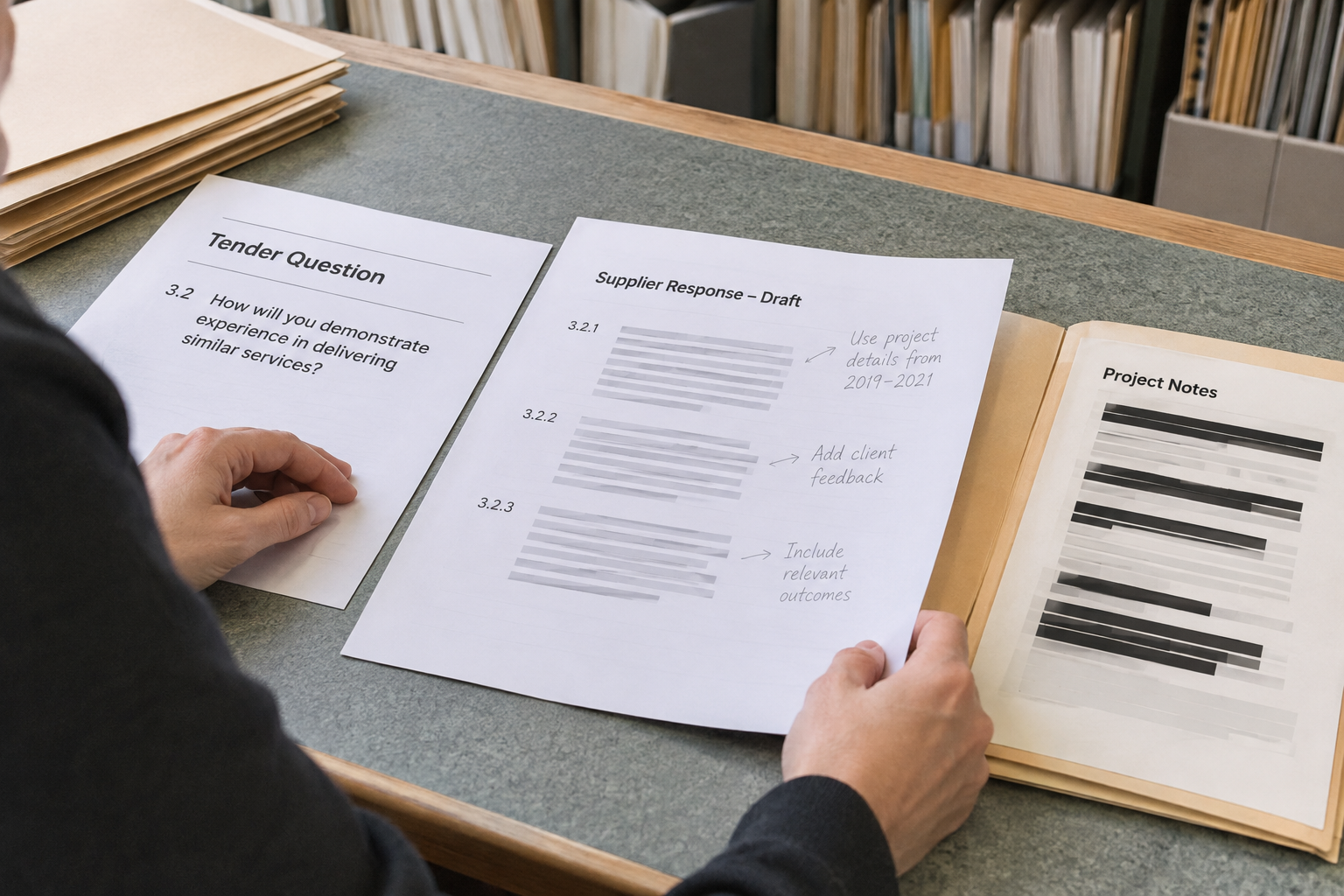
Check that examples are accurate, current and shareable. Remove confidential information where necessary and obtain permission before identifying a customer or sharing restricted material. If the buyer requests references, follow its instructions rather than substituting a case study. Do not imply that an accreditation, insurance policy or capability is in place if it is not.
Policies are more persuasive when you explain how they will be applied. Instead of attaching a policy and assuming it speaks for itself, connect its relevant procedures to the buyer’s question, subject to the submission rules. Similarly, a team member’s experience should support a named role in the proposed delivery model, not merely appear in a list of credentials.
If you lack a directly comparable contract, be honest. Explain transferable experience and the controls you would use to manage the differences. Do not invent customers, results or testimonials. An evaluator needs a reliable account of your capacity, not a story that cannot be substantiated.
How Should You Price the Tender?
Follow the buyer’s pricing schedule and instructions first. Identify the units, quantities, contract period, required breakdown and treatment of VAT. Distinguish fixed charges from variable charges and check whether the buyer asks for options, assumptions or a particular pricing model. Use the spaces provided for qualifications; do not assume that an undisclosed exclusion will be accepted later.

Build your price from the work you have proposed. Consider labour, materials, travel, management time, subcontractors, mobilisation and other costs relevant to the scope. Check quantities and arithmetic independently, and confirm that any partner prices cover the same specification and period. Where volumes are uncertain, use the buyer’s stated assumptions or seek clarification through the permitted route.
A low headline figure is not a substitute for a deliverable offer. Conversely, additional value should be explained in terms of the buyer’s published requirements, not used to obscure a price that is difficult to compare. If alternatives are allowed, label them clearly and provide the compliant base offer as instructed.
Before approval, compare the pricing schedule with the written response and contract terms. Look for mismatches in staffing, service hours, locations and exclusions. Our guide to tender bid costs and value explores how to make the relationship between price and delivery clearer.
How Do You Review and Submit Your Bid?
Leave time for a review by someone who did not write the answer. Ask them to read the question, scoring guidance and response together. They should check whether each part is answered, whether the evidence supports the claim and whether the proposed method is understandable without extra explanation.

Run a separate compliance and commercial check. Confirm that required declarations are complete, attachments are the correct versions and the price has the necessary internal approval. Test that your files open and are readable, and check that any redactions are effective. Follow the buyer’s instructions on signatures and authorised representatives.
- Recheck the deadline, time zone and submission method in the latest buyer communication.
- Confirm that all required answers, forms and attachments are included.
- Check file names, format, size and any portal-specific instructions.
- Submit with enough time to deal with access or upload problems.
- Keep the submission receipt or other confirmation, together with the final submitted versions.
If a technical issue arises, use the buyer’s published support or clarification route promptly. Do not assume an emailed copy or late upload will be accepted. After submission, monitor the permitted communication channel and respond to clarification requests within the buyer’s instructions.
For buyers looking to run a clearer process, TenderLock supports structured requirements, sealed bids and requirement-by-requirement checks, while named people make the final decisions. Organisations can start their first live tender free, with no card required. Suppliers invited to respond can do so free.
Where Can You Learn More About Tendering?
A short walkthrough can help a new bid team see how an invitation, response and evaluation fit together. Use a video as a general introduction, then return to the actual tender documents: the buyer’s instructions and contract terms govern the submission.
For public-sector opportunities, consult the buyer’s published notice and the relevant official guidance. The UK government’s Find a Tender service is one place to find public procurement notices. Private buyers may advertise or invite suppliers through different channels.
Frequently Asked Questions
How long should a tender response be?
Use the buyer’s specified word, page or character limits and answer in the requested location. If no limit is given, make the response as concise as the question allows while covering the method, responsibilities and evidence. Extra pages do not automatically strengthen an answer, and material outside the permitted format may not be evaluated.
Can a small business compete for a tender?
Yes, if it meets the stated requirements and can deliver the contract. Look carefully at capacity, financial conditions, insurance and any evidence requested. A smaller supplier can explain its relevant experience and practical delivery arrangements; it should not imply it has resources or partnerships that are not actually available.
Should I reuse answers from an earlier bid?
You can use previous material as a starting point, but check every statement and tailor it to the new question. Remove references to the old buyer, confirm that evidence is still accurate and update the delivery method and price. A copied answer can miss a sub-question or promise something your current team cannot provide.
Can AI help write a tender response?
AI can help organise requirements, identify possible gaps and produce a draft for review. A person should check the buyer’s instructions, verify every claim and approve the final response. Protect confidential information and follow your organisation’s rules on using AI tools; never submit invented evidence or assume a generated answer is compliant.
What should I do if my bid is unsuccessful?
Ask for feedback through the route the buyer provides and compare it with your submitted response and the published criteria. Record lessons about fit, evidence, pricing and review time without assuming that one change would have altered the outcome. Update reusable materials only after checking that the changes are accurate and relevant.
Ready to put a clearer tender process into practice? TenderLock offers organisations their first live tender free, with no card required.