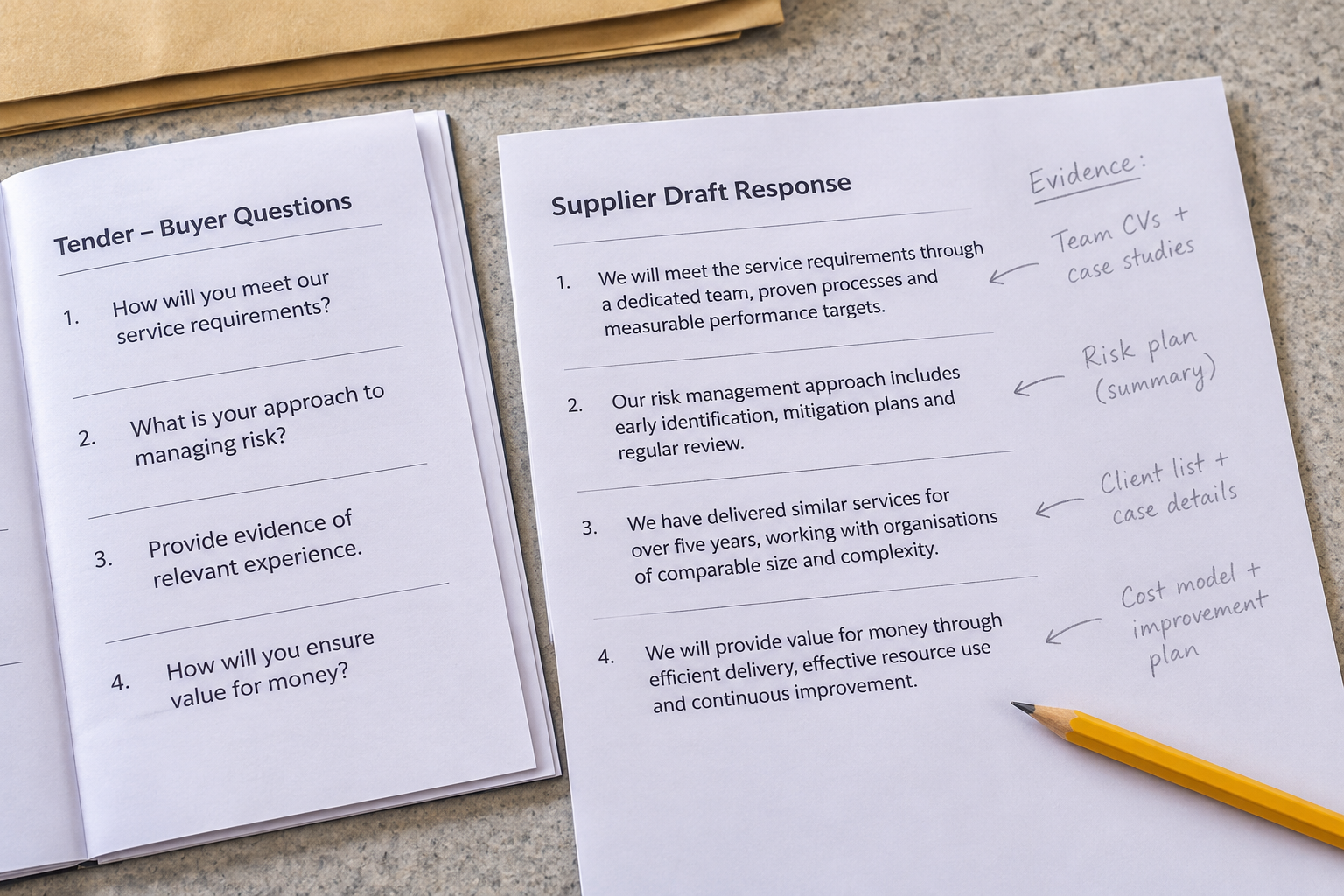

To write a methodology for a tender, explain how you will deliver the buyer’s requirements, who will do the work, when each activity will happen and how you will manage risks and measure performance. Follow the invitation’s instructions, support your approach with relevant evidence and make it easy for evaluators to connect each part of your answer to the question.
What Is a Tender Methodology?
A tender methodology is the practical delivery plan in your bid. It tells the buyer what you propose to do, how you will do it and how you will check that it is working. Depending on the tender, it may be a standalone document or a series of answers to method statements and quality questions.
It is not the same as a company profile or a price schedule. Your profile describes your organisation; your price explains what the buyer will pay. The methodology connects the proposed resources and price to the work itself. It should show the evaluator how your approach responds to this particular contract, rather than how you generally operate.

For example, a facilities buyer might ask how a supplier will maintain several occupied sites. A useful answer would cover mobilisation, planned visits, access arrangements, handling urgent issues and reporting. It would explain which team is responsible and what happens if a visit cannot proceed as planned.
How to Write a Methodology for a Tender Step by Step
Start with the buyer’s documents, not an old bid. Read the specification, response template, evaluation criteria, contract terms and any published clarifications together. A good answer can only be useful if it responds to the question the buyer has actually asked.
- Break down the question. Mark every requested activity, output, condition and supporting document. Note the word limit and whether the buyer asks for a particular structure.
- Map the requirements. Create a working checklist linking each requirement to the relevant answer, owner and evidence. Distinguish mandatory requirements from scored quality questions where the documents do so.
- Plan the work in sequence. Describe mobilisation, delivery, monitoring and close-down or handover where relevant. Include dependencies and decision points, not just a list of tasks.
- Assign responsibility. Identify roles, their responsibilities and any proposed subcontractors. Explain how the buyer can raise an issue and who can resolve it.
- Make the approach measurable. State the checks, reporting arrangements and proposed measures that are relevant to the specification. Use the buyer’s required measures where provided.
- Attach or reference evidence. Use permitted examples, delivery plans or supporting documents that substantiate the specific claims you make.
- Review and submit. Check consistency with the price, timetable and other answers. Confirm that the correct files are uploaded before the deadline.
If the documents are unclear, use the buyer’s stated clarification process rather than quietly guessing. Keep a record of the question and response, and share the answer with everyone preparing the bid. If an assumption remains necessary, make it explicit in the permitted place and consider whether it affects your ability to comply.

For a broader look at preparing the whole submission, see how to write a tender bid step by step.
Which Methodology Myths Can We Put Aside?
These misconceptions can lead to answers that sound polished but leave evaluators without the detail they need. Use the table as a review aid, not as a substitute for the buyer’s instructions.
| Myth | Fact | What to do instead |
|---|---|---|
| A long answer is automatically a strong answer. | Length does not prove that you have addressed the question. | Answer every requested point, then remove repetition and unsupported claims. |
| One generic method statement works for every tender. | Contracts differ in scope, risks, constraints and evaluation criteria. | Adapt the sequence, resources and evidence to the specific requirement. |
| Buyers only want technical detail. | They may also need to understand responsibilities, communication and continuity. | Explain who acts, how issues are escalated and how progress is reported. |
| Experience is enough evidence on its own. | Past work does not explain how this contract will be delivered. | Connect a relevant example to a specific proposed activity or control. |
| Risks should be left out because they look negative. | A credible plan acknowledges relevant risks and responses. | Identify likely issues, owners and practical contingencies. |
| AI can produce a finished answer without review. | A draft still needs contract-specific facts, evidence and human checks. | Verify every claim, commitment and reference before submission. |
Myth: The More Detail, the Better
Detail helps when it answers a buyer’s question. It becomes a distraction when it describes unrelated projects, repeats the specification or spends valuable words on marketing language. A concise explanation of the delivery sequence, responsibilities and controls is more useful than pages of generic assurances.
Match the level of detail to the question and any word limit. If the buyer asks about mobilisation, explain the steps needed to start safely and on time. Do not use most of the space to recount your organisation’s history. Where a response template sets headings or requests a specific format, follow it even if your preferred structure is different.
Myth: A Previous Winning Answer Is Ready to Reuse
A previous answer can be a useful starting point for terminology, evidence and lessons learned. It is not proof that the same plan fits a new contract. Site access, service hours, volumes, reporting arrangements and buyer priorities may all differ.
Before reusing material, check each statement against the new specification. Replace old names and dates, remove irrelevant commitments and confirm that proposed people and resources are available. Review any reference to another customer for accuracy and permission. If the current tender does not allow supplementary material, do not assume an old appendix will be considered.
Myth: Promising to Comply Is Enough
Statements such as “we will deliver a high-quality service” tell the evaluator little about how the promise will be kept. Explain the activity, its owner and the check that demonstrates whether it has happened. A claim about rapid escalation, for instance, is stronger when it identifies the escalation route and the proposed response process.
Only commit to timescales and service levels your team can resource and your price supports. If the buyer has specified a mandatory target, address it directly. If you propose a target of your own, label it as a proposal and make sure it does not conflict with the contract documents.
What Should a Strong Methodology Include?
The exact content depends on the work and the question. Use the following elements as a checklist, then keep only what is relevant and permitted in your response.
- Understanding of the requirement: A short account of the outcomes, scope and constraints that shape your approach. Avoid simply copying the specification back to the buyer.
- Delivery sequence: The activities you will carry out, their order, key dependencies and the outputs the buyer can expect.
- People and resources: The roles, capacity, equipment and subcontracted support needed to deliver the work, including how responsibilities are coordinated.
- Quality control: The checks, review points and records you will use, who owns them and how issues will be corrected.
- Risk and continuity: Relevant risks, preventative actions, contingencies and escalation routes.
- Communication and reporting: Meeting or update arrangements, proposed reports, named roles and the route for decisions or complaints.
- Evidence: Relevant information that supports your claims, presented in the form and location the buyer permits.
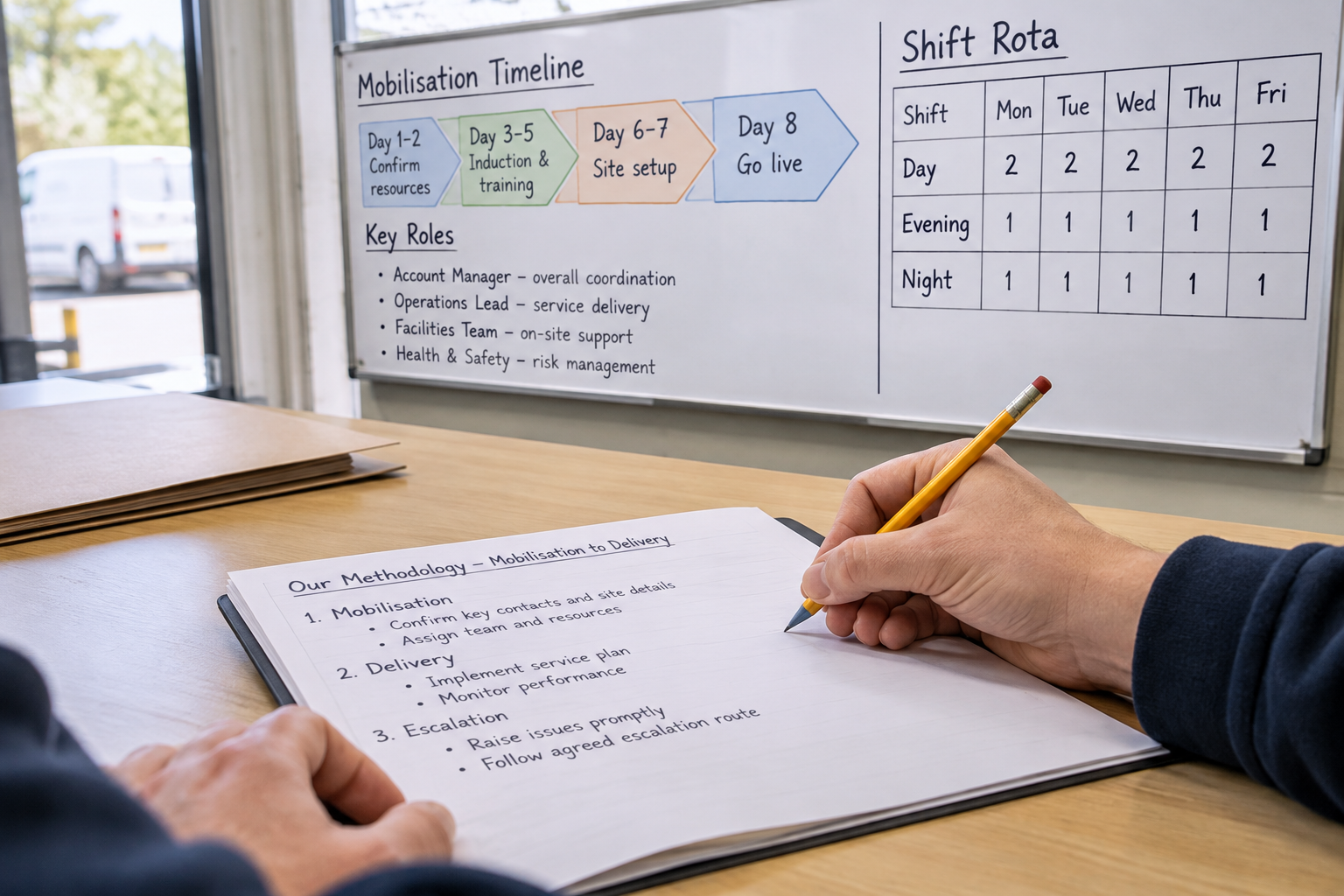
Think about the interface between your team and the buyer. If your plan depends on site access, a buyer decision or information from a third party, say so. Explain when that input is needed and how you will handle a delay. This gives the buyer a clearer view of the responsibilities on both sides without hiding a material dependency.
For background on how buyers structure and score quality questions, read the step-by-step guide to tender evaluation criteria. The published tender documents remain the authority for the particular opportunity.
If you are preparing tenders for suppliers to answer, TenderLock can help turn a plain-English brief into structured requirements and weighted criteria. Named people retain the final decisions. Start your first live tender free; no card is required.
How Do You Connect Your Method to the Evaluation Criteria?
Evaluators need to find the answer to each question in the material they are allowed to assess. Follow the question’s order where possible, use the buyer’s terminology naturally and make the link between each requirement and your response explicit. Do not rely on an evaluator finding a crucial point in a different answer or attachment.
For each scored question, check the published criteria and any scoring guidance. If the buyer asks for an explanation of how you will manage missed visits, a sentence saying that visits are monitored may not be enough. Set out how a missed visit is identified, who contacts the buyer, how the work is rearranged and how the issue is recorded.
A private response matrix can help your team check coverage. Record the question reference, the requirement, the proposed answer location, the evidence and the person responsible for reviewing it. This is a working tool: submit it only if the buyer asks for it or allows it as part of your response.
Where a tender is subject to public procurement rules, use the published opportunity documents and official guidance rather than assuming that every buyer evaluates in the same way. The UK Government’s Procurement Act guidance provides context for relevant procurements; check which rules apply to the particular tender.
A Worked Methodology Example
Hypothetical scenario: A buyer asks a supplier to explain how it will deliver planned maintenance across occupied sites, including mobilisation, missed visits and reporting. The example below illustrates an approach; it is not evidence of an actual contract or a claim about a real supplier.
Mobilisation: Our proposed contract manager will meet the buyer’s representative to confirm the site list, access contacts, service hours and existing maintenance information. We will use these inputs to prepare a visit schedule for the buyer’s review before delivery begins.
Delivery: The service coordinator will allocate visits to suitable operatives and confirm access arrangements with each site. Operatives will record the work completed and any issues requiring further action. The coordinator will maintain the schedule and advise the buyer when a planned visit changes.
Missed visits: If a visit cannot take place, the coordinator will record the reason, notify the buyer’s nominated contact and agree a rearranged date. Where the issue could affect safe operation or the contract schedule, the contract manager will escalate it through the agreed route.
Reporting: We will provide the buyer with the agreed report showing completed visits, outstanding actions and missed or rearranged visits. The contract manager will review recurring issues with the buyer and record agreed actions and owners.

This example works as a starting structure because it links activities to roles and describes what happens when delivery goes wrong. It still needs the actual tender’s details: required service levels, reporting frequency, site constraints, mobilisation timetable and any mandatory format. The supplier would also need to confirm that the proposed team and price support the commitments.
Notice that the example does not claim a guaranteed outcome or rely on a named customer. If the buyer requests evidence of similar work, add an accurate, relevant example in the permitted place and explain which part of the proposed approach it supports.
How Can You Show Evidence Without Overclaiming?
Evidence should support the precise statement beside it. If you say your team has delivered a comparable service, identify the relevant scope and your organisation’s role, subject to confidentiality and the buyer’s instructions. If you describe a proposed quality check, a sample record or process description may help where attachments are permitted.
Check that every piece of evidence is current, accurate and attributable. Do not imply that a subcontractor’s experience is your own, or that a proposed team member is committed if their availability has not been confirmed. Where you refer to policies or credentials, check their status and relevance rather than adding them as decoration.
Keep personal and commercial information proportionate to the request. The Information Commissioner’s Office guidance on UK GDPR is a useful starting point when considering personal data in bid materials. Follow the buyer’s submission instructions and your organisation’s own data protection procedures.

A final reviewer should be able to trace important claims back to their source and distinguish evidence of past work from commitments for the proposed contract. For related guidance on supporting a supplier response, see practical tips for writing a tender proposal.
Where Can You See Method Statements Explained?
For another way to explore the topic, look for a practical demonstration of tender method statements. Check that any example reflects the buyer’s actual instructions before using its structure or claims.
A video can illustrate the drafting process, but it cannot tell you what an individual buyer will accept. The specification, response instructions and published clarifications should guide your final submission.
Frequently Asked Questions
How long should a tender methodology be?
Use the word, page or character limit in the tender documents. If no limit is given, write enough to address each requested point clearly, without adding unrelated material. The complexity of the work matters: a multi-site service with transition and continuity requirements will normally need a fuller explanation than a simple, well-defined task.
Should I include a timetable in my methodology?
Include a timetable if the buyer requests one or if it helps explain a relevant delivery sequence and the format permits it. Show key activities, dependencies and decision points. Make clear whether dates are fixed requirements or your proposals, and check that the plan is consistent with your staffing, price and other answers.
Can I use AI to draft a tender methodology?
AI can help organise notes, identify possible gaps and suggest a structure. Give it only information you are authorised to use, and check the buyer’s rules on AI and confidentiality. A person who understands the contract should verify every claim, reference and commitment against the specification, evidence and actual delivery plan.
What if the buyer provides a response template?
Follow the template and its instructions, including any limits, file requirements and rules on attachments. Use its headings to make the required information easy to find. If an important point does not appear to fit, consider whether it belongs in another permitted answer or whether you need to raise a clarification.
How is a methodology different from a mobilisation plan?
A mobilisation plan focuses on preparing to start the contract, such as confirming contacts, resources, access and initial schedules. A methodology can cover mobilisation as well as ongoing delivery, monitoring, issue resolution and handover. The distinction depends on the tender: answer each question as written and avoid assuming one document replaces another.
Ready to create a clearer tender for suppliers to respond to? Start your first live tender free with TenderLock using the link above; no card is required.