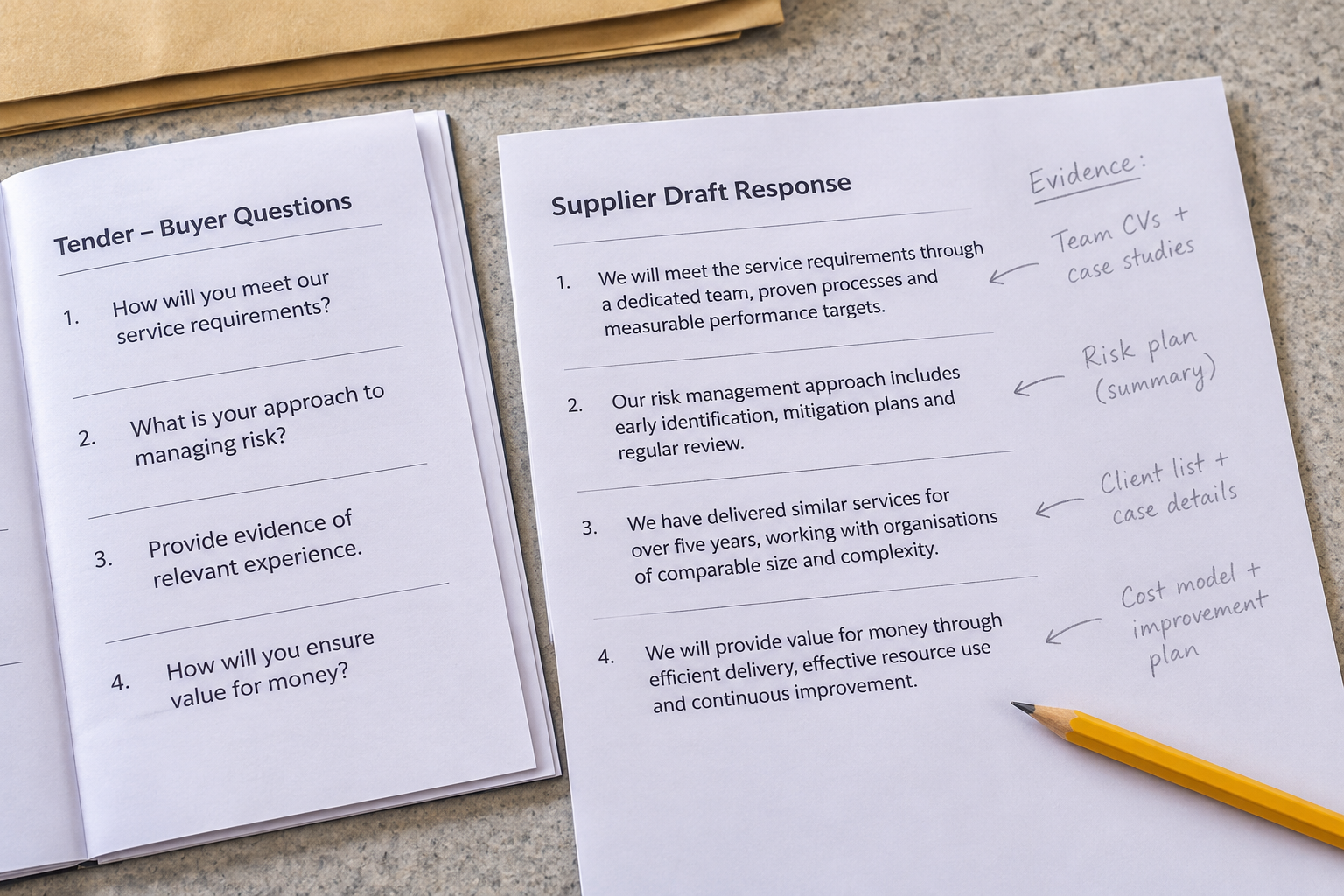

To understand how to write a tender quotation, start with the buyer’s instructions, then explain what you will deliver, how you will deliver it and what it will cost. Make every response easy to match to a requirement, support your claims with relevant evidence and check the complete submission before the deadline.
What Is a Tender Quotation?
A tender quotation is a supplier’s formal response to a buyer’s request for goods or services. It usually combines a price with information about the proposed delivery, relevant experience and any conditions attached to the offer. Depending on the procurement, the buyer may call it a quotation, a bid, a tender response or a proposal.
A simple request for quotation may focus on price and delivery terms. A more detailed tender can also ask for method statements, financial information, technical evidence and answers to scored questions. Follow the documents supplied rather than assuming that one format fits every opportunity.
The aim is not just to make an attractive offer. It is to give the buyer enough clear, comparable information to decide whether your response meets the requirements and offers value against the published criteria.

How to Write a Tender Quotation: Practical Tips
Use these steps to turn the invitation into a complete, assessable response. The right level of detail depends on the buyer’s instructions and the complexity of the work.
- Read the invitation before drafting. Identify the scope, deadline, submission route, mandatory conditions, pricing instructions and evaluation criteria. Note any word limits, required templates and clarification deadlines.
- Build a response checklist. Record each question or requirement, its reference, the person responsible, the evidence needed and the location of the answer. Include declarations and attachments, not just the narrative questions.
- Check whether the opportunity is a good fit. Consider capacity, location, contract terms, delivery dates and the skills or resources required. If a mandatory condition is impossible to meet, resolve the issue before investing heavily in the response.
- Answer in the buyer’s order. Use the supplied template where required. Mirror question numbers and headings so evaluators can find each answer without searching through unrelated material.
- Describe delivery in concrete terms. Explain the activities, responsibilities, timing and controls relevant to the contract. Tailor the detail to what the buyer has asked rather than inserting a generic company profile.
- Price the complete scope. Use the buyer’s pricing schedule and units. Check quantities, recurring charges, one-off costs and any required breakdowns against the delivery plan.
- Support claims with evidence. Refer to relevant examples, policies or records when requested. Make it clear how each item supports the answer and remove information the buyer has not asked for if it distracts from the response.
- Review and submit deliberately. Check arithmetic, consistency, signatures, file formats and upload requirements. Leave time to resolve access or technical problems before the deadline.
If a requirement is unclear, use the buyer’s stated clarification process. Do not rely on an informal conversation as a change to the tender documents. Record the question and response, then make sure the final quotation reflects any published clarification.
Give the checklist an internal completion date for each item, allowing time for review before the buyer’s deadline. Where several people contribute, agree who will combine their answers and check that terminology and commitments match. Flag dependencies early: a delivery plan may need confirmed resource availability before the price can be finalised, for example.
Which Details Should Your Quotation Include?
The invitation always takes priority, but the following checklist helps you plan a response. Not every tender needs a separate document for each item: the buyer may provide a portal, form or workbook that brings them together.
| Item | What to include | Final check |
|---|---|---|
| Supplier details | Legal entity name, contact details and requested identifiers | Do they match the contracting entity? |
| Scope | Goods or services offered, quantities and delivery locations | Does the offer cover the requested scope? |
| Delivery approach | Relevant activities, responsibilities, timetable and controls | Does it answer the buyer’s specific questions? |
| Price | Completed schedule, units, totals and tax treatment as requested | Do the figures reconcile with the narrative? |
| Evidence | Requested examples, policies, references or supporting records | Is each attachment relevant and clearly labelled? |
| Commercial terms | Requested validity period, payment details and permitted qualifications | Are assumptions and exclusions visible and allowed? |
| Submission | Required forms, declarations, signatures and files | Are all items complete and ready for the specified route? |
When a buyer supplies a mandatory template, complete it even if your own quotation document contains similar information. A separate brochure or standard sales document may be useful supporting material, but it should not replace an answer the buyer expects in a particular field.
Use the checklist to locate information across the submission, not to create unnecessary extra attachments. For instance, if the pricing workbook contains the commercial details and the portal contains the delivery answer, record those locations against the relevant items. This makes missing information easier to spot during the final review.

How Should You Present Price and Commercial Terms?
Start with the pricing instructions. The buyer may ask for a fixed total, unit rates, a schedule of labour and materials, or prices for optional services. Enter figures in the requested fields and avoid changing formulas or workbook structure unless the buyer permits it.
For each price, make the unit and scope understandable. A rate per visit, for example, should be distinguishable from a monthly management charge. If the invitation asks for a whole-contract price, check that the schedule accounts for the contract period, expected quantities and any stated transition or mobilisation work.
Show VAT treatment as requested, including whether figures are exclusive or inclusive of VAT. If tax treatment or another commercial point is unclear, ask a qualified adviser or use the clarification process rather than guessing. The GOV.UK guidance on VAT for businesses is a useful starting point for UK suppliers.
State assumptions and exclusions only in the manner permitted by the tender. A hidden assumption can make an apparently competitive price misleading; an unauthorised qualification can also make a response unacceptable. Explain any allowed assumption plainly, including the cost or delivery implication where relevant.
Check: does your narrative promise an activity that your price omits? Does your pricing schedule include an option the buyer did not request? Resolve these inconsistencies before submission, or explain an authorised alternative in the place the buyer specifies.
Work through the schedule line by line against the specification. For example, if the buyer asks for scheduled visits and a separate optional service, check that each appears in the requested place and that the total uses the quantities specified. Have another reviewer check calculations and copied figures, particularly where the same total appears in both a workbook and a portal field.
How Do You Answer Requirements and Evaluation Criteria?
Requirements describe what the buyer needs; evaluation criteria explain how responses will be assessed. Some requirements may be mandatory, while other answers receive a score. Read the full instructions carefully: a strong scored answer does not necessarily compensate for failing a mandatory condition.
For each question, identify the action the buyer wants you to address. If it asks how you will manage service interruptions, describe the process, who is responsible, how the buyer will be informed and how service will resume. Avoid answering a process question solely with a statement that your organisation is experienced.
Where weightings are provided, use them to plan effort without neglecting lower-weighted or mandatory sections. For an explanation of how buyers structure their assessments, see the step-by-step guide to tender evaluation criteria.
Clearly labelled hypothetical example: a buyer requests a planned maintenance service and asks how urgent faults will be handled. A useful answer would identify the reporting route, proposed response arrangements, escalation contact and record-keeping approach, using the timeframes the supplier can actually commit to. It would also explain how those arrangements fit the buyer’s stated site access rules.
Make it easy to trace evidence back to the answer. Instead of writing “see attached policy”, identify the relevant document and section, then summarise the point in the response itself. Follow any restrictions on attachments: evaluators may be instructed not to consider extra material.
Before writing, break a multi-part question into its component requests and check the draft against each one. If the buyer asks for both a process and the records it produces, include both rather than assuming one implies the other. Within a word limit, prioritise the contract-specific steps and responsibilities over introductory company history.

If you are a buyer preparing an invitation, TenderLock can turn a plain-English brief into structured requirements and weighted criteria. It keeps bids locked until the deadline and checks responses requirement by requirement, while named people make final decisions. Start your first live tender free; no card is required.
What Evidence Makes a Quotation Credible?
Choose evidence that directly supports the requirement. Depending on the tender, this could include a relevant project example, a proposed delivery plan, a policy, a sample report or details of the people assigned to the work. Check the invitation for limits on age, format, length and the type of evidence accepted.
Explain the connection between the evidence and the proposed contract. For a past project, describe the relevant scope and your organisation’s role without implying that the earlier work is identical. If the buyer asks for references, obtain permission where appropriate and provide the requested contact information accurately.
Avoid unsupported superlatives such as “best in class”. Instead, say what you will do, who will do it and what record or example supports the statement. Do not claim an accreditation, capability or resource that you cannot substantiate or will not have available for the contract.
Check confidential information before sharing attachments. Remove material you are not authorised to disclose, and follow the buyer’s instructions for personal data. The Information Commissioner’s Office guidance for organisations provides a starting point for handling personal information responsibly.
For a broader view of what buyers may ask to see, use the UK supplier vetting checklist. Prepare evidence early, but tailor the final selection to the invitation rather than sending every document you hold.
Check that each selected document is current and readable, and that its title matches the reference in your answer. If an example covers several activities, point to the part relevant to the buyer’s question. Where an attachment cannot be supplied in the requested form, raise the issue through the permitted process rather than assuming a substitute will be accepted.
Review the Quotation Before You Submit
A good final review checks both compliance and clarity. Ask someone who has not drafted the response to read the buyer’s question alongside your answer. Can they find a direct response? Can they tell which evidence supports it? If they cannot, the evaluator may struggle too.
- Completeness: every required question, declaration, attachment and pricing field is addressed.
- Consistency: dates, quantities, prices, service descriptions and named responsibilities agree across documents.
- Accuracy: calculations, contact details and legal entity information are correct.
- Presentation: files use the requested format and names, and remain readable when opened.
- Authority: the right person has approved the offer and signed any required declaration.
- Submission: the correct portal or other permitted route is accessible, and the deadline and time zone are understood.
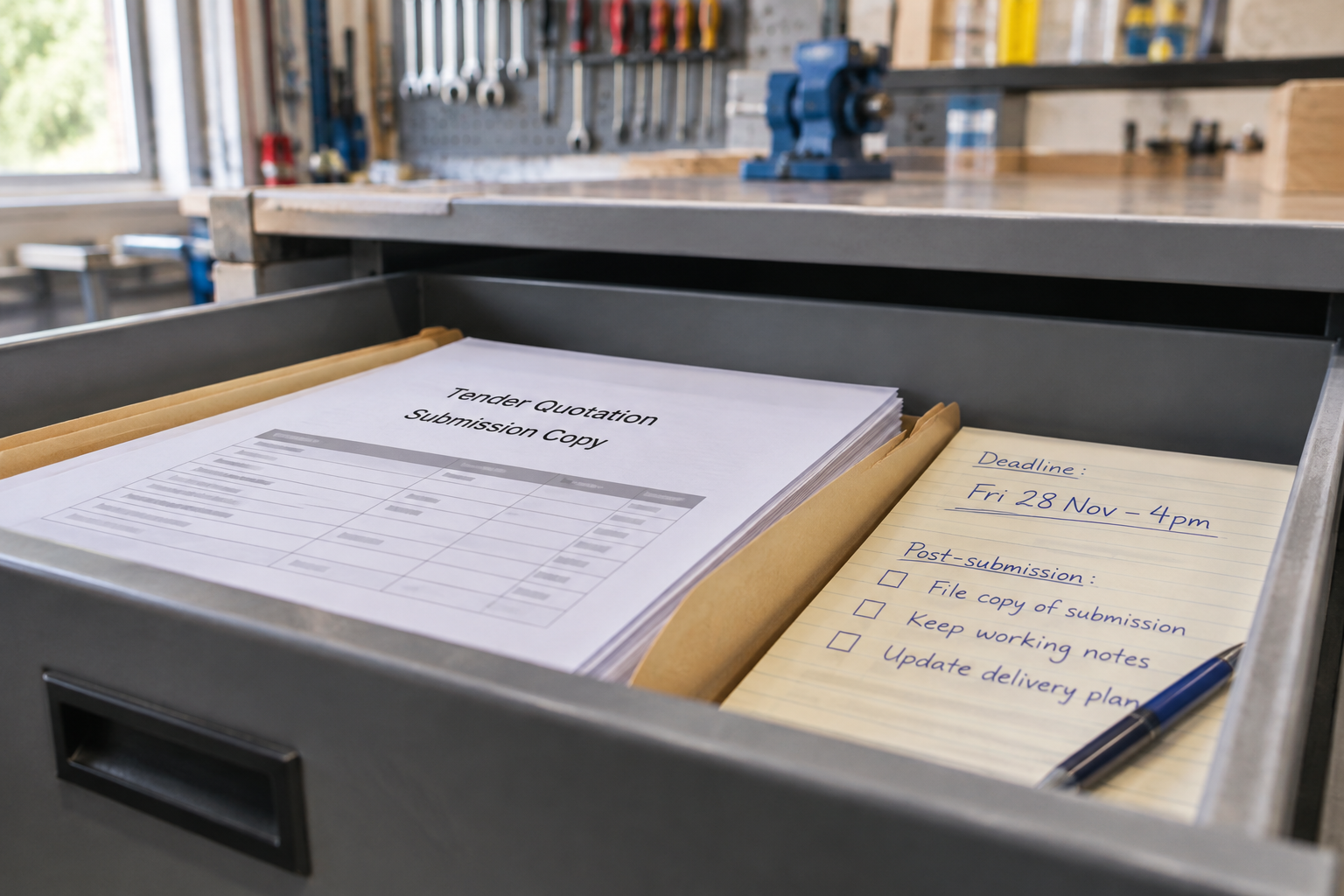
Build in time for internal approval and upload checks. Keep a copy of the submitted files and any confirmation provided by the buyer’s system. If a problem occurs, use the buyer’s published support or clarification route; do not assume a late email will be accepted as a substitute.
After assembling the final files, compare them with the checklist rather than relying on an earlier draft. Open each attachment to verify that it is the intended version and that referenced sections can be found. If the submission route provides a review screen, check the entries and attachments there before completing the submission.

For a fuller supplier-side process, read how to write a tender bid step by step. Keep that broader process separate from the specific instructions for the opportunity in front of you.
Watch: Preparing a Tender Quotation
A walkthrough can help you see how suppliers organise a response. Use the search below to find a relevant example, then check its advice against your own tender documents and current buyer instructions.
Frequently Asked Questions
Is a tender quotation the same as a tender proposal?
The terms can overlap, but a quotation often emphasises price and commercial terms, while a proposal may contain more detail about the solution and delivery approach. In practice, the buyer’s documents determine what is required. Treat the requested templates, questions and pricing schedule as the definitive guide, whatever the response is called.
Should I include a cover letter?
Include one if the buyer requests it or permits additional material and it serves a clear purpose. Keep it short: identify the opportunity and your organisation, and provide any requested contact or offer details. Do not put essential answers only in the letter if the buyer has provided specific response fields for them.
Can I offer an alternative to the requested specification?
Only if the tender rules allow it. Some buyers request a compliant base offer and permit a separately identified alternative; others may not accept variants. Check the instructions and use the clarification process if necessary. Make the implications for price, scope and delivery explicit without changing a mandatory response format.
How long should a quotation remain valid?
Use the validity period stated in the invitation if you can accept it. If no period is given, decide what your organisation can reasonably hold open and state it where the buyer permits. Consider supplier costs, delivery dates and internal approval, and seek clarification before imposing a condition that may conflict with the tender.
What happens after I submit?
The buyer will follow its stated process for opening and evaluating responses and may request permitted clarifications. Keep your submission and supporting records accessible, monitor the nominated contact route and respond within any stated deadline. Do not assume you have won until you receive the buyer’s formal decision and any required contract arrangements are complete.
Ready to run a clearer tender as a buyer? Your first live tender with TenderLock is free, with no card required.