

Tender evaluation criteria construction buyers use should test more than price: they should assess whether a contractor can deliver the specified work safely, on programme and to the required quality. Set the criteria, weightings and scoring method before inviting bids, then apply them consistently to the evidence each supplier provides.
This guide explains how to build a practical evaluation model, compare construction bids and record the reasons for your decision. It is relevant to private-sector buyers and useful as a starting point for public buyers, who must also follow the procurement rules applicable to their project.
What Are Tender Evaluation Criteria in Construction?

Evaluation criteria are the measures a buyer uses to compare tenders against the contract’s needs. In construction, they translate project risks and desired outcomes into questions that bidders can answer and evaluators can score. A criterion might assess a proposed programme, for example, while the question asks the bidder to explain sequencing, key dependencies and its approach to delays.
Keep three related decisions distinct:
- Minimum requirements: conditions a bid or supplier must meet, assessed using the stated pass/fail rules.
- Selection checks: checks on a supplier’s suitability, capacity or financial standing, as relevant to the procurement.
- Award criteria: the factors used to compare eligible tenders and decide which offers the best outcome under the published method.
The distinction matters because a strong quality score should not automatically rescue a bid that fails a mandatory condition. Equally, a long company history should not receive extra marks under an award criterion unless the stated question and rules allow it.
For a broader introduction to setting questions and scoring, see our step-by-step guide to tender evaluation criteria.
Which Criteria Should You Compare?
Choose criteria that reflect the work, the site and the consequences of failure. A straightforward refurbishment may need a simpler model than a complex, occupied-site project. The following comparison is a starting point, not a universal set of weightings.
| Criterion | What to assess | Useful bid evidence | Watch for |
|---|---|---|---|
| Price and cost | Comparable cost against the defined scope and pricing schedule | Completed schedule, assumptions and exclusions | Low headline price supported by missing items or unrealistic assumptions |
| Methodology | How the work will be planned, sequenced and delivered | Project-specific method, interfaces and constraints | Generic statements that do not address the site |
| Programme | Whether the proposed sequence and milestones are credible | Programme, lead times and dependencies | Dates with no explanation of critical activities |
| Health and safety | How relevant risks will be managed in delivery | Project-specific risk controls and responsibilities | A policy that says little about the proposed work |
| Quality management | How workmanship, inspections and defects will be controlled | Inspection approach, hold points and handover process | Promises of quality without a practical checking process |
| Team and supply chain | Whether proposed roles and subcontractor arrangements suit the work | Named roles, responsibilities and proposed coverage | Key resources that may not be available when needed |
| Environmental and social outcomes | Relevant impacts and commitments that can be measured | Material, waste or local delivery proposals linked to the project | Broad commitments with no method or accountability |
Ask only for evidence you intend to assess. If a criterion contains several distinct elements, explain how they will be considered so suppliers do not have to guess which part matters most. Make the questions proportionate: requesting a full delivery plan for every low-risk purchase can create unnecessary work for both sides.

Consider project-specific risks
Start with a short risk discussion involving people who understand the site. An occupied school, for example, may make segregation and working hours central to the methodology; an infrastructure repair may place more emphasis on access, interfaces and temporary works. Reflect those priorities in the specification and evaluation questions rather than relying on a generic template.
For health and safety, establish the relevant duties and project arrangements before drafting the question. The Health and Safety Executive’s Construction Design and Management guidance is a useful starting point. A tender score does not replace the need to meet applicable legal duties or manage safety during delivery.
How Should You Weight Construction Tender Criteria?
Weightings express the relative importance of the criteria in the award decision. Agree them before bids are invited, with input from procurement, technical specialists and the person accountable for the project. The total should equal 100%, and the invitation should explain how each score contributes to the final result.
Hypothetical example: for an occupied-building refurbishment, a buyer might allocate 40% to price, 25% to methodology and site management, 15% to programme, 10% to health and safety, and 10% to quality and handover. This is illustrative, not a recommended split. The right balance depends on the scope, risk and applicable rules.
Test the model before publication. Consider whether a very low price could outweigh an unacceptably weak delivery plan, or whether a high quality score could make a materially unaffordable bid appear preferable. If either outcome would be unacceptable, decide whether an appropriate minimum threshold, budget condition or different weighting is needed, and explain it in the tender documents.
Weight sub-criteria too, or otherwise explain their relative importance where appropriate. Avoid changing the model after bids arrive simply because a preferred supplier performs poorly under it. If a genuine problem is discovered, obtain procurement or legal advice before deciding how to proceed.
Make price bids comparable
Give bidders the same pricing schedule and identify the quantities, assumptions and optional items to include. Explain whether you will assess a fixed tender sum, specified rates, whole-life costs or another stated basis. A whole-life approach may be useful where maintenance or operating costs are material, but only if the inputs can be compared consistently.
Review qualifications and exclusions before applying the price formula. An apparently cheaper bid may omit work that another bidder has included. Do not silently add costs or change a supplier’s price: follow the stated clarification process and record the basis of any permitted correction or comparison.
How Do You Build a Scoring Method?
A scoring method should tell evaluators what each mark means and tell suppliers what a good response needs to demonstrate. Use a scale with descriptions tied to the question, not just labels such as excellent or poor.
| Illustrative score | Evidence-based description |
|---|---|
| 0 | No relevant response, or no evidence against the question. |
| 1 | Major gaps; the response gives little confidence that the requirement is understood or can be delivered. |
| 2 | Partially addresses the requirement but leaves important gaps or uncertainty. |
| 3 | Addresses the requirement adequately, with a credible approach and supporting detail. |
| 4 | Addresses the requirement thoroughly, with clear project-specific evidence and a convincing approach. |
For a quality criterion weighted at 25%, a score of 3 out of 4 produces 18.75 weighted points: divide 3 by 4, then multiply by 25. Apply the same calculation to each quality criterion, unless the published method says otherwise. Explain rounding in advance if it could affect the outcome.
For price, one possible formula is the lowest eligible price divided by the bid price, multiplied by the available price points. Explain which prices are eligible for comparison, how exclusions will be treated and what happens if a price is incomplete. This formula is not suitable for every procurement; test it using realistic ranges before issuing it.
Include any minimum quality score and its consequences in the invitation. For example, if a bid must achieve a stated minimum on methodology to remain eligible, evaluators need to know whether that threshold applies before or after moderation. Suppliers need the same information when preparing their responses.

What Evidence Should Suppliers Provide?
Good evidence answers a specific question and connects the proposed approach to the contract. Ask bidders to explain who will do the work, how they will do it, what constraints they have identified and how they will manage a problem. Set reasonable page or word limits where useful, and state whether attachments count towards them.
For a programme question, you might ask for a sequence from mobilisation to handover, with dependencies, access assumptions and an explanation of how the bidder will manage a delay to a long-lead item. For quality, ask how inspections, non-conformances and defects will be recorded and resolved. Each question should point back to the published specification.
Separate evidence of a proposed project approach from evidence used for supplier checks. A buyer may need to examine corporate information, financial standing or relevant experience, but should explain the purpose and assessment method. Our UK supplier vetting checklist covers practical checks to consider.
Do not treat a polished response as proof of delivery. Look for a credible connection between the claim and the evidence: a named responsibility, a workable sequence, a relevant example or a clear control. Where a response is unclear, use the permitted clarification process rather than filling gaps with assumptions.
TenderLock can help turn a plain-English brief into structured requirements and weighted criteria, then check supplier responses requirement by requirement. Named people remain responsible for the final decisions. You can start your first live tender free, with no card required.
How Do You Run a Fair Evaluation?
Agree the process before opening bids. Identify evaluators, their responsibilities and any conflicts of interest. Make sure the team has the same version of the specification, questions, weightings and scoring guidance. If bids are sealed, explain the submission deadline and opening arrangements, including how late submissions will be handled under the applicable rules.
- Check completeness and eligibility. Apply the stated rules to mandatory requirements and submission instructions. Record any exclusion and its reason.
- Assess responses independently. Evaluators should score against the published questions and capture evidence references, rather than relying on general impressions.
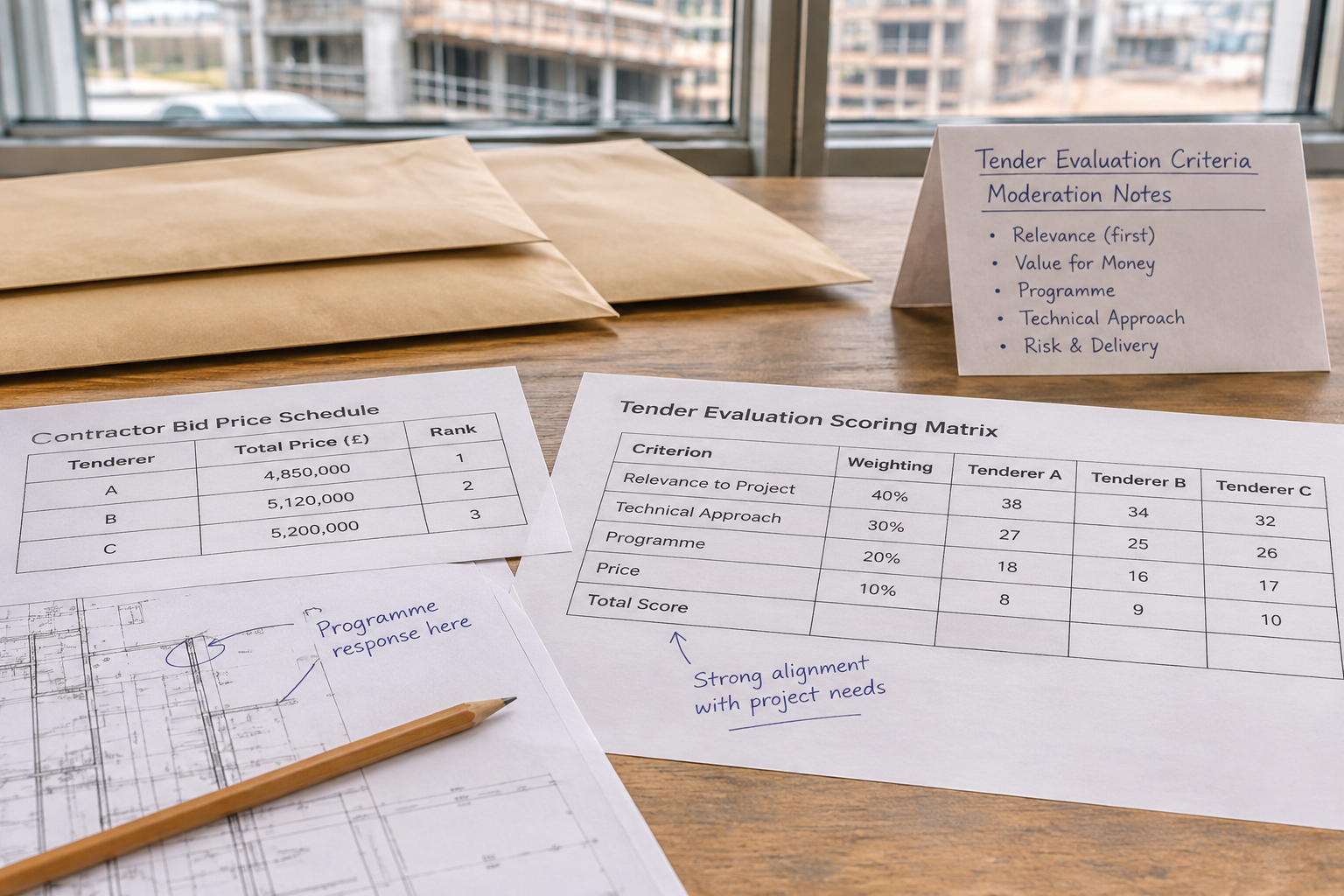
- Moderate scores. Discuss material differences, refer back to the responses and agree a reasoned score. Keep a record of the discussion and the final rationale.
- Clarify where appropriate. Ask focused questions under the stated process. Do not use clarification to give one bidder an undisclosed opportunity to improve its bid.
- Complete the comparison. Apply the published calculations, thresholds and any tie-break rules. Check arithmetic and the treatment of assumptions.
- Approve and communicate. Obtain the required internal authorisation, record the decision and notify bidders in line with the applicable process.
For UK public procurement, check the rules and guidance relevant to the authority, contract and procedure before issuing documents. The government’s Procurement Act guidance collection provides a starting point; it should not be treated as a substitute for project-specific advice.
For more on sealed bids and opening controls, read our sealed bidding process walkthrough.
What Should Your Evaluation Record Include?
A defensible record lets someone who was not in the room understand how the team reached its decision. Keep the issued tender documents and any amendments, the evaluation plan, conflict declarations, bid submissions, clarifications, individual assessments where retained, moderation notes, final scores and approvals.
Comments should identify both the evidence and its significance. Instead of writing “good programme”, an evaluator could note that the response identifies the access constraint and gives a sequenced approach to managing it. If an answer lacks detail, record the gap against the question rather than making a general criticism of the bidder.
Control access to commercially sensitive material and follow your organisation’s retention and data-handling policies. Recorded calls and summaries can support a record where appropriate, but they do not replace agreed scores or documented decisions. TenderLock provides an audit trail, evidence-linked evaluation and recorded calls with AI summaries; check your organisation’s consent and retention requirements before recording.

Common Mistakes to Avoid
- Using generic questions: ask about actual site constraints and delivery risks, not just whether a bidder has a policy.
- Double-counting: decide where a response element will be scored so the same strength does not receive unintended credit under several criteria.
- Overweighting price without testing: model possible outcomes before publication and check that the result supports the project’s priorities.
- Confusing selection with award: make clear whether information is used to establish suitability or compare tenders, and apply the stated rules.
- Rewarding unsupported claims: score the evidence provided, not confidence in a supplier’s reputation or presentation style.
- Leaving assumptions unresolved: identify qualifications and exclusions that affect comparability, then handle them through the permitted process.
- Recording only the final number: retain the reasons and evidence references needed to explain the score.
Finally, remember that an evaluation model cannot repair an unclear specification. Review the scope, drawings, pricing schedule and questions together before inviting suppliers. A red-team review for ambiguity can help identify missing information or conflicting instructions while there is still time to correct them.
See Construction Tender Evaluation in Practice
For a visual introduction to the process, search for practical examples of construction bid scoring and moderation. Check any suggested method against your own tender documents and applicable procurement rules.
Frequently Asked Questions
Is the lowest construction tender always the best choice?
No. A low price may be attractive, but it needs to be comparable with other bids and assessed alongside the published quality criteria. Check the pricing schedule, assumptions and exclusions. If the tender states that price alone determines the award, apply that stated method and any applicable eligibility rules rather than introducing new quality measures later.
Can health and safety be a pass/fail requirement and a scored criterion?
It can be useful to distinguish a clearly defined minimum requirement from a separate assessment of the project-specific approach. Avoid scoring the same evidence twice without explaining why. Set out the pass/fail test, the quality question and their consequences in advance, and check the approach against the rules governing the procurement.
How much detail should a small construction tender request?
Request enough information to assess the project’s material risks, but keep the burden proportionate. A short method statement, a simple programme and a completed pricing schedule may be more useful than lengthy generic policies for straightforward work. Increase the level of detail where site constraints, safety risks or contract interfaces justify it.
Can evaluators consider information outside a supplier’s bid?
Follow the published assessment method and applicable rules. If external checks are planned, tell suppliers what will be checked, how the information will be used and how any discrepancies will be handled. Evaluators should not add informal knowledge or undisclosed assumptions to a quality score simply because they know a bidder.
Can AI make the construction tender award decision?
AI can assist with drafting criteria, identifying ambiguity and checking responses against requirements, but its output needs human review. Evaluators should verify evidence, resolve uncertainties and record their reasoning. In TenderLock, named people make the final decisions; the tool supports the process rather than replacing accountability.
Ready to put your criteria into practice? Start a free tender with TenderLock and build a structured, auditable process from brief to award.