
Tender Evaluation Criteria Specifications: A Practical Guide for Buyers
23 November 2026 · 10 min read

Tender evaluation criteria specifications explain what you need to buy and how you will judge the bids against that need. A good tender separates essential requirements from scored questions, tells suppliers what evidence to provide and makes the evaluation method clear before bids arrive. This helps buyers compare responses consistently while keeping final decisions with named people.
What Are Tender Evaluation Criteria Specifications?
In practice, the phrase covers two connected parts of a tender. The specification describes the goods, services or works required. The evaluation criteria describe the factors the buyer will use to decide which eligible bid offers the best outcome. They should work together, but they do different jobs.
For example, a specification for office cleaning might state the sites, required cleaning frequencies, access arrangements and reporting expectations. The evaluation criteria might assess price, the proposed service method, mobilisation and how the supplier will manage quality. A supplier needs the first set of information to design its offer and the second to understand how that offer will be assessed.
Other tender instructions complete the picture: how to submit, the deadline, the contract terms, any supplier selection checks and the evidence required. Keep these elements distinct so that a bidder can see whether a statement is a requirement, an instruction or a scored question.
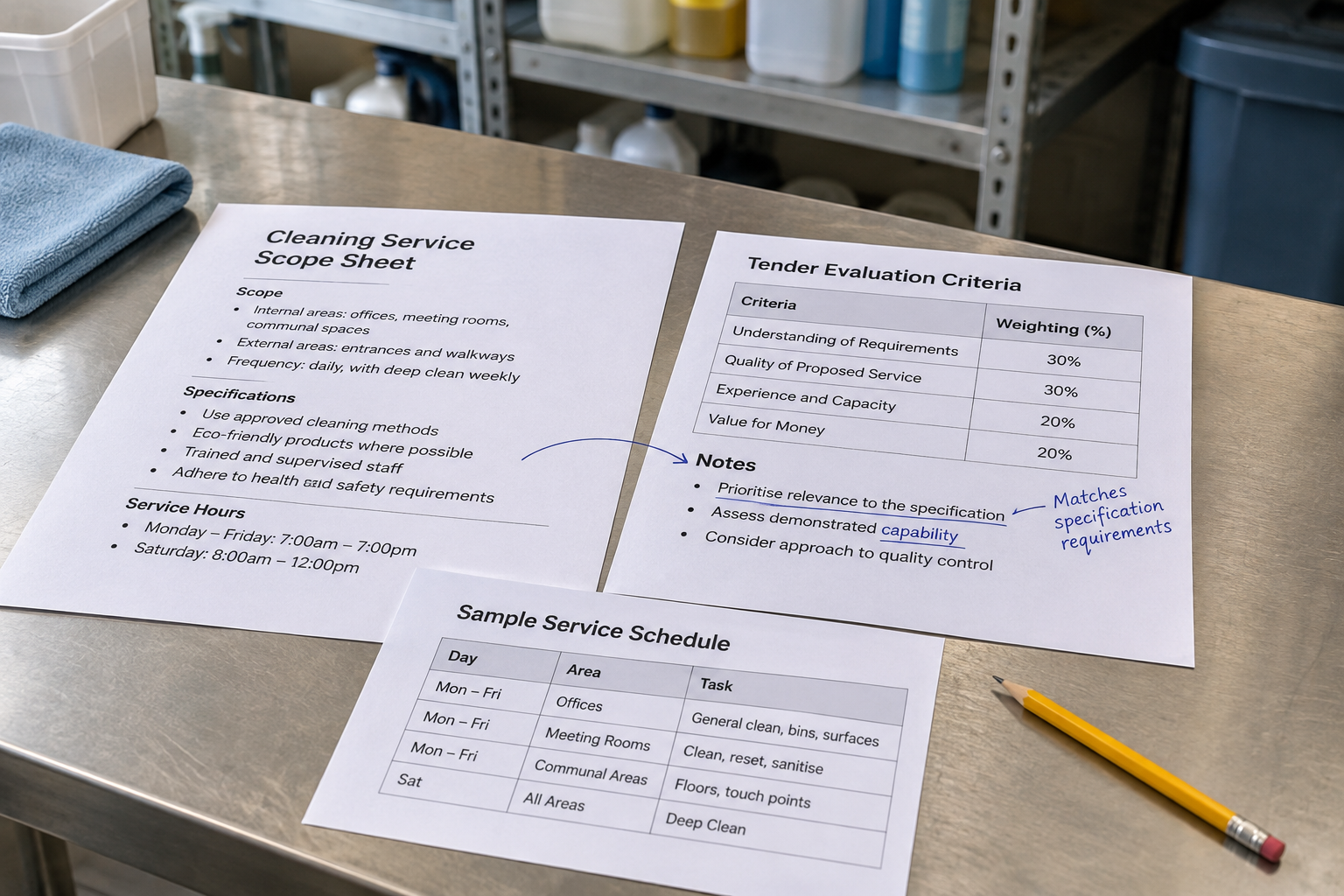
A useful test is to trace every important criterion back to a genuine need in the specification. If a criterion has no clear connection to the purchase, consider removing it. Equally, if a critical requirement has no corresponding check or question, decide how you will establish whether suppliers can meet it.
How Do Specifications, Selection Checks and Award Criteria Differ?
These terms are often mixed together. Separating them makes the tender easier to answer and gives evaluators a clearer route through the submissions.
| Element | Purpose | Illustrative example | Typical assessment |
|---|---|---|---|
| Specification | Defines the required outcome or service | Clean the stated areas at the frequencies in the schedule | Check the response against the stated requirements |
| Selection check | Assesses whether a supplier meets relevant participation conditions | Provide requested information about financial standing | Apply the published check or threshold |
| Mandatory requirement | Sets an essential condition that must be met | Confirm availability during the stated service window | Pass or fail, if stated in the tender |
| Award criterion | Compares the merits of eligible offers | Explain the proposed service and quality-control method | Score against the published rubric and weighting |
| Contract term | Sets an obligation for the contract | Submit a service report at the agreed interval | Check acceptance and manage performance after award |
The precise terminology and rules depend on the procurement. Public-sector buyers should check which regime applies to their procedure, including any transitional provisions. The Procurement Act 2023 and the government’s Procurement Regulations 2024 guidance are useful starting points, but neither replaces advice on a particular procurement.
For private buyers, the same distinctions are still useful even when a different legal framework applies. Set proportionate checks, describe the process you intend to follow and involve legal or procurement advisers where appropriate.
How Do You Turn a Specification Into Scored Questions?
Start with the outcome you need, then identify the risks and evidence that would help you judge each offer. Avoid copying a generic list of criteria without considering whether it fits the contract.
- Define the requirement. Describe the service, deliverable or outcome in terms a supplier can understand. Include relevant volumes, locations, constraints and assumptions where known.
- Identify what matters most. Consider the consequences of failure, the available budget and the differences between supplier approaches that could affect delivery.
- Separate essentials from comparative factors. Use a mandatory check for a genuine minimum and a scored question when you need to compare the quality of different approaches.
- Ask for useful evidence. State whether you want a method statement, a completed schedule, a sample report or another form of response. Explain any relevant limits.
- Write the scoring guidance. Describe what evaluators should look for and how they will distinguish a strong answer from a weak one.
- Check the route through the tender. Make sure each requirement, question and criterion has an owner and that suppliers can find the necessary information.
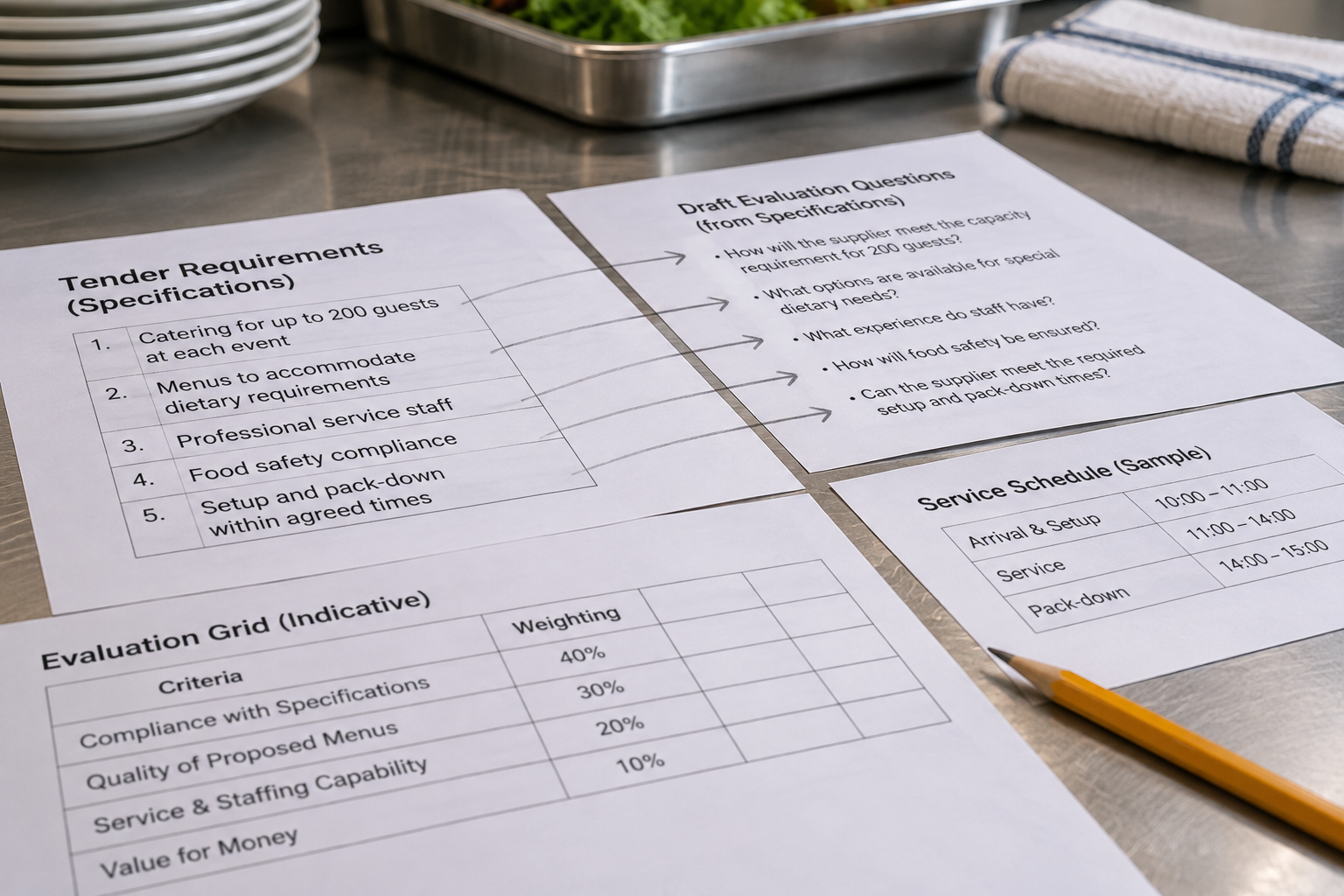
Consider a hypothetical cleaning contract. The specification says that the buyer needs a process for dealing with missed tasks. A corresponding question could ask: “Explain how you will identify, report and resolve a missed cleaning task, including who is responsible and how the buyer will be informed.” The evaluator can then look for a practical process, clear responsibilities and an appropriate communication route.
That is more useful than asking suppliers to say they provide “excellent service”. It also avoids scoring presentation polish alone. If the evaluator needs a particular detail to award a higher score, tell suppliers what they should cover.
For more on drafting the underlying requirement, see how to write a tender specification. To build a wider assessment plan, use the step-by-step guide to tender evaluation criteria.
Which Criteria and Weightings Should You Use?
Choose criteria that reflect the decision you actually need to make. Price is important, but the lowest initial price may not address delivery risk, service quality or costs over the contract term. Other criteria should relate to the purchase and be specific enough to assess from the information requested.
The following is an illustrative weighting for the hypothetical cleaning contract, not a recommended formula for every tender. The figures add up to the whole assessment and show how a buyer might prioritise service alongside cost.
| Criterion | Example weighting | What the buyer could assess |
|---|---|---|
| Price | 40% | Completed price schedule against a stated pricing method |
| Service method and quality control | 30% | Approach to scheduling, checking work and resolving missed tasks |
| Mobilisation | 20% | Practical plan for starting the service and managing handover |
| Reporting and communication | 10% | Proposed contacts, reporting and escalation arrangements |
Before publishing, test the weightings against plausible bid differences. Would a small price saving outweigh a significant weakness in a critical service area? If that would be unacceptable, revisit the balance or consider whether the critical element needs a properly defined minimum. Avoid changing the method after bids have been submitted simply because the outcome is inconvenient.
Also tell suppliers about sub-criteria and their relative importance where relevant to the process. If mobilisation is scored on both a transition plan and staffing arrangements, make clear how each part contributes. Do not quietly treat an unstated preference as decisive.
If you want help turning a brief into structured requirements and weighted criteria, start your first live tender free with TenderLock. No card is required. Your team remains responsible for reviewing the tender and making the final decisions.
How Should You Write a Scoring Method?
A scoring method tells evaluators how to translate evidence into a consistent judgement. It should describe the scale, what each level means, how the score is weighted and how missing or unclear information will be handled under the stated process.
A simple quality scale might run from no relevant response through to a comprehensive, well-evidenced response. Define the levels in terms of the requirement: for example, whether the proposed method covers all requested steps, assigns responsibilities and addresses foreseeable risks. Avoid vague labels such as “good” without explaining what good looks like.

For an illustrative calculation, suppose a quality question is worth 30 points and uses a five-point maximum score. A score of four would contribute 24 points: four divided by five, multiplied by 30. Explain any rounding rule in advance and use the same calculation for every response. The example only illustrates arithmetic; it does not imply that a particular supplier deserves that score.
Price also needs a published method. Some buyers use a formula based on the lowest eligible price, while others use a different approach suited to the purchase. Whichever method you select, specify the price inputs, treatment of optional items, taxes where relevant, and any assumptions. Test the formula with sample prices, including unusually low or high figures, to see whether it behaves as intended.
Keep mandatory checks separate from scored quality wherever possible. If a requirement is genuinely essential, say what evidence establishes a pass and what happens if it is not met. Do not present an item as mandatory in one place and as an optional route to extra points elsewhere.
What Evidence Should Evaluators Record?
An evaluation record should allow someone who was not in the room to understand the decision. For each scored response, record the score, the relevant evidence and a concise reason linked to the published rubric. Identify who assessed it and retain the version of the bid and tender documents used.
Evidence is not the same as an evaluator’s impression. “The response describes a named escalation contact and a process for reporting missed tasks” points to something checkable. “They seem reliable” does not explain which part of the submission supports the judgement. A strong record also notes material limitations in the response rather than only its strengths.
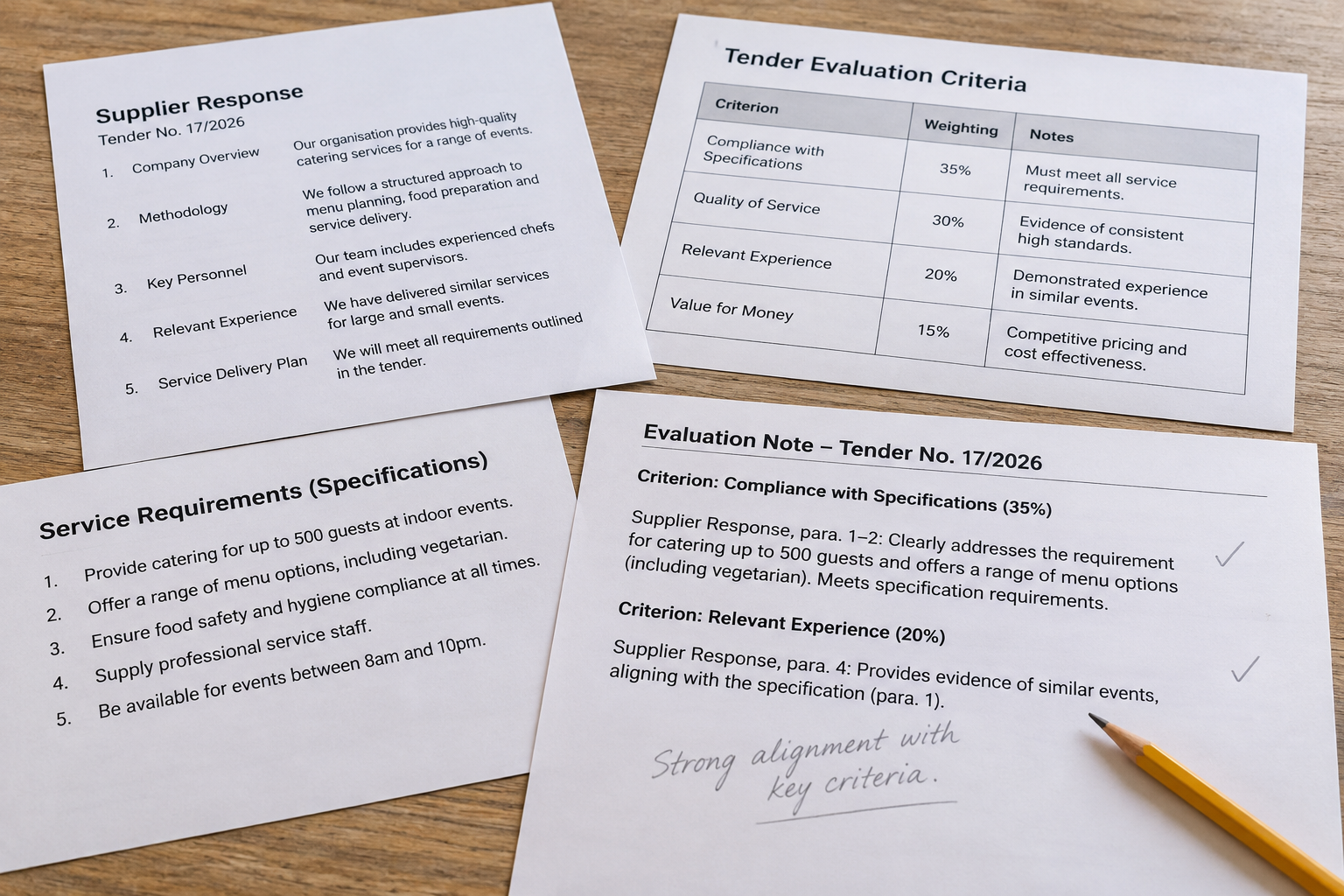
Agree evaluator roles and manage conflicts of interest before opening bids. Independent scoring followed by a documented moderation discussion can help a panel identify differences in interpretation. Record the agreed score and the reasons for it; moderation should not become a way to invent new criteria.
Plan clarifications carefully. Keep a record of the question, response and decision, and follow the rules applicable to your procurement. A clarification should not become an undisclosed opportunity to rewrite a bid or give one supplier an unfair advantage. Where the process permits clarifications, make sure evaluators understand what they may rely on.
A sealed process can support fair handling by keeping bids inaccessible until the deadline. The sealed bidding process walkthrough explains the steps buyers can plan around opening and evaluation.
How Can AI Support Tender Evaluation Without Replacing Judgement?
AI can help organise a lengthy tender, identify potential ambiguity and map supplier responses to individual requirements. It can also help evaluators find the passages they need to review. Those tasks are most useful when the original documents remain accessible and a person can check the proposed mapping.
AI should not be treated as proof that a supplier has met a requirement. A summary may omit context, misunderstand a qualification or point to the wrong passage. Evaluators should read the underlying response, apply the published rubric and document their own rationale. They should also check whether the tender contains sensitive information and follow their organisation’s data-handling requirements.
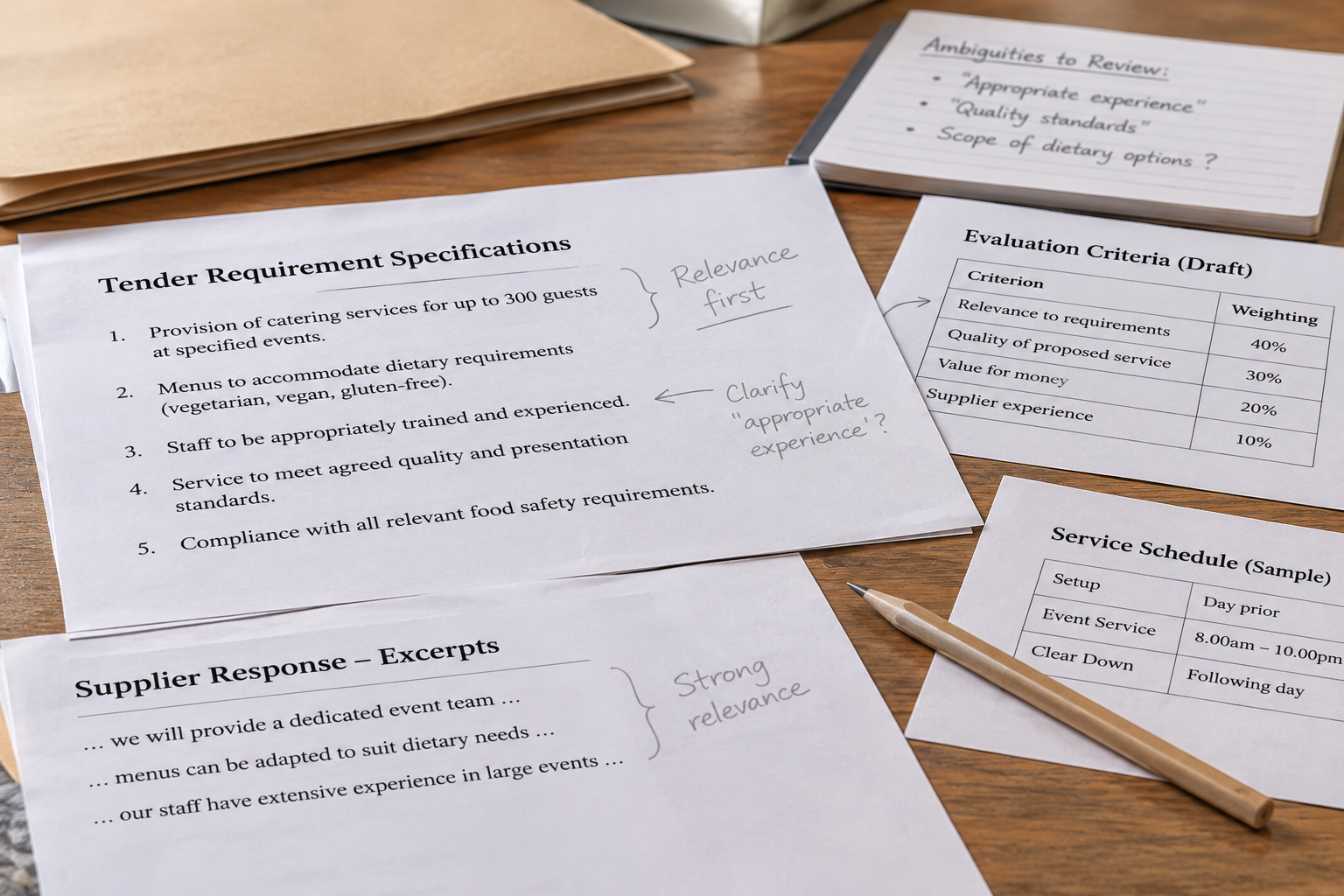
TenderLock supports this workflow by converting plain-English briefs into structured requirements and weighted criteria, offering Red Team reviews for ambiguity and checking responses requirement by requirement. Its evidence-locked evaluation and audit trail are intended to keep decisions connected to the relevant record. Named people make the final decisions.
The platform also includes Companies House and Creditsafe checks, recorded calls with AI summaries, and dashboards. Decide which checks and records are appropriate for the contract rather than assuming a platform feature replaces due diligence. Suppliers invited to respond can do so free.
Video: Planning an Evaluation
For a visual introduction, look for a procurement training video that explains how specifications, weighted criteria and scoring rubrics fit together. Check its date and jurisdiction before applying any legal guidance to your own tender.
Frequently Asked Questions
Should every specification requirement receive a score?
No. Some requirements are better treated as mandatory checks, contract obligations or background information. Score the factors that help you compare eligible offers and that suppliers can meaningfully address in their submissions. For every important requirement, decide how compliance will be established, even if it does not attract a separate score.
Can price be the only award criterion?
That depends on the procurement and applicable rules. A price-only approach may be appropriate where the specification fully defines what is needed and offers can be compared on that basis. It is less helpful if the buyer needs to distinguish between different service methods or delivery risks. Check the applicable regime and make the intended approach clear to suppliers.
How detailed should a supplier response be?
Ask for enough detail to assess the stated criterion, but keep the request proportionate to the contract. Specify the topics to cover, the evidence required and any page or word limits. Give evaluators a corresponding rubric so that they assess relevant substance rather than rewarding the longest or most polished response.
Can criteria be changed after the tender is issued?
Changes can affect supplier effort, fairness and the validity of the process. The options depend on the stage of the tender and the rules that apply. If a change is necessary, take appropriate procurement or legal advice, communicate it consistently and consider whether suppliers need more time. Do not make undisclosed changes during evaluation.
Who should make the final award decision?
A named person or authorised group should make the decision under the organisation’s governance arrangements, using the documented evaluation and any required approvals. Evaluators, subject specialists and AI tools can provide input, but accountability should be clear. Record the decision and retain the supporting evidence in line with the applicable process.
Ready to put your criteria into practice? Start your first live tender free with TenderLock, with no card required.