How to Write a Tender Specification: Practical Answers for UK Buyers in 2026
7 November 2026 · 12 min read

If you need a quick answer to how to write a tender specification: define the problem and outcomes, list measurable requirements, set fair weighted criteria, describe deliverables, milestones and service levels, and lock governance from who can decide to how bids remain sealed. Use plain language, avoid ambiguity, and test the spec with peers or AI before release.
How to Write a Tender Specification
A strong specification is your single source of truth for what you are buying, why it matters, and how you will judge success. Start with the business need: what problem does the organisation have, and what outcome will improve cost, quality, speed or compliance? Keep this problem statement short and objective. Then, translate outcomes into requirements that are testable. For example, “The system must process 1,000 transactions per minute with 99.95% availability measured quarterly,” not “The system should be fast and reliable.”
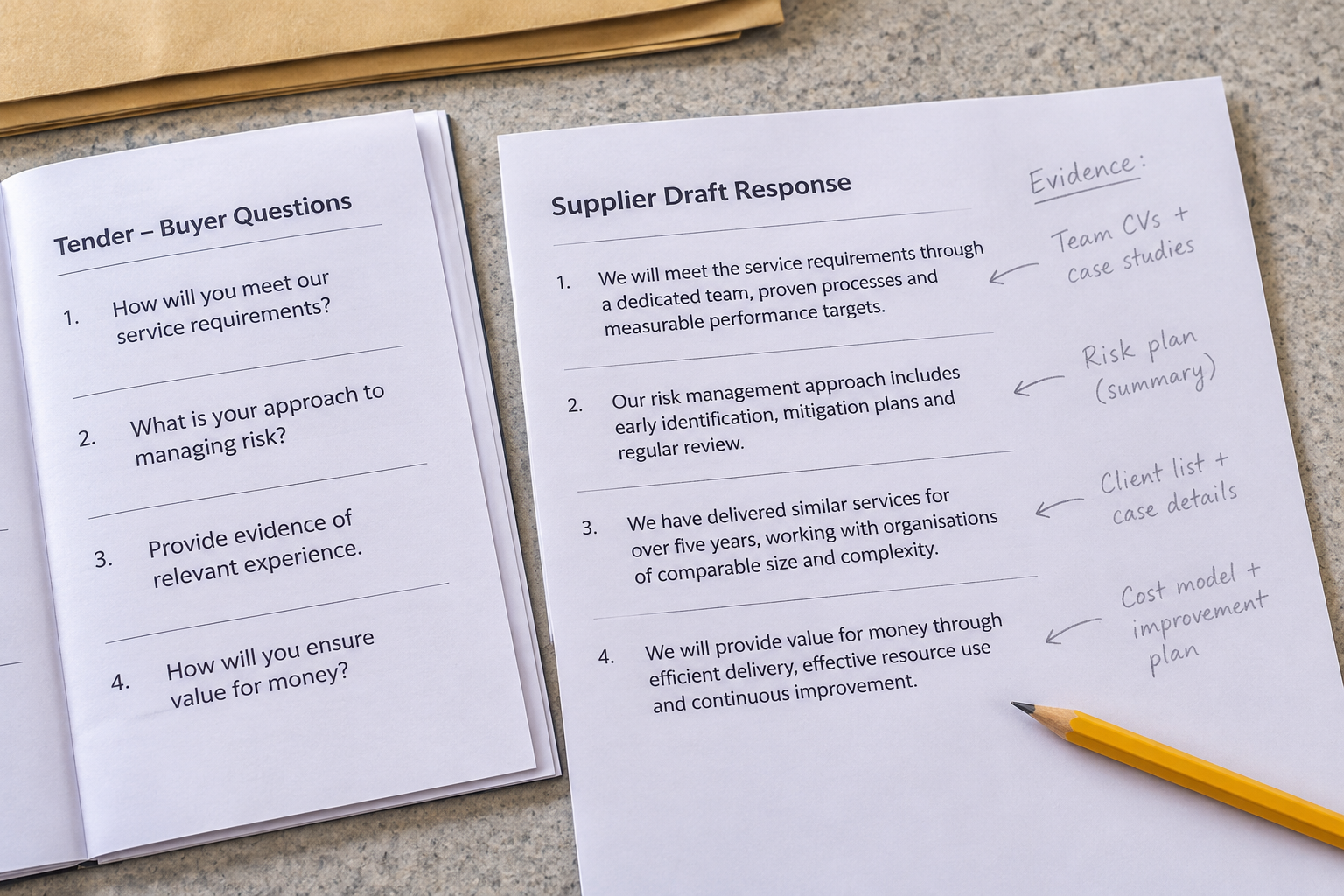
Group requirements into functional (what the product/service must do) and non-functional (performance, security, accessibility, SLAs, sustainability). For each, capture acceptance criteria. This makes it easy for suppliers to respond and for evaluators to score. Next, define your evaluation criteria and weightings. Link each criterion to requirements and to evidence suppliers must provide, so scoring is grounded in facts rather than opinions.
Lock scope boundaries (what’s in and out), delivery responsibilities, and key constraints such as target dates, budget envelope or dependencies on your own teams. Finally, build governance into the document: the evaluation method, who sits on the panel, how conflicts of interest are handled, how questions and clarifications will be managed, and how bids remain sealed until the deadline. Tools like TenderLock can convert a plain-English brief into structured, weighted requirements and keep an auditable trail from brief to award.
What is a tender specification and how is it different from a statement of work?
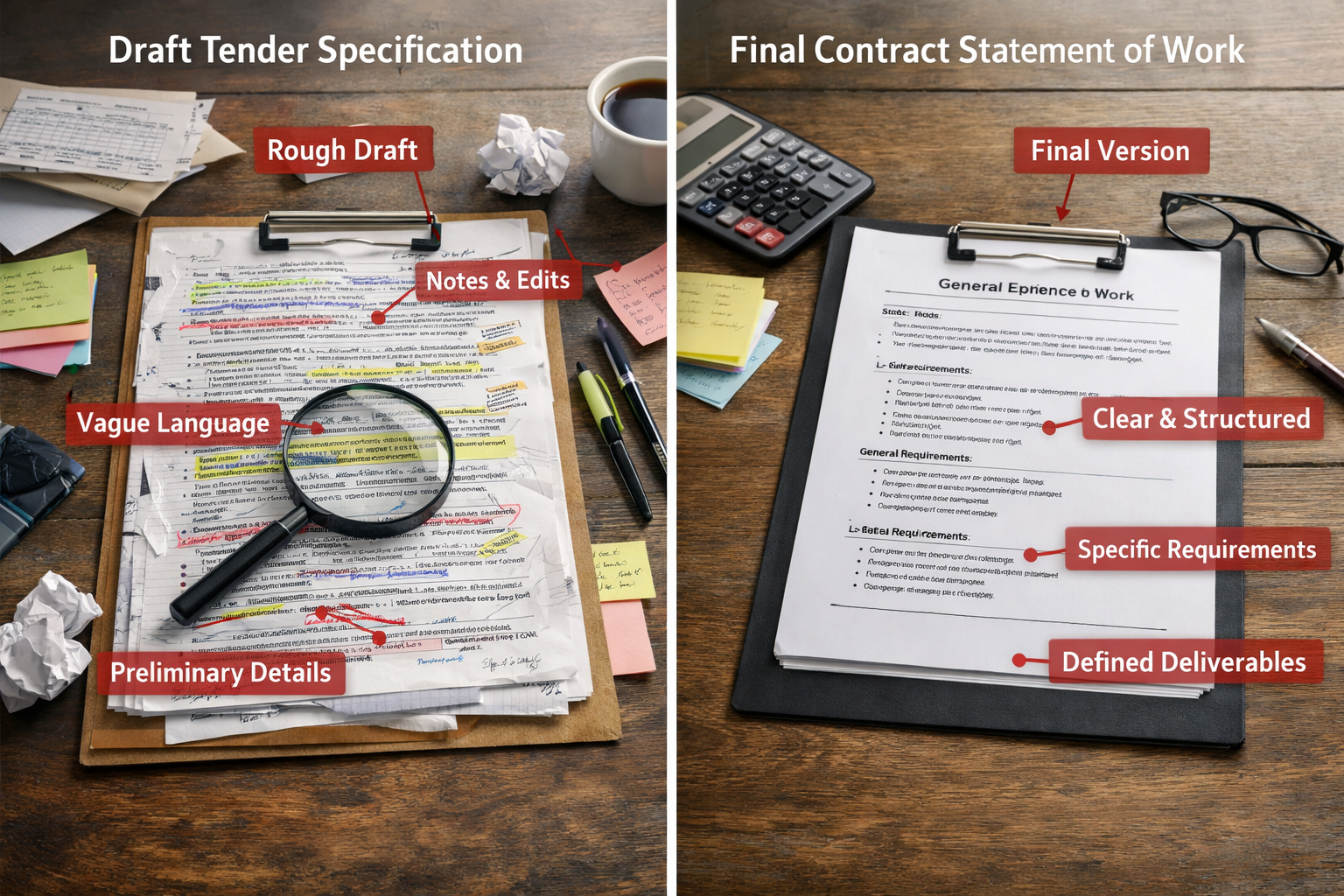
Both documents describe what you need, but they play slightly different roles at different points in the procurement. A tender specification (sometimes called a specification of requirements) is written before supplier selection. It sets out the scope, outcomes, requirements and evaluation model so bidders can propose solutions on a level playing field. It is intentionally vendor-neutral and focuses on measurable needs rather than prescribing a single way to deliver them.
A statement of work (SoW) is usually finalised with the chosen supplier. It translates your selected solution into a contract-ready plan: detailed tasks, milestones, deliverables, acceptance tests, resourcing, change control, and commercial terms. Where the specification must invite competition, the SoW operationalises what the winner will do and how progress will be governed. Many buyers start with a broad specification, then turn the winning bidder’s approved response into a precise SoW by merging deliverables, SLAs and the agreed approach into the contract.
One practical tip: keep the specification outcomes-led to avoid constraining innovation, but include non-negotiable standards (for example, data protection or accessibility) so bidders do not waste time proposing non-compliant options. During evaluation, ensure the SoW remains aligned to the scored offer; avoid expanding scope without formal change control once a supplier is selected.
Which sections should every specification include?
Every effective specification follows a recognisable shape so buyers and suppliers can navigate quickly and respond consistently. The headings can vary by organisation, but the content should cover the same ground. If you are training a team on how to write a tender specification at scale, a stable structure also makes peer reviews and governance simpler.
A practical structure includes:
- Background and objectives: the problem, the current state, drivers (cost, compliance, risk, growth) and desired outcomes.
- Scope and exclusions: what is in, what is out, and any assumptions or dependencies on your organisation or third parties.
- Detailed requirements: functional and non-functional requirements, each with acceptance criteria and references to standards (for example, security or accessibility).
- Deliverables and milestones: what will be delivered when, including formats (reports, training, configurations) and handover expectations.
- Service levels and KPIs: quantifiable targets, measurement methods, reporting cadence and service credits or remediation steps where appropriate.
- Evaluation criteria and weightings: the scoring method, evidence required, and the role/responsibility split of evaluators.
- Commercials: pricing model, cost breakdown requirements, and any constraints (budget cap, indexation assumptions).
- Governance and process: timelines, Q&A rules, clarification windows, sealed-bid handling, conflict of interest statements, and audit trail expectations.
- Legal and compliance: data protection, information security, health and safety (if relevant), and ethical sourcing standards.
- Submission format: how suppliers should structure answers, page/word limits, and documentation or certifications to attach.
When your team keeps to this shape, comparisons are faster and less subjective. It also helps suppliers to provide directly comparable submissions, cutting down clarification cycles and making final award decisions easier to justify to auditors.
How detailed should requirements and evaluation criteria be?
As a rule of thumb, requirements should be precise enough that two independent evaluators would reach the same pass/fail judgement or a very similar score. Avoid adjectives that cannot be measured (“robust”, “world-class”) unless you define what they mean (“withstanding X cycles”, “achieving Y standard”). Where possible, pair each requirement with its acceptance method: demonstration, document review, test results, or reference checks.
For evaluation criteria, balance breadth and depth. Too many criteria dilute focus and invite scoring drift; too few make it hard to separate offers. Many teams use 4–6 top-level criteria (for example, solution fit, implementation approach, service quality, risk and sustainability, and commercial value), each with sub-criteria. Weightings should reflect what truly drives success; if service reliability matters more than small cost differences, give it the weight it deserves and say why in the preamble.
To make scoring reliable, define what “excellent”, “good”, “adequate” and “poor” evidence looks like. That can be as simple as a four-point rubric per sub-criterion, describing observable features. Also, tell suppliers which evidence to include (case examples, accreditations, sample reports) so evaluators are not forced to guess. Evidence‑locked evaluation in platforms like TenderLock helps by binding scores to the cited evidence, making audits in 2026 far smoother.

Step-by-step: From plain‑English brief to structured, weighted requirements
Moving from a sketchy brief to a clear, competitive specification is easier when you follow an ordered workflow. Below is a repeatable pattern you can use today, whether you draft in a document or with an AI‑assisted tool.
- Capture the need and outcomes: write three to five bullet points describing the business problem, the users affected, and the changes you want by date or metric.
- Decompose outcomes into requirements: convert each outcome into functional and non-functional requirements, each with a one-line acceptance test.
- Group and prioritise: cluster related requirements and mark them must/should/could, then decide which clusters drive your top-level criteria.
- Draft the evaluation model: set 4–6 criteria, allocate weightings that reflect risk and value, and design rubrics for consistency.
- Define deliverables and milestones: list what will be produced, in what format, and by when; ensure milestones align with your evaluation model.
- Add service levels and KPIs: specify targets, measurement sources and reporting cadence; include remediation and review points.
- Lock governance: name the evaluation panel (roles, not people if publishing openly), Q&A process, sealed-bid rules, and conflict of interest controls.
- Run a Red Team review: ask peers to hunt for ambiguity or missing assumptions; address anything that could distort bids or scoring.
- Publish and manage clarifications: keep a single public register of Q&A so all bidders see the same information at the same time.
AI can accelerate steps 2–4 by turning natural language outcomes into structured requirements and initial weightings, then flagging vague terms. Platforms like TenderLock add governance by keeping bids locked until the deadline and recording clarifications and evaluation discussions, with AI‑summarised notes to support the audit trail.
If you want to go from idea to audit-ready faster, you can start your first live tender free with TenderLock. You’ll convert a plain brief into weighted criteria, keep supplier responses sealed, and track every decision without needing a card to begin.
Common mistakes and how to fix them
Even experienced teams fall into predictable traps when drafting specifications. The good news: each has a straightforward remedy rooted in clarity and fairness.
- Vague requirements: words like “robust” or “industry-leading” invite guesswork. Fix by adding measurable thresholds or referencing recognised standards.
- Hidden assumptions: internal constraints (data availability, integration limits) left unsaid lead to mispriced bids. Fix by listing assumptions, dependencies and what you will provide.
- Over-prescription: specifying the solution rather than the outcome can stifle innovation and raise costs. Fix by focusing on outcomes and acceptance criteria, with room for alternative approaches.
- Unbalanced weightings: overweighting price compresses quality and risk management. Fix by running a dry-run scoring on hypothetical bids to check whether the model rewards best value.
- Inconsistent scoring: unclear rubrics or too many sub-criteria cause drift. Fix by simplifying the model and training evaluators together before opening scores.
- Late governance: naming evaluators or agreeing conflicts of interest after opening bids undermines confidence. Fix by documenting roles and sign-offs in the specification.
- Weak handover to contract: losing the thread between the winning bid and the SoW invites scope creep. Fix by carrying requirements, KPIs and assumptions straight into the contract with change control.
Imagine a 40-person firm replacing a legacy service desk. Their first draft said “improve response times”. After a peer review, they sharpened it to “respond to P1 within 15 minutes, P2 within 1 hour, 24/7, measured across a rolling 30-day window.” That single change turned a fuzzy wish into a verifiable service level suppliers could price and deliver against.

Governance, fairness and sealed bidding: getting audit-ready in 2026
Across the UK public and regulated sectors, expectations on transparency and fairness continue to rise. The UK Government Sourcing Playbook and public procurement policy emphasise clear requirements, proportionate competition and robust evaluation records. In health, NHS England procurement guidance underlines non-discrimination, transparency and value. Even in private sector buying, the same principles protect you from disputes and help you prove fair dealing.
Sealed bidding is central to perceived fairness. It prevents early visibility of prices or offers that could bias teams. Your specification should state how bids remain inaccessible until the deadline, who can unlock them, and how decisions are recorded. A platform that keeps bids locked, records clarifications, and enforces role-based decision making will reduce human error and strengthen your audit trail. TenderLock, for example, pairs evidence‑locked scoring with recorded calls and AI summaries so every decision has a breadcrumb.
If you are teaching colleagues how to write a tender specification that is audit‑ready, bake governance into the document, not just the process. Include conflict declarations, name decision roles, define your Q&A log rules, and specify how consensus will be reached (independent scoring followed by a moderation meeting, for instance). This way, governance is not an afterthought; it is part of the specification that bidders see and trust.
Should I include supplier vetting and risk controls in the spec?
Yes. You do not need to front-load the entire contract’s diligence, but your specification should signal the vetting threshold and what evidence suppliers must be ready to provide. That might include financial resilience checks (such as Companies House filings and Creditsafe ratings), insurance levels, data protection posture, and relevant certifications. Specify whether you will conduct vetting at selection, award, or contract sign, and how failure affects eligibility.
Risk controls belong in two places. First, in non-functional requirements (for example, information security, business continuity, health and safety where relevant). Second, in the evaluation model (for example, a weighted criterion for risk and resilience, asking for concrete evidence and remediation plans). If a requirement is truly non-negotiable, label it as such and make it pass/fail rather than a scored item.
For a practical checklist, see TenderLock’s Supplier Vetting Checklist (UK, 2026). Adopting a standardised vetting baseline saves time for both buyers and suppliers, and it keeps decisions consistent across tenders by year-end 2026.

Templates, examples and a quick-reference table
Templates help teams write faster and evaluate more consistently. The goal is not rigid paperwork; it is predictable content that allows apples-to-apples comparison and removes ambiguity. If you need inspiration for the evaluation part specifically, our step-by-step guide to evaluation criteria walks through realistic scoring structures and weightings you can adapt.
Use the table below as a quick-reference when drafting. It pairs common sections with their purpose and an example line you can adapt. Treat it as a starter; expand with your context and standards.
| Section | Purpose | Example you can adapt |
|---|---|---|
| Background & Outcomes | Explain the problem and what success looks like | “Reduce average case handling time by 25% by Q4 2027 while maintaining CSAT ≥ 4.5/5.” |
| Scope & Exclusions | Define what is in and out; avoid scope creep | “In scope: UK operations only. Out of scope: legacy on‐premise CRM replacement.” |
| Functional Requirements | State what the solution must do | “Provide omnichannel ticketing with email, chat and phone integration; single queue view.” |
| Non‐Functional Requirements | Set performance, security and quality bars | “Achieve 99.9% monthly availability; WCAG 2.2 AA; ISO 27001 certification or equivalent.” |
| Acceptance Criteria | Define how you will verify outcomes | “Demonstrate 1,000 tpm in UAT with 95th percentile latency < 250ms.” |
| Deliverables & Milestones | Clarify outputs and dates | “Implementation plan, training pack, and cutover checklist by week 6.” |
| Service Levels & KPIs | Make service measurable | “P1 response ≤ 15 mins; P2 ≤ 1 hour; monthly service review with trend analysis.” |
| Evaluation Criteria & Weighting | Explain how you will score | “Solution fit 40%, Implementation 20%, Service 20%, Risk 10%, Commercial 10%.” |
| Commercials | Standardise pricing | “Submit 3‑year TCO split by licence, services, support; note any indexation assumptions.” |
| Governance & Process | Protect fairness and audit | “Sealed bids; panel of 5 evaluators scoring independently, then moderation meeting.” |
| Submission Format | Ensure comparable responses | “Follow the response template; 500 words per question; attach named evidence only.” |
If you are running sealed competition for the first time, this practical guide to sealed bidding shows a start-to-finish flow with governance points to watch. A well-structured specification reduces clarifications and makes moderation calmer because the evidence and rubrics are already set.

Frequently Asked Questions
What’s the simplest way to get started if I’ve never written one?
Begin with three sections: outcomes, scope, and high-level requirements. List measurable results, what’s in/out, and 10–15 musts with acceptance tests. Then draft 4–6 evaluation criteria and rough weightings. You can refine details later. A peer or AI Red Team review will quickly flag vague language before suppliers see it.
How long should a specification be for a mid-sized project in 2026?
Enough to remove ambiguity without drowning suppliers. For a mid-sized service or SaaS buy, 8–15 pages is typical: two pages of context, four to six on requirements and acceptance, one to two on evaluation, plus submission and governance notes. Complex or regulated buys may run longer due to compliance sections.
Do I need different specifications for lots or optional items?
If lots could be awarded separately, treat each as its own mini-spec: outcomes, requirements, evaluation, and pricing per lot. Shared background and governance can sit centrally. This keeps competition fair and lets specialists bid only for what they can deliver well, improving both quality and value.
How do I handle supplier questions without giving someone an advantage?
Publish all clarifications anonymously in a single register and time-box the window for questions. Update the specification only via formal addenda so every bidder works from the same version. Record who approves each answer. A transparent log protects fairness and helps your 2026 audit trail.
What if internal stakeholders disagree on priorities or weightings?
Run a short workshop: stakeholders rank outcomes, you convert them into criteria, then vote on weights before drafting. Test the model against two hypothetical bids to see if it rewards the intended behaviour. Document the rationale so evaluators can explain decisions later with confidence.
Ready to turn your brief into a sealed, auditable competition? Start your first live tender free with TenderLock. Convert plain language into structured requirements, keep bids locked to deadline, and record every decision from brief to award.