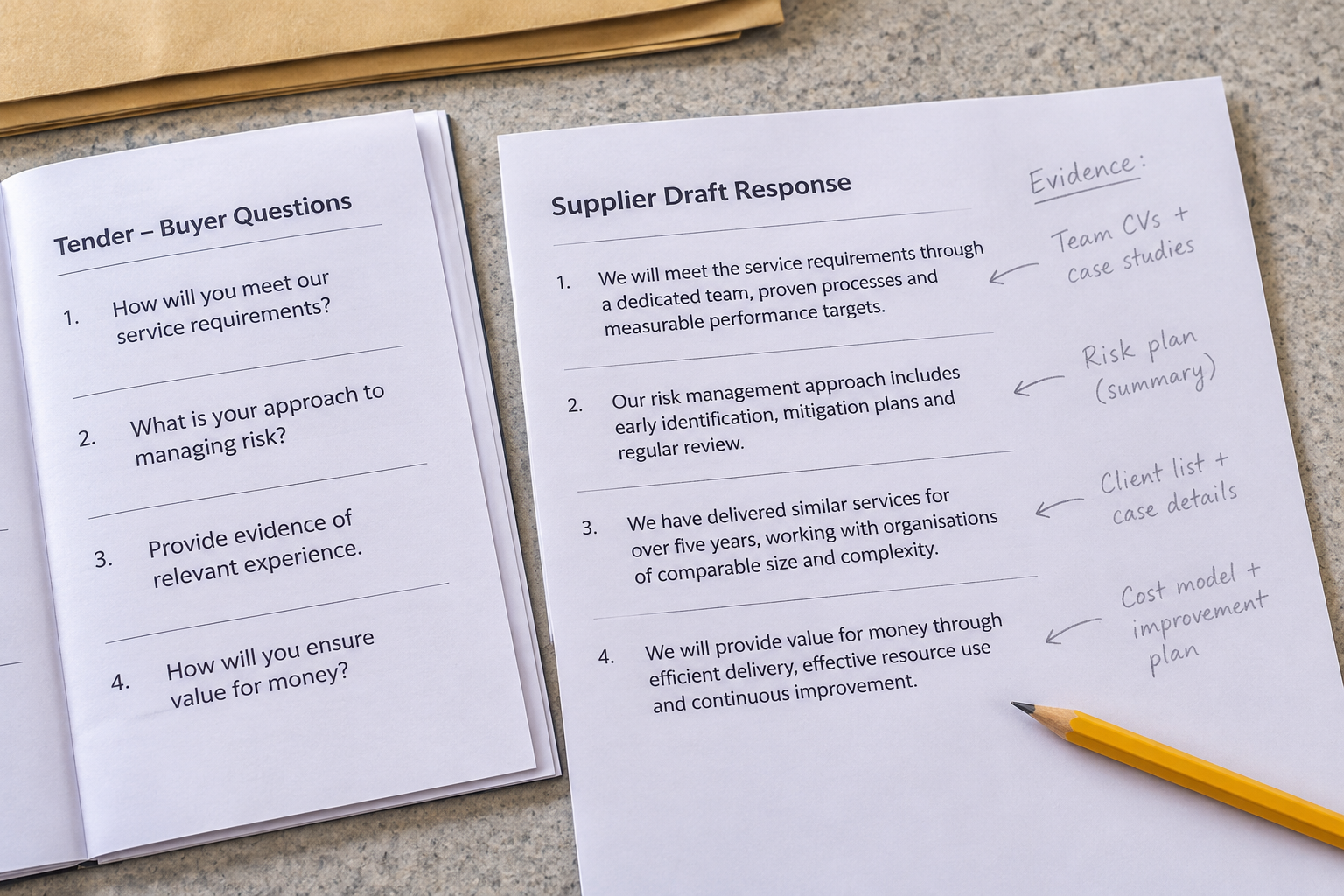

Design and build tender evaluation criteria help buyers compare contractors on more than price. A useful framework tests how well each bid meets the project brief, delivers a buildable design, manages cost and risk, and provides credible evidence of delivery. Set the criteria, weightings and scoring rules before inviting bids, then apply them consistently.
Why design and build tenders need a different approach
In a design and build contract, the contractor generally takes responsibility for both designing and constructing the works, subject to the contract’s precise terms. That combined responsibility can give the buyer a clearer route to delivery, but it also means the evaluation must examine design proposals and construction capability together.
A bid can look attractive on price while leaving important questions unanswered: Is the proposed layout suitable for the people who will use it? Have key technical assumptions been identified? Can the contractor manage its designers and specialist subcontractors? What happens if the design develops differently from the bidder’s initial proposal?

Good criteria turn these questions into a transparent comparison. They should reflect the project’s requirements, the information suppliers can reasonably provide at tender stage and the risks that matter to the buyer. A refurbishment of an occupied building, for example, may place more emphasis on disruption and sequencing than a comparable new-build project on an empty site.
Before drafting the tender, decide which design decisions are fixed and which bidders may propose. Make the status of drawings, performance requirements and assumptions clear. Otherwise, evaluators may end up comparing different scopes rather than different approaches to the same project.
Which design and build tender evaluation criteria should you use?
The right criteria depend on the project, but most frameworks need to cover design, delivery, cost and the team responsible for the work. The table below is a starting point, not a prescribed set of weights. Adapt each criterion to the brief and ask for evidence that is proportionate to the decision.
| Criterion | What to assess | Useful evidence | Common warning sign |
|---|---|---|---|
| Design quality and brief response | How the proposal meets functional, spatial and user needs | Design narrative, drawings and a response to key requirements | Attractive visuals without an explanation of usability |
| Technical and buildability | Whether the design can be coordinated, constructed and maintained | Technical proposals, buildability review and design assumptions | Unresolved interfaces presented as settled |
| Price and cost certainty | Evaluated price, allowances, exclusions and cost assumptions | Completed pricing schedule and qualifications | A low headline price with material exclusions |
| Programme and delivery | Sequencing, milestones, procurement and handover approach | Programme, critical dependencies and mobilisation plan | Dates unsupported by a credible sequence |
| Team and supply chain | Relevant capability, roles, capacity and coordination | Project organisation chart and relevant experience | Unclear responsibility for design coordination |
| Risk and change control | Identification, allocation and management of project risks | Risk register, assumptions and proposed change process | Risks transferred in principle without a management plan |
| Safety and site management | How the bidder plans to manage project-specific site risks | Outline arrangements for access, segregation and coordination | Generic policy text that ignores the site |
| Sustainability and whole-life value | How proposals respond to stated environmental and operational priorities | Material, energy or maintenance proposals tied to the brief | Broad promises without a method or supporting information |
Do not score every topic simply because it appears in a template. If accessibility is central to the project, for example, make it visible within the design criterion or give it a separate criterion. If a requirement is mandatory, explain whether failure means exclusion rather than relying on a high score elsewhere to compensate for it.
For more help connecting questions, evidence and scoring, see the step-by-step guide to tender evaluation criteria.
How do you set weightings and scoring rules?
Weightings communicate the relative importance of each criterion. Start with the project objectives and the consequences of getting each decision wrong, rather than copying a split from another tender. The weight assigned to a criterion should be large enough to influence the result if the difference between bids matters to the project.
Separate commercial evaluation from quality evaluation, but make sure both examine the same scope. Explain how prices will be checked for completeness and how qualifications or exclusions will be treated. A price formula can produce misleading results if one bidder has omitted work that others have included.
Illustrative framework: for a hypothetical community building, a buyer might allocate 35% to price, 25% to design and technical response, 15% to programme, 15% to team and delivery approach, and 10% to risk and change management. These weights total 100%. They are an example, not a recommended split for every project.

Next, publish a scoring scale with definitions. A simple zero-to-four scale can work if the tender explains what each score means:
- 0 — no response: no relevant answer or evidence supplied.
- 1 — major concerns: the response addresses little of the requirement or leaves substantial uncertainty.
- 2 — partially meets: the response addresses some needs but has material gaps.
- 3 — meets: the response addresses the requirement with a credible, sufficiently evidenced approach.
- 4 — exceeds: the response offers demonstrable additional value relevant to the stated requirement.
Define what an improvement means for each criterion. A visually impressive design should not earn an automatic premium if it does not better satisfy the published brief. Similarly, a detailed programme should not score highly merely because it is long; it should show a credible route through the project’s actual dependencies.
For a quality criterion scored out of four, one straightforward calculation is: criterion points = score ÷ 4 × criterion weighting. If a response receives three out of four for a criterion weighted at 20%, it earns 15 weighted points. State any minimum scores, tie-break rules and treatment of abnormal or incomplete prices in advance.
What should bidders submit as evidence?
Ask focused questions that allow suppliers to demonstrate the same things. A request for “your approach to design” is unlikely to produce comparable answers. Instead, identify the project issue, specify the response expected and say how it will be assessed.
For example: “Explain how your proposed layout meets the brief’s access and circulation requirements. Identify any departures, the reason for each departure and its effect on users.” This gives evaluators a clear route from the requirement to the bidder’s evidence and any qualification.
Useful submissions might include:
- A requirements response: a line-by-line statement of compliance, departures and assumptions against the employer’s requirements.
- A design narrative: the rationale behind key choices, supported by drawings at the requested level of development.
- A design management plan: roles, review points, coordination interfaces and how information will be shared.
- A cost schedule: prices, allowances, exclusions and any qualifications in the buyer’s required format.
- A delivery programme: design, approvals, procurement, construction, testing and handover milestones, with dependencies.
- A project-specific risk register: the main risks, proposed owners, mitigation and outstanding information.
Set sensible page limits and file requirements. Asking for detailed design work too early can increase suppliers’ bidding costs without improving the decision. Equally, accepting only a short marketing statement may leave evaluators unable to distinguish between bids. Match the requested detail to the stage of design and the information available.
Use references and supplier checks to corroborate relevant claims, not as a substitute for assessing the response to this project. The UK supplier vetting checklist covers practical checks to consider alongside the tender evaluation.
How do you compare design, price and delivery fairly?
First check that bids are complete and that each submission is being assessed against the same published requirements. Record departures without silently changing a bidder’s price or design. If an answer is unclear, use the clarification process stated in the tender and keep a record of the question and response. A clarification should not become an undisclosed opportunity to rewrite the bid.

Then assess quality responses against the evidence requested. Evaluators should note the relevant page or document, the strength or gap identified and the reason for the score. Where possible, have evaluators score independently before a moderation discussion. Moderation should resolve differences using the published criteria, not average away concerns without discussion.
Commercial review needs equal care. Compare the pricing schedules, allowances and exclusions, and identify where assumptions could affect the buyer’s eventual cost. Consider whole-life costs only where the tender explains the basis and asks bidders for comparable information. If alternatives are permitted, state whether they are scored separately from a compliant base bid.
A hypothetical bidder might offer a lower initial price while excluding a utility connection; another might include it. That is a prompt to check the tender’s pricing instructions and seek an appropriate clarification, not proof that either bid is better. Apply the published treatment of exclusions consistently and document the decision.
Finally, review the combined result for arithmetic errors and confirm that any thresholds have been applied. A high total does not cure failure of a stated mandatory requirement. Check that the award recommendation explains both the result and the evidence behind it.
TenderLock can help structure requirements and weighted criteria, keep bids locked until the deadline and check responses requirement by requirement. Named people make the final decisions. Start your first live tender free; no card is required.
How should you handle legal duties and project risk?
The procurement route and contract determine which rules apply. Public-sector buyers should check the current legislation, any applicable transitional arrangements and their organisation’s guidance before setting an evaluation method. The UK government’s Procurement Act guidance collection is a useful starting point, but it is not a substitute for advice on a particular procurement.
Do not confuse tender evaluation with transferring every risk to the contractor. Bidders need enough information to price their responsibilities, and evaluators need to understand the consequences of the proposed allocation. Review site information, existing surveys, planning assumptions and third-party dependencies before issuing the tender. Identify gaps and explain how they are to be handled.
Safety deserves a project-specific assessment rather than a generic policy check. In Great Britain, consult the Health and Safety Executive’s guidance on the Construction (Design and Management) Regulations to understand the relevant duties. The contract and the arrangements for the project should make responsibilities clear; a tender score alone does not establish legal compliance.

Look carefully at design responsibility and approval language. A buyer’s review of drawings, the scope of the contractor’s design obligations and the process for changes should be understood in the context of the proposed contract. Where matters are material or uncertain, involve appropriate technical, commercial and legal advisers.
Build an auditable evaluation process
Governance begins before bids arrive. Name the people responsible for approving the brief, opening bids, assessing each criterion, moderating scores and making the award decision. Record conflicts of interest and agree how they will be managed. Give evaluators the same instructions, scoring definitions and access to the relevant evidence.
A practical audit trail should contain:
- The approved requirements, evaluation criteria, weightings and scoring guidance.
- The tender documents issued to suppliers and a record of any changes.
- Submission deadlines, opening records and any admissibility decisions.
- Clarification questions and responses, including how relevant information was shared.
- Individual scores, evidence references, moderation notes and final calculations.
- The award recommendation, decision and supplier communications.
Keep the decision record proportionate but specific. “Good programme” is difficult to defend without explaining which milestones, dependencies or mitigation measures supported the score. Equally, an evaluator should identify a material omission rather than rely on an impression that a bidder is inexperienced.
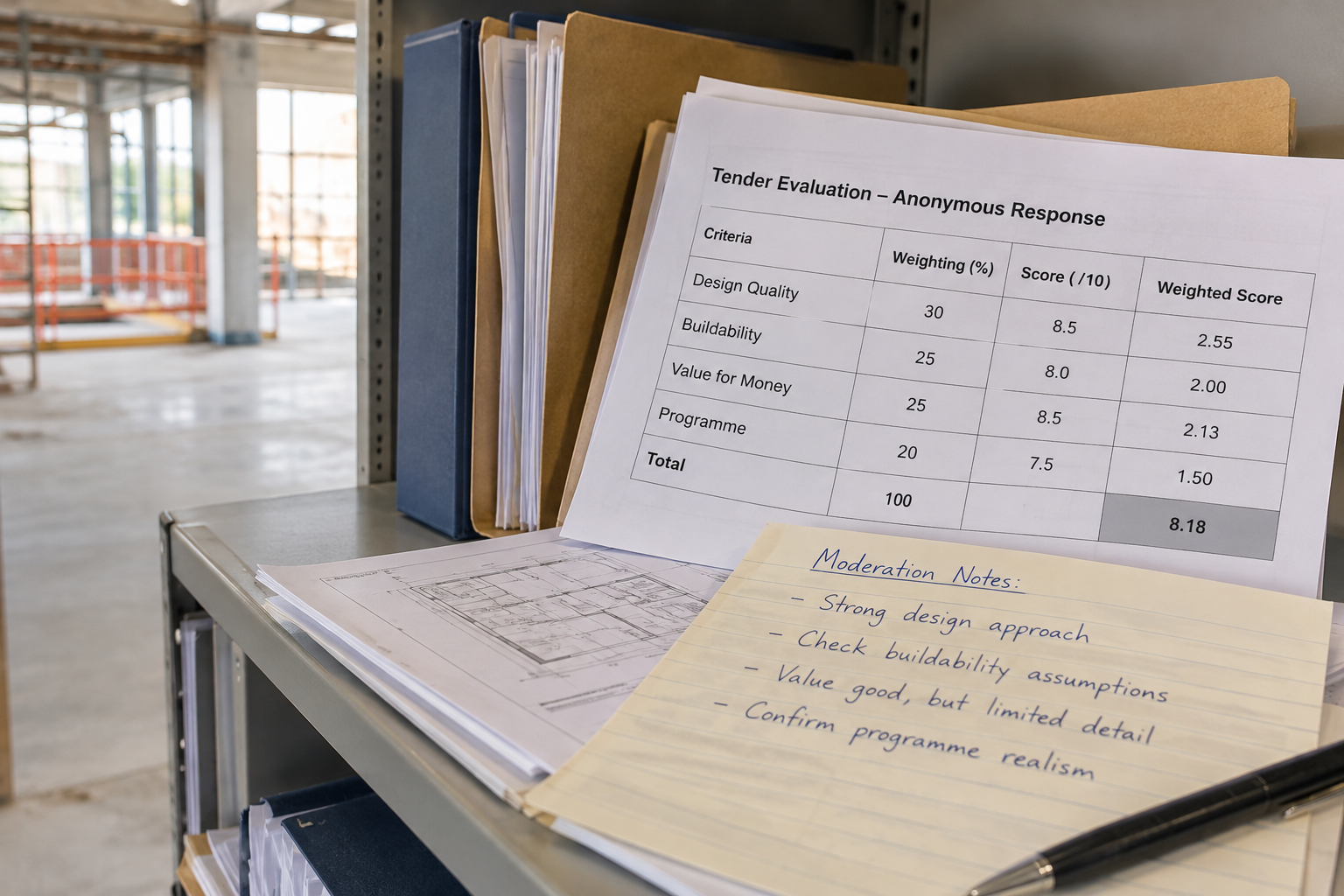
Digital tools can make the process easier to follow, provided the team checks their outputs. TenderLock supports Red Team reviews for ambiguity, evidence-locked evaluation, dashboards and an audit trail. It also offers Companies House and Creditsafe checks and recorded calls with AI summaries. Review any automated output against the source material and keep accountability with the people authorised to decide.
Watch an introduction to design and build evaluation
For a visual introduction, look for explanations that connect the employer’s requirements, contractor design responsibility and the published scoring method. Check the jurisdiction and date of any guidance before applying it to your procurement.
Use the video as background, then return to your own brief and contract documents to decide what evidence bidders should provide.
Frequently Asked Questions
What is the difference between selection and award criteria?
Selection generally considers whether a supplier is suitable to participate, while award criteria compare tenders to identify the preferred offer. The applicable rules and terminology depend on the procurement route. Keep the purpose of each question clear, and avoid using a bidder’s general experience as a substitute for evaluating its proposed approach to the specific project.
Should the lowest price win a design and build tender?
Not necessarily. The published evaluation method determines how price and other criteria contribute to the decision. A buyer may decide that design quality, delivery or other stated factors justify a different outcome. Price must still be assessed consistently, including the treatment of exclusions and assumptions, rather than overridden by an unpublished preference.
How detailed should the design be at tender stage?
Request enough detail to test the requirements and distinguish between bids, without asking suppliers to develop unnecessary work. The appropriate level depends on the project, the design information already available and the procurement route. State which drawings and narratives are required, which assumptions are acceptable and how much flexibility bidders have to propose alternatives.
Can evaluators change the weightings after bids arrive?
Changing weightings after receipt risks undermining the fairness and transparency of the process. Agree and approve the evaluation method before issuing the tender, and follow the applicable rules if a correction is needed. Do not change the method simply because an emerging result is unexpected; seek procurement or legal advice where the position is unclear.
How can AI support the evaluation without making the award decision?
AI can help organise requirements, identify possible gaps and direct evaluators to relevant passages in supplier responses. People should check those outputs against the submitted evidence, apply the published scoring rules and record their judgement. The authorised decision-maker remains responsible for the award; an AI-generated summary is not a substitute for that decision.
Ready to put a consistent process into practice? Start a free tender with TenderLock and build your evaluation around the requirements that matter to your project.