Government Tender Evaluation Criteria: What Good Looks Like in 2026
8 November 2026 · 15 min read
The short answer: government tender evaluation criteria are the transparent, predefined rules and weightings used to score bids fairly against what you actually need. They must trace back to your specification, be published up front, and be applied consistently. Do that well and you drive value for money, reduce challenge risk and make awards that stand up to audit.
What Do We Mean by 'Criteria' in Public Procurement?
When buyers talk about criteria, they mean the specific requirements and scoring measures used to compare bids. At their best, these criteria turn a plain-English need (for example, “we need secure cloud hosting with 24/7 support”) into concrete tests that can be scored consistently: uptime levels, response times, accreditations, migration plan quality, data residency, and total cost of ownership. The more these measures connect directly to outcomes, the stronger your process will be.
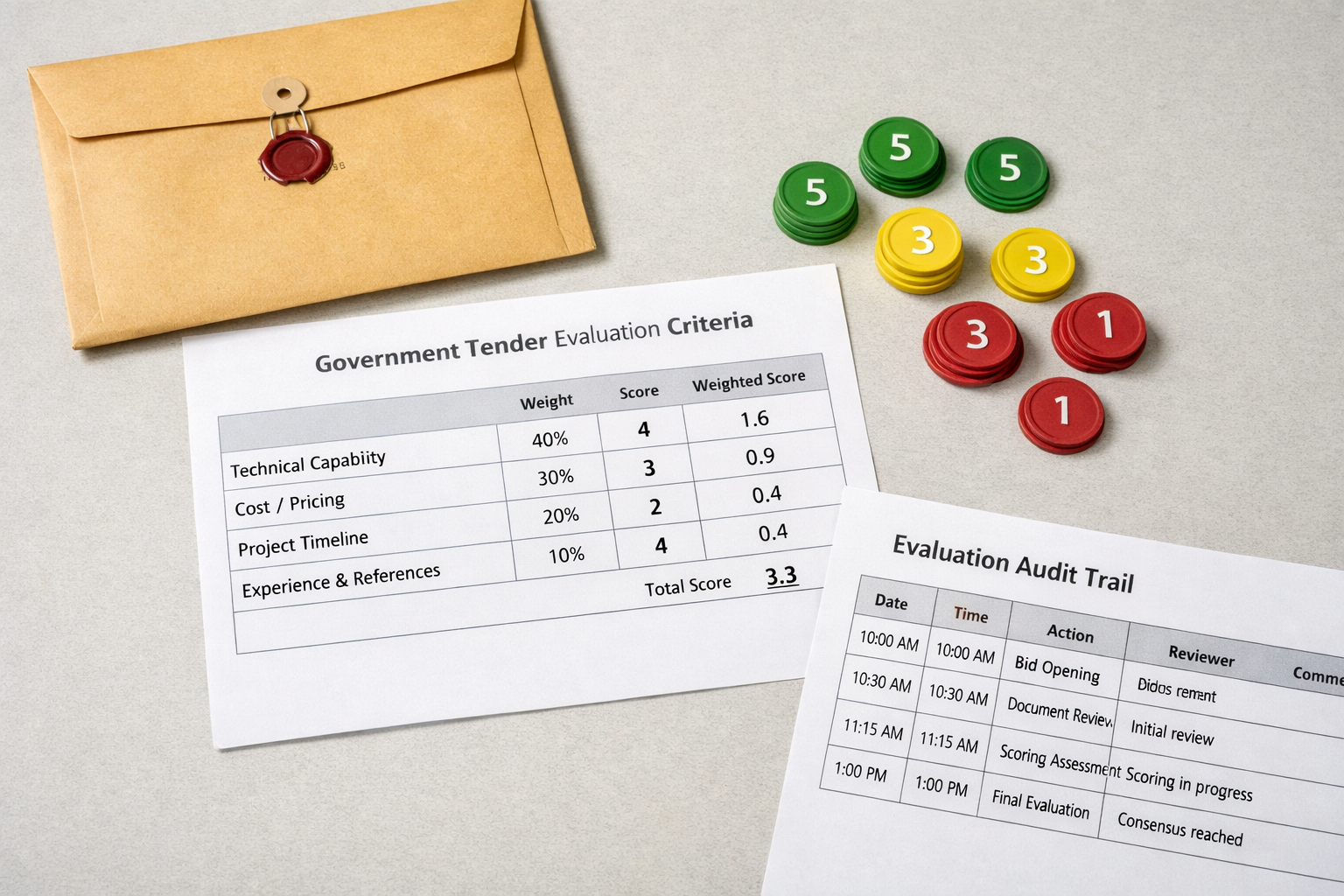
Criteria live at two levels. First, compliance or gateway checks decide who can progress: mandatory declarations, basic financial stability, relevant experience, insurance and any must-have certifications. Second, the award stage compares conforming bids on quality and price, often with sub-criteria like technical merit, implementation, social value and risk management. Each sub-criterion should have clear guidance for evaluators: what excellent, acceptable and inadequate responses look like, with indicative point ranges.
Using government tender evaluation criteria well means being unambiguous about what matters and what carries weight. If resilience, accessibility and data protection are actually crucial, they must surface explicitly as weighted measures, not as vague narrative prompts. Similarly, if ongoing cost is the main driver, that has to be reflected in the price weight and the price-scoring method you will use, stated upfront.

The Law vs Practice: How Policy Shapes Scoring
Public procurement is governed by statute and guidance, but most of the heavy lifting happens in design and discipline. In the UK, the Procurement Act 2023 guidance collection sets the tone: transparency, non-discrimination and value for money. That translates into real-world obligations: publish criteria and weightings up front, apply them consistently, document decisions, and ensure evaluators stick to the stated scheme.
Policy also requires that your evaluation aligns with your objectives. If you commit to social value in the opportunity notice, you must include it explicitly in the scoring model and explain how it will be assessed. Central guidance such as the UK government’s Social Value Model shows one way to anchor qualitative claims in measurable outcomes. Importantly, your team needs to agree on scoring definitions before bids arrive to avoid arbitrary judgements.
Good practice goes beyond compliance. If you say you will run sealed competition, you must actually prevent access to bid content until the deadline passes. If you assert that conflicts will be managed, you must keep a register and record abstentions where relevant. And if you rely on interviews or presentations, those sessions should be scheduled, question sets locked in advance and answers documented to the same evidential standard as written responses. In short, the legal framework tells you what must happen; process discipline ensures it actually does, every time. Thoughtful use of government tender evaluation criteria is what brings those obligations to life.
Myths vs Facts: The Fast Way to Fix Common Mistakes
Too many competitions drift off course because of persistent myths. Use the table below to translate each misconception into practical action today. Share it with your evaluators before they score.
| Myth | Fact | What to Do Now |
|---|---|---|
| We can fine‐tune weights after seeing bids. | Weights and methods must be set and published in advance, then applied consistently. | Lock weightings and price formula before release. Record version control and sign‐off. |
| Lowest price always wins. | Value for money balances outcomes, risk and cost. Quality may outweigh price where justified. | Use a clear price-quality ratio and defend it with outcome‐based rationale. |
| We can ignore a requirement if a supplier is impressive elsewhere. | Non‐compliance against a must‐have is disqualifying or should score zero for that part. | Flag gateways clearly, and apply them uniformly without exceptions. |
| Interview performance can fix a weak written response. | Only if the interview is a stated, weighted criterion with predefined questions and scoring. | Publish interview weight, topics and scoring approach up front. Record every answer. |
| We can keep notes light; we all remember why we scored as we did. | Without evidence, your decision is vulnerable to challenge and internal audit. | Capture requirement‐by‐requirement justification and source evidence for each score. |
| Past relationships should inform scoring; we know who’s reliable. | Only tendered evidence can be scored. Past experience may create bias. | Red‐team for bias, and use named, accountable evaluators who follow the rubric. |
| We can add clarifications that change the ask mid‐way. | Material changes require fair notice to all bidders and may need a deadline extension. | Log clarifications, publish to all suppliers, and extend timelines where appropriate. |
| Using government tender evaluation criteria is a tick‐box exercise. | Criteria are your instrument for achieving outcomes and defending decisions. | Align measures with outcomes, define scoring anchors, and audit adherence rigorously. |
If you do nothing else this week, review your planned criteria against these facts and remove anything vague, overlapping or unscorable. Your evaluators (and your governance team) will thank you.

Where Do Scoring Weights Come From, and How Should You Set Them?
Weights should reflect the relative importance of outcomes, not the convenience of scoring. A practical way to set them:
- Start with outcomes: what must be true for success in year one and beyond?
- Map outcomes to verifiable measures (uptime, error rates, response times, user accessibility, cost‑to‑serve).
- Group measures into sub‑criteria (e.g., Technical Merit, Implementation, Service, Social Value, Risk).
- Run a short structured exercise with stakeholders: distribute 100 points across sub‑criteria, then debate outliers.
- Derive question‑level weights from the sub‑criteria totals and ensure nothing exceeds its parent.
Example. Imagine a 40‑person firm procuring managed network services for three offices. Outcomes: resilient connectivity, swift incident response, predictable costs, and carbon reduction. A plausible split might be 50% quality (Technical 20; Service 15; Implementation 10; Sustainability 5) and 50% price. Under Technical, you may weight response to bandwidth variability higher than optional extras because it impacts daily operations.
Two checks strengthen your model. First, coverage: every important outcome is represented somewhere in the scoring. Second, incentive alignment: would a rational supplier invest effort in the right areas if your weightings were all they saw? If your weights reward glossy case studies more than migration plans, expect the wrong focus. Use calibration: draft two hypothetical responses and see if the stronger one reliably wins under your current scheme.
Do Price-Quality Ratios Decide Everything?
Price-quality splits shape behaviour, but they are not destiny. A 60/40 or 50/50 split is only meaningful if the price method and the quality rubric are both sound. Two common pitfalls derail evaluation even when the ratio is sensible. First, poorly designed price methods amplify tiny price differences into disproportionate point swings. Second, vague quality anchors let evaluators over‑reward narratives that don’t actually deliver outcomes.
Guard against these traps. For price, pick a method that rewards value without creating cliff‑edges. Linear normalisation (lowest price gets full marks; others score proportionally) is simple, but can overweight marginal savings on very low values. You can mitigate with outlier checks or by disclosing any caps or minimum viable specifications. For quality, write explicit scoring anchors: what evidence demonstrates “excellent” (full marks) versus “acceptable” (mid) versus “weak” (low). Include must‑have thresholds where appropriate.
Also consider lifecycle, not just purchase price. Total cost of ownership can include transition, training, consumables, integrations, exit, and supplier‑side learning curves that affect performance. If your ratio is balanced but the questions ignore these real costs, you haven’t modelled value for money; you’ve only modelled chapter one of the story. When in doubt, revisit whether the ratio and the criteria jointly reward what will matter in month 18 on a rainy Friday.

How Should government tender evaluation criteria Be Built in Practice?
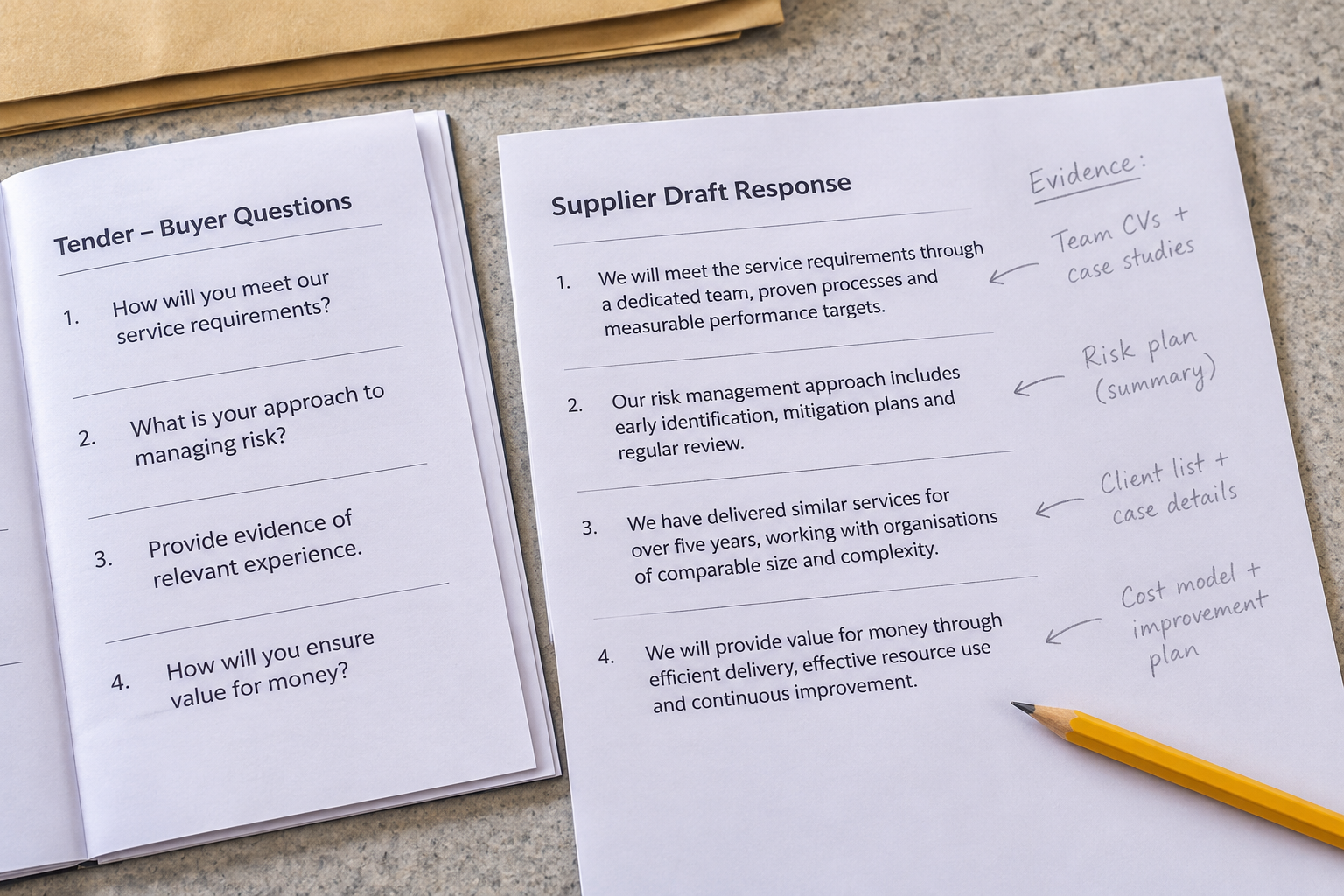
Start by translating your needs into structured requirements. Write each as a verifiable statement (“Supplier must maintain ISO 27001 certification”, “Respond within 30 minutes to P1 incidents”). Next, add measurable evaluation prompts: “Describe how you will achieve X; show evidence Y; provide metric Z.” From those prompts, extract scoring anchors so assessors know what earns full, mid and low marks—then test them with a dry run.
Sequence matters. Lock your compliance gateways first (eligibility, certifications, insurances), then finalise award criteria and sub‑criteria with weights. Publish both alongside the opportunity and keep a change log. Decide how you will score price and social value; for the latter, use recognised models where relevant and fit for purpose. Pre‑agree interview topics, demonstration scripts or site visits if you will use them, and state their contribution to the total score.
During evaluation, keep names accountable: assign each requirement to a primary and secondary assessor, then run calibration sessions before individual scoring to align expectations. Meeting records should capture who saw what, when. Finally, compile a decision record that traces every score back to evidence. This discipline keeps your competition defensible and your award recommendation easier to sign off.
What Does 'Sealed' Really Mean, and Why Does It Protect You?
Sealed competition is more than a promise not to peek. It is a set of controls that prevent access to commercial or technical content until the deadline has passed and all submissions are locked. That includes audit trails showing who could access what and when, immutable timestamps, and procedures for late submissions. It also includes controls that segregate roles so that no single person can both unlock bids and alter criteria or weights.
Why it matters: fairness and trust. If suppliers believe content can be seen and reacted to mid‑competition, the whole market loses faith. Buyers also risk internal pressure to “just check” a price or a capability early—pressure that good process removes. A sealed process makes challenge less likely because you can prove nothing changed once the starting pistol was fired.
TenderLock is designed to keep bids locked until the deadline, enforce role‑based access, and produce a full audit trail of every view and change. It also checks each supplier response requirement‑by‑requirement against your prompts, so you can assess evidence rather than guess intent. Ready to try this safely? Start your first live tender free—no card required.

Red Teaming, Clarifications and Bias: How to Keep the Process Clean
Clarity is the antidote to both bias and challenge. A Red Team review—an internal or peer group whose job is to break your documents—catches ambiguity before suppliers do. They will ask: can a reasonable bidder misread this requirement? Does any question invite a sales brochure instead of verifiable evidence? Are there overlapping prompts that will double‑score the same thing? You should apply the same scrutiny to your scoring anchors and interview scripts.
Clarifications must be public, time‑stamped and visible to all bidders. The minute a question establishes that your requirement was unclear or materially incomplete, issue an addendum and consider extending the deadline. Resist the urge to fix a design flaw through private communication; even the appearance of unequal treatment can draw a credible challenge.
Then consider bias. Scoring in panels helps, but it is not a cure‑all. Do conflict of interest declarations early and refresh them before evaluation; record recusals. Rotate who leads on high‑risk sections to reduce personal influence. Calibrate together; score individually; then reconcile. And ensure interviewers stick to predefined questions and evidence standards, not charisma or brand familiarity. Tools that lock questions and capture recordings with time‑stamped notes make this easier and more auditable.
Governance, Evidence and Audit: What Stands Up to Scrutiny?
Auditable decisions have three traits: traceability, sufficiency and proportionality. Traceability means each score links to a specific piece of tendered evidence or an agreed observation from an interview or demonstration. Sufficiency means the record explains why that evidence was persuasive against the published scale. Proportionality means the documentation is detailed where risk is high (for example, security, safety, or major expenditure) and concise where risk is low.
Third‑party checks are part of the story. If financial resilience matters, set out what you will check and how you will interpret the result. For UK buyers, basic identity checks are supported by Companies House guidance on company information and commercial credit tools; just be clear which thresholds are gateways versus scored considerations. Any such checks should be applied equally and recorded alongside the evaluation, not as off‑book lore.
TenderLock supports evidence‑locked evaluation: assessors score requirement‑by‑requirement with visible anchors, and their notes are tied to the source text, document or interview timestamp. Recorded calls include AI summaries for governance while keeping named people responsible for the final decision. Dashboards show progress, conflicts and deadlines; the audit trail logs every action. This gives governance teams a single source of truth when they review awards before approval and if questions arise months later.

From Plain English to Scorable Measures: A Repeatable Method
Vagueness is the arch‑enemy of fair scoring. A repeatable translation method keeps you honest:
- Write outcomes in plain English. “Keep staff productive when connectivity fails.”
- Turn outcomes into requirements. “Supplier must provide automatic failover within 60 seconds with no manual intervention.”
- Create prompts that elicit evidence. “Describe failover design, include topology diagram, describe detection thresholds, provide metrics from a live client.”
- Define scoring anchors. “Full marks: architecture, thresholds and metrics align; evidence from live deployment is provided; risks addressed. Mid: partial detail or unclear evidence. Low: generic claims, no metrics.”
- Test with a hypothetical weak and strong answer. If both score the same, your anchors need work.
Do this for each critical area—security, service, migration, exit—and you’ll get defensible, comparable scores. If you struggle to express an anchor, that’s a red flag that the requirement itself might be unclear. Revisit it before going live. For further inspiration on shaping strong measures, see our guide to tender evaluation criteria examples with practical comparisons.
Supplier Vetting and Risk: Where It Fits Without Double-Counting
Vetting lives in two places. As gateways, it ensures only eligible, capable suppliers progress—identity, sanctions, insurance, core accreditations, minimum financial health. As scored risk, it examines the bidder’s approach to delivery risk, security, data protection, subcontractor management and exit planning. Avoid double‑counting by deciding which aspects are pass/fail and which are scored for quality.
Keep thresholds realistic and proportionate to the contract value and risk. Outline how you’ll handle borderline cases before bids arrive (for example, a supportable plan to reach a certification by go‑live). If you use credit scores, specify the source and any mitigations you would consider if a score is marginal but the overall proposition is strong.
If you need a detailed checklist to structure your approach, our Supplier Vetting Checklist UK lays out practical steps with UK‑specific references so you can be thorough without over‑engineering the process.
How to Avoid Scope Creep in Clarifications and Negotiations?
Clarifications exist to ensure understanding, not to redesign the requirement on the fly. If your answer to a supplier question materially changes risk, effort or deliverables, you owe every bidder the same information and usually a time extension. Keep a running change log that differentiates between true clarifications (no material effect) and addenda (material change). This log becomes part of your audit record and protects you in case of complaint.
Where permitted, negotiations or best‑and‑final rounds must be grounded in the published criteria. You can explore how suppliers will meet outcomes and improve value, but not introduce a brand‑new scoring dimension that others didn’t prepare for. In practice, this means preparing a negotiation plan that maps questions to existing sub‑criteria, and capturing all interactions with the same evidential discipline as written responses, including attendance lists and time‑stamped notes.
Finally, avoid moving deliverables across phases to “fix” affordability without updating the commercial model. If a feature is now post‑go‑live, re‑model the price, risk and service measures so your scoring still reflects the contract you intend to sign. Otherwise, your evaluation ceases to mirror the deal, and governance rightly pushes back.
How Do Tools Help Without Replacing Human Judgement?
Software should enforce process and surface evidence; people should make the decision. The best tools convert plain‑English briefs into structured, scorable requirements; prevent early access to submissions; and guide assessors through consistent, anchored scoring. They also log every action for audit and make it easy to trace a score to its source evidence or interview timestamp.
For example, TenderLock uses AI to draft structured requirements and weighted sub‑criteria from your brief, runs sealed tenders with immutable timestamps, and checks supplier responses requirement‑by‑requirement. Red Team reviews catch ambiguity; Companies House and Creditsafe checks sit alongside your evaluation record; and recorded calls are summarised for governance while ensuring named people make the final decisions. If you’re new to sealed processes, our walkthrough on the sealed bidding process demystifies every step.
Crucially, the platform doesn’t decide the winner—you do. It standardises how evidence is captured and presented so your panel can score consistently, reconcile differences, and recommend an award that stands up to internal and external scrutiny. That’s the partnership that works in practice: automation for discipline, humans for judgement.
Frequently Asked Questions
What is the difference between gateway checks and award scoring?
Gateway checks determine basic eligibility—identity, financial stability thresholds, mandatory certifications and declarations. Only suppliers who pass those gates proceed. Award scoring compares conforming bids on qualitative and price measures aligned to your outcomes. Both stages should be published up front, but gateways are pass/fail, while award measures allocate points against defined anchors.
How many evaluators should score each question?
Two is often a practical minimum for balance, with a third for tie‑break or specialist areas. The key is calibration: agree scoring anchors before you begin, score independently, then reconcile with evidence‑based discussion. Keep named accountability for each section and record rationales. Larger panels can help, but process discipline matters more than headcount.
Can interviews or demos be used to change scores?
Yes—if they were published as part of the evaluation method with a defined weight, topics and scoring approach. Keep question sets consistent across suppliers, record sessions, and tie notes to the same anchors you use for written responses. Avoid charisma bias by focusing on demonstrable capability and evidence observed during the session.
What documentation should we keep for audit?
Maintain the specification, published criteria and weights, change logs, conflict declarations, clarification log, sealed submission evidence, individual and reconciled scores with rationales, interview records, financial and identity checks, and the final award recommendation. Ensure traceability: each material score should link to specific tendered evidence or observed proof captured during evaluation.
How do we handle a supplier challenge after award?
Respond transparently with your published method, the scoring record and rationale tied to evidence. Review whether any material clarifications were not shared equally or whether a scoring anchor was misapplied. Where an error is found, follow your governance process—this may include rescoring or re‑running a stage. Strong documentation shortens and strengthens your response.
If you want to run a fair, sealed and fully auditable competition without heavy admin, start now. Open your free TenderLock tender and turn a plain‑English brief into a governed, scorable process in minutes.