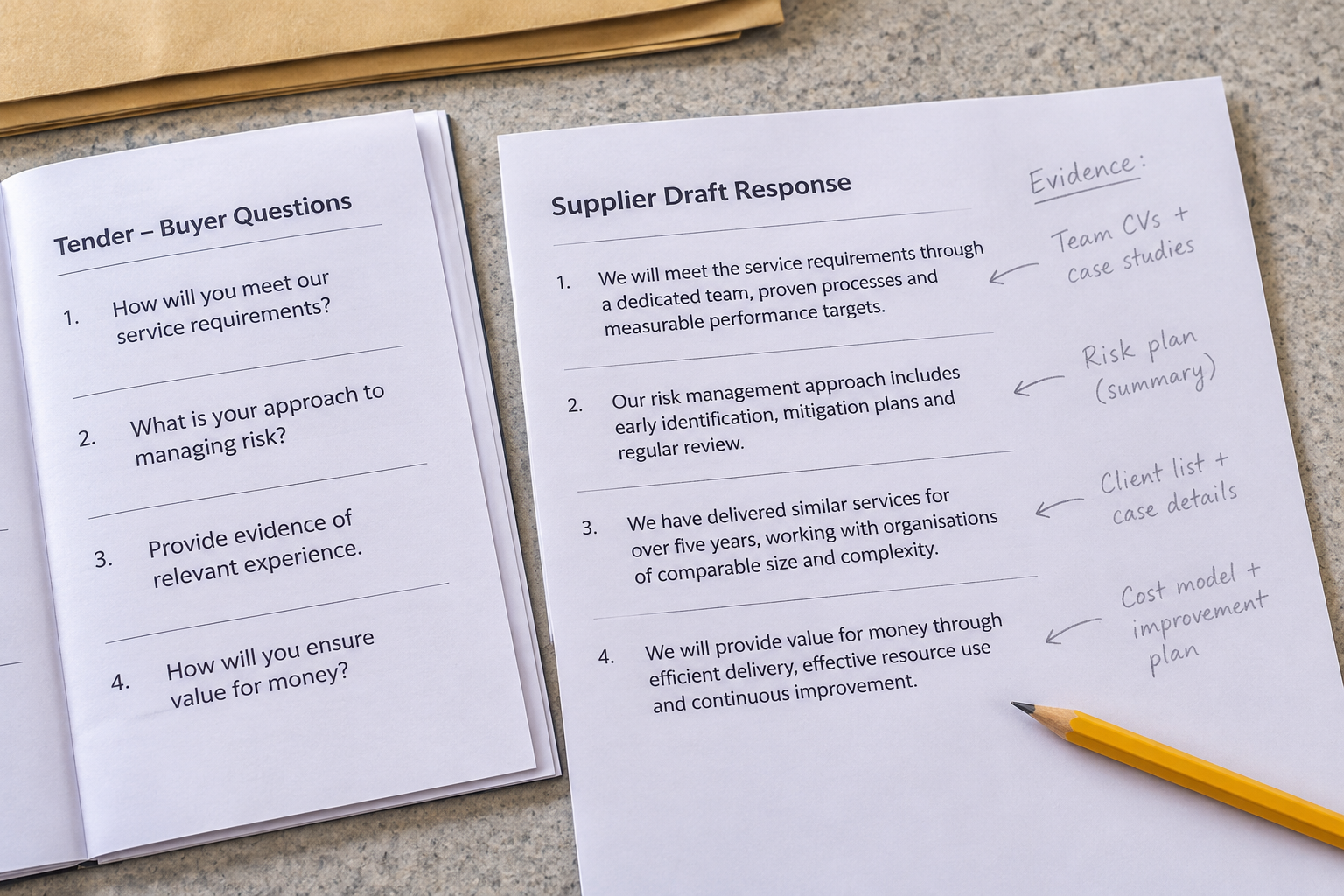

To understand how to write a tender for a job, start by defining the work, the outcome you need and the information suppliers must provide. Then set fair evaluation criteria, explain the timetable and contract terms, and invite comparable bids. A good tender gives suppliers enough detail to price and plan the work without prescribing an unnecessary solution.
1. What Does Writing a Tender for a Job Mean?
In this guide, writing a tender means preparing an invitation for suppliers to bid for work. The buyer describes the job and asks potential suppliers to explain how they would deliver it and at what price. The buyer then assesses those responses against the published requirements and criteria.
This is different from writing a tender response: that is the supplier’s proposal in answer to the buyer’s invitation. If you have been invited to bid, our guide to writing a tender bid explains the supplier’s side.
A tender can be useful for a one-off job or an ongoing service. The depth of the documents should reflect the value, complexity and risk of the work. A small, straightforward assignment may need a concise brief and pricing form; a complex project may also need detailed specifications, implementation plans and specialist review.
Before drafting, identify who can approve the budget, who understands the work and who will evaluate the responses. If the procurement is subject to public-sector or other regulated rules, check the applicable requirements before choosing your process. This guide is practical guidance, not legal advice.

2. Define the Job and Its Boundaries
Write a short statement of the problem and the outcome you want. Avoid starting with a long list of tasks before you understand what success looks like. For example, a buyer might need a supplier to maintain a set of business premises safely and respond to faults within agreed times.
Then turn that outcome into a scope. Include the locations, assets, users or volumes involved where relevant, and distinguish between what is included and what is not. Identify dependencies: perhaps the buyer will provide site access, existing documentation or a named contact. Make clear which details are confirmed and which are estimates.
Hypothetical example: A growing business wants to tender for office cleaning across two sites. Its brief could state the areas to be cleaned, expected service days, access restrictions and the supplies each party will provide. It should also identify any specialist cleaning that falls outside the routine job.
Consider adding these points to your scope:
- Background: why the work is needed and any relevant existing arrangements.
- Deliverables: the services, documents or completed work the supplier must provide.
- Boundaries: exclusions, interfaces with other suppliers and buyer responsibilities.
- Timing: the expected start, key milestones and anticipated contract duration.
- Constraints: access, safety, confidentiality or operational requirements.
Ask someone who knows the job to check the scope, and someone less familiar with it to read it for missing context. If either person needs to make assumptions, suppliers probably will too.
3. How Do You Turn the Scope Into Clear Requirements?
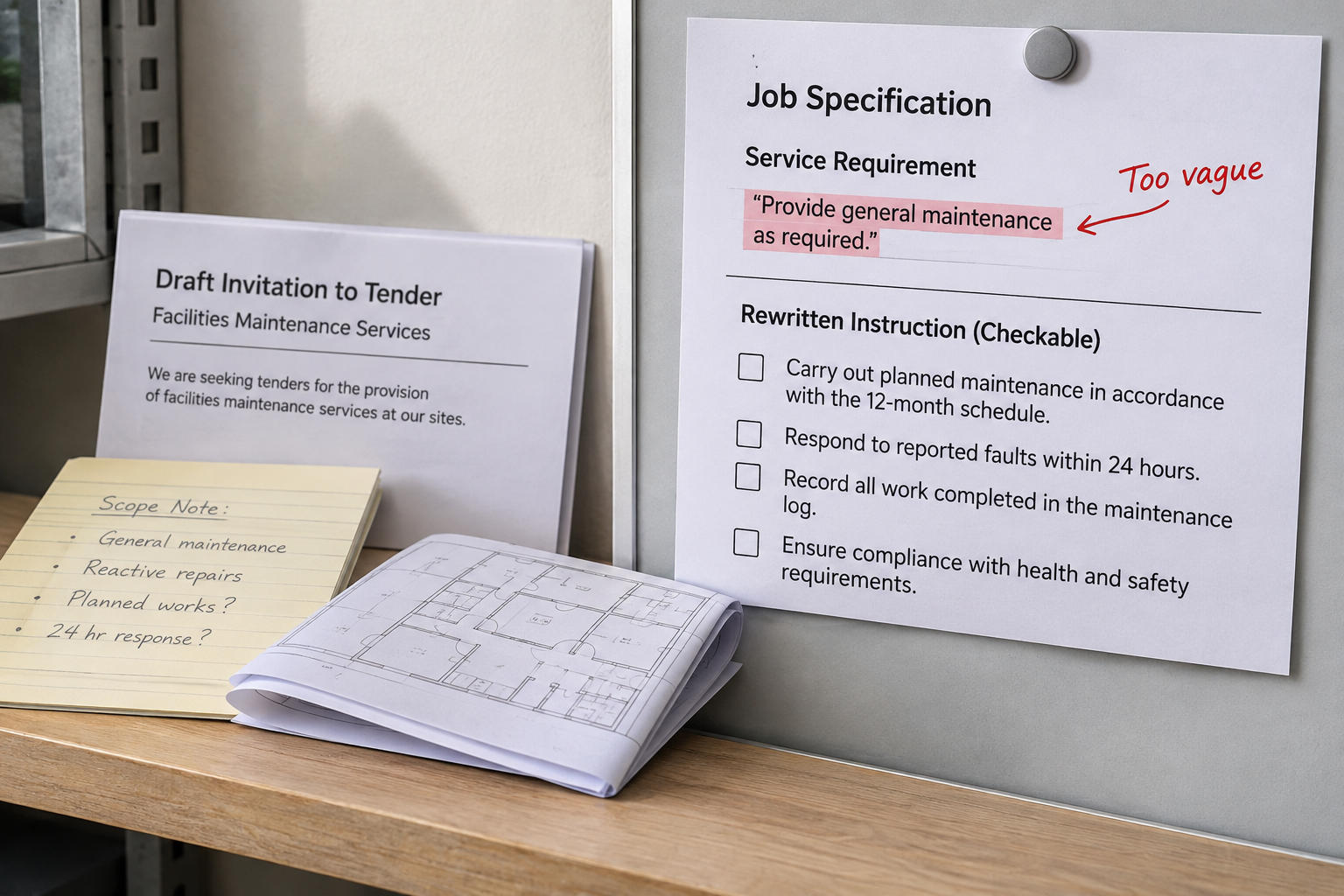
A requirement tells suppliers what they need to provide or demonstrate. Make each one specific enough to check, relevant to the job and proportionate to its risks. Separate essential conditions from preferences so that bidders know what is compulsory and evaluators know what they are assessing.
For example, “provide a reliable service” leaves room for different interpretations. A more useful requirement might ask the supplier to explain its process for reporting and responding to urgent faults, with proposed response times and escalation contacts. If a particular response time is essential, state it explicitly and explain how compliance will be assessed.
| Element | What to include | Hypothetical cleaning job example |
|---|---|---|
| Outcome | The result the buyer needs | Clean, usable offices ready for the working day |
| Scope | Work, locations and exclusions | Routine cleaning at two offices; specialist carpet cleaning excluded |
| Requirement | A clear obligation or capability | Provide a proposed cleaning schedule for each site |
| Evidence | What the supplier must submit | A sample schedule and description of cover for staff absence |
| Assessment | How the response will be judged | Assess whether the schedule covers the stated areas and access times |
Where possible, specify the outcome rather than a particular brand or method. If compatibility with existing equipment matters, explain the reason and describe the requirement accurately. Avoid asking for evidence that you do not intend to use: every extra question takes time for suppliers to answer and for your team to assess.
For a deeper look at drafting measurable requirements, see how to write a tender specification.
4. Set Evaluation Criteria Before Inviting Bids
Decide how you will choose the successful supplier before sending the tender. This helps you ask for the right evidence and gives bidders a fair understanding of what matters. Your criteria should reflect the job rather than a generic wish list.
Common criteria include price, approach to delivery, relevant experience, mobilisation and risk management. You might also assess service cover or quality control when those are important to the work. Use subcriteria if they make the assessment clearer, and publish the criteria and their relative importance as appropriate to your process.
Hypothetical example: For the cleaning job, a buyer could weight price at 40%, the proposed service approach at 35%, staffing and cover at 15%, and mobilisation at 10%. These are illustrative choices, not recommended universal weights. The buyer should select weights that reflect its own priorities and explain how each criterion will be scored.
Make the scoring method usable. Define what a strong, adequate or weak answer looks like, and explain whether missing an essential requirement makes a bid ineligible. For price, specify the pricing basis and calculation method in advance. Decide how you will treat optional items, assumptions and unusually low or incomplete prices.
Choose evaluators with relevant knowledge and identify any conflicts of interest before bids are reviewed. Plan a moderation discussion to compare evidence and resolve differences in scoring; record the reasons for the final scores. The guide to tender evaluation criteria walks through this process in more detail.
TenderLock can help turn a plain-English brief into structured requirements and weighted criteria, while named people make the final decisions. You can start your first live tender free, with no card required.
5. What Should the Tender Documents Ask Suppliers to Submit?
Give suppliers a consistent response structure. If every bidder answers different questions or prices a different scope, comparison becomes difficult. Provide a response template or clear instructions that match the requirements and evaluation criteria.
At a minimum, request the supplier’s contact details, confirmation of any essential conditions, a proposed approach, relevant evidence and a completed pricing schedule. Ask for named contacts or roles where they matter to delivery, but avoid seeking unnecessary personal information. Tell bidders how much detail is useful and whether supporting attachments are permitted.
A practical invitation can contain:
- An introduction and background to the job.
- The scope, specification and expected deliverables.
- Instructions, deadlines and the route for questions.
- Essential conditions and supplier checks.
- Evaluation criteria, weights and scoring approach.
- A response form and pricing schedule.
- Proposed contract terms and the intended award process.
For pricing, state whether figures should include or exclude VAT, the currency, the pricing period and any assumptions about volumes. Ask bidders to identify one-off charges, recurring charges and optional costs separately where applicable. If you need a total comparison price, explain exactly how it will be calculated.
Give suppliers access to the same relevant information, including site details or background documents. If a site visit is needed, say whether it is compulsory, how to arrange it and what suppliers may inspect. Set a process for sharing clarifications that affect the bid with all participating suppliers, while protecting genuinely confidential information.

6. Check Supplier Suitability and Contract Terms
Supplier vetting should fit the job. Decide what you need to know before award and what evidence is reasonable to request. Depending on the work, that may include company details, relevant experience, references, financial information, insurance or an explanation of how the supplier manages safety and subcontractors.
Check information independently where appropriate. The Companies House register can help you look up a UK company’s published information. A register entry alone does not establish that a supplier is suitable or financially sound, so consider the wider evidence and investigate inconsistencies.
Make proposed contract terms available with the invitation, or explain clearly which terms will apply. Address the scope, payment arrangements, responsibilities, reporting, changes, confidentiality and termination. Include any job-specific provisions, such as site access or handling of buyer information. Ask suppliers to identify exceptions rather than discovering disagreements after you have selected a preferred bidder.
If personal data will be handled, establish the parties’ responsibilities and consider the relevant data protection requirements. The Information Commissioner’s Office guidance on UK GDPR is a useful starting point. Seek specialist advice where the risks or contract terms warrant it.
Build time into the timetable for checks and clarifications. TenderLock supports Companies House and Creditsafe checks alongside the tender record; your team still needs to decide what the findings mean for the job and whether further review is necessary.
7. Review the Invitation and Run a Fair Bidding Process
Before publication, read the documents as a supplier would. Can a bidder tell what is required, what to submit and how the response will be assessed? Check that the scope, pricing form, criteria and draft terms do not contradict one another. Remove undefined terms and explain abbreviations that suppliers may not know.
A red-team review can help: ask someone who was not involved in drafting to look for ambiguity, missing information and unintended assumptions. In TenderLock, Red Team reviews are available to help identify ambiguity before the tender goes live. Review the findings yourself and amend the documents where needed.
Set a realistic timetable for questions, any site visit, bid preparation, evaluation and award. Tell suppliers the submission deadline, the submission method and who to contact. If you change the scope or deadline, communicate the change consistently and consider whether suppliers need more time to respond.
For sealed bidding, explain when bids will be opened and who can access them. TenderLock keeps bids locked until the deadline. Whatever method you use, document receipt and opening arrangements, restrict access appropriately and follow the rules you have published for late submissions.
Keep a record of supplier questions, answers and any changes to the tender. If a clarification materially affects the work, share it with all bidders who need it rather than giving one supplier an information advantage. Avoid disclosing another bidder’s confidential information.

8. Evaluate Responses and Record the Award
Once the deadline has passed and bids are available for review, check each response against the essential conditions and the published criteria. Follow your stated process for clarifications. A clarification can help you understand an answer, but you should avoid using it to change the competition or give one supplier an unfair opportunity.
Have evaluators record scores with references to the relevant supplier evidence. Distinguish what the supplier actually promised from assumptions the evaluator has made. At moderation, discuss differences, agree the final assessment and record the reasons. Keep the pricing calculation and any suitability checks with the decision record.
TenderLock checks supplier responses requirement by requirement and supports evidence-locked evaluation and an audit trail. Recorded calls with AI summaries can also support the record where used appropriately. Review AI-generated material against the underlying evidence; named people remain responsible for the final decision.
After the appropriate approvals, notify suppliers in line with your process and any applicable rules. Give useful feedback where appropriate, based on the published criteria and the evaluation record, without revealing another bidder’s confidential information. Then finalise the contract, confirm the start arrangements and hand the agreed scope and supplier commitments to the person managing delivery.

Where Can You Learn More About Tender Preparation?
If you prefer a visual introduction, look for a walkthrough that covers both the buyer’s specification and the evaluation process. Check that its advice suits your organisation and the rules applicable to your procurement.
Frequently Asked Questions
How much detail should a job tender include?
Include enough detail for suppliers to understand the work, assess the risks and submit comparable prices. The right amount depends on the job. A simple service may need a short scope and response form; complex work may need technical schedules, milestones, site information and detailed contract terms. Avoid adding questions or requirements that do not serve a clear purpose.
Should I include a budget in the tender?
A budget or price range can help suppliers decide whether the opportunity is suitable and shape realistic proposals. You may instead ask bidders to price a defined scope without publishing a figure. Whichever approach you choose, make the pricing instructions clear and check whether any rules governing your procurement affect what you must disclose.
Can I change a tender after inviting suppliers?
Sometimes a correction or clarification is necessary. Tell all affected suppliers what has changed, retain a record and consider extending the deadline if they need more time. Significant changes may require a different approach, particularly in a regulated procurement. Check the applicable rules and obtain advice before proceeding if you are unsure.
Does the lowest-priced bid have to win?
Not necessarily. If your published method assesses quality as well as price, the successful bid should be selected using that method. Do not change the weights or introduce new criteria after receiving bids simply to favour a supplier. Record how the evidence and price calculations support the decision.
Can suppliers respond to a TenderLock invitation for free?
Yes. Suppliers invited to respond can do so free. The buyer should still give them clear submission instructions, a contact for questions and enough time to prepare a response. Suppliers remain responsible for checking the invitation and providing the evidence and pricing the buyer requests.
Ready to put your job out to tender? Start your first live tender free with TenderLock; no card is required.