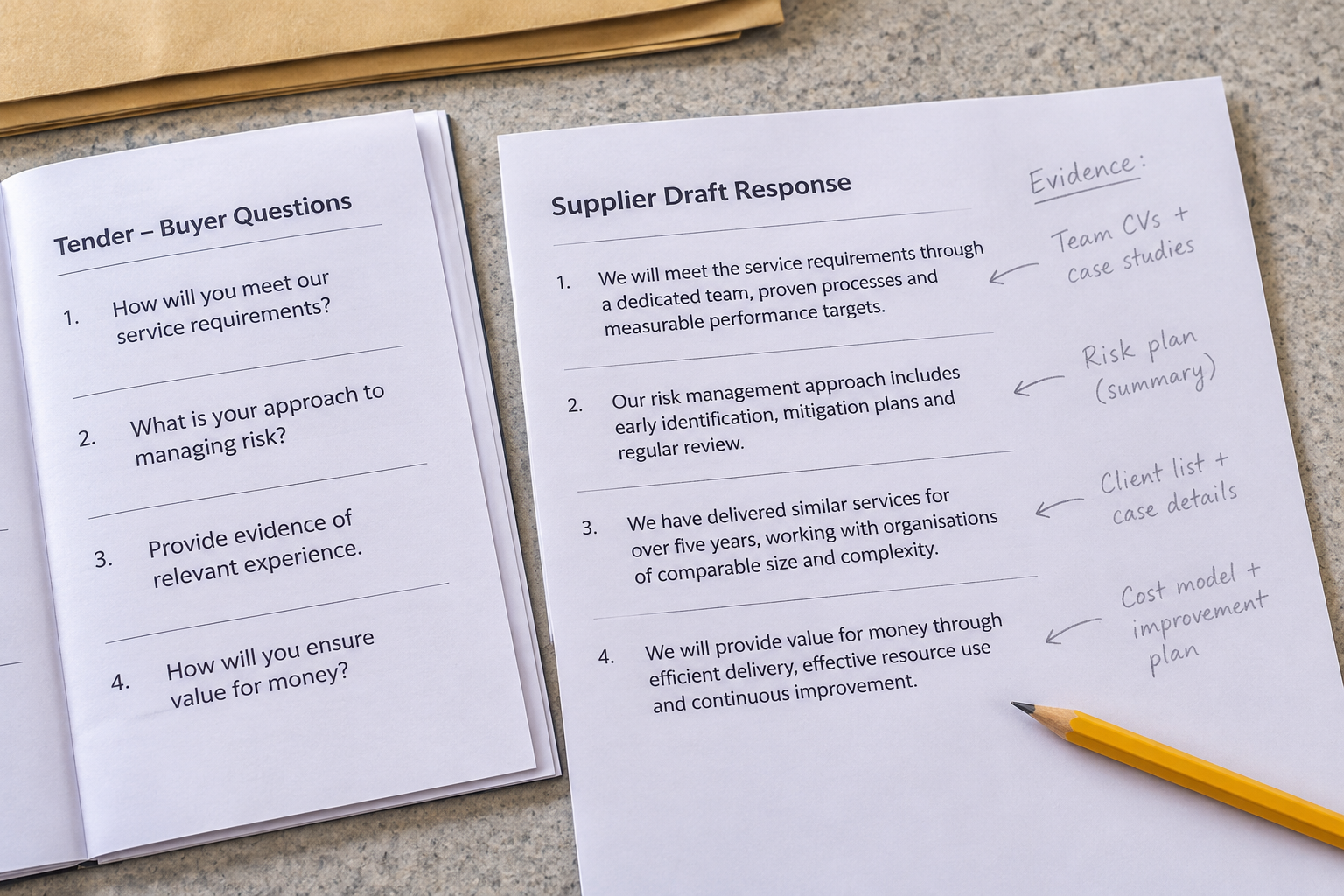

To write a tender response, start by checking the buyer’s instructions and deciding whether you can meet the requirements. Then answer each question directly, explain how you will deliver, support your claims with relevant evidence and submit the requested documents on time. The walkthrough below uses a clearly hypothetical service tender to show what that looks like in practice.
What Does a Strong Tender Response Need to Do?
A tender response is your organisation’s formal answer to a buyer’s invitation to supply goods, services or works. It needs to make it easy for the buyer to see what you are offering, how it meets the brief and what it will cost. It should also give evaluators enough relevant evidence to assess the offer against the published criteria.
That is different from sending a general sales proposal. A persuasive company profile may explain what you do, but it cannot stand in for an answer about the buyer’s specific delivery schedule, reporting needs or service risks. The buyer may have prescribed forms, word limits and a scoring method, so the response needs to work within those boundaries.
For this hypothetical walkthrough, imagine a supplier considering an invitation to provide routine cleaning for several buyer-managed premises. The buyer asks for a mobilisation plan, a quality-control approach, a price schedule and evidence of suitable insurance. The example is illustrative: it does not describe a real procurement, named organisation or outcome.
As you work through it, replace the example requirements with the actual wording in your invitation. The buyer’s documents, including any clarifications and amendments, take precedence over a generic checklist.

Before drafting, identify the person responsible for the submission, the colleagues who must contribute and the person who can approve the final offer. That avoids discovering at the deadline that a price, declaration or attachment still needs an authorised signature.
How to Write a Tender Response: Start With the Instructions
Read the full invitation before writing any answers. Look beyond the question set: the specification, contract terms, pricing workbook and submission guidance may all contain obligations that affect your response. Download any appendices and check whether there are later versions or notices in the buyer’s portal.
In the hypothetical cleaning tender, the supplier first establishes which premises are in scope, the expected service hours and whether the buyer has specified a start date. It also checks whether the invitation asks suppliers to attend a site visit or submit questions by a particular date. If the documents are silent or inconsistent, the supplier records the issue rather than filling the gap with an unsupported assumption.
Create a simple response plan that captures:
- Submission rules: deadline, time zone, portal, file formats and any size limits.
- Mandatory conditions: declarations, insurance requirements and any pass-or-fail questions identified by the buyer.
- Scored questions: the question wording, available marks or weightings, and response limits where provided.
- Commercial requirements: pricing format, contract duration, payment terms and requested assumptions.
- Dependencies: site information, internal approvals, third-party input and clarification deadlines.
Do not assume every item in the invitation carries the same consequence. A missing mandatory declaration may be treated differently from a weak answer to a scored question. The tender documents should explain the buyer’s approach; if they do not, ask through the stated clarification process.
For public-sector opportunities, the relevant rules and procurement documents matter as well as good writing. The UK government’s Procurement Act guidance collection is a useful starting point, but check which regime and instructions apply to the particular opportunity.
Should You Bid, and What Should You Clarify?
A well-written response cannot compensate for a contract you cannot deliver. Hold a short bid-or-no-bid discussion before committing substantial time. Involve someone who understands the service, someone who can test the commercial position and, where needed, someone who can assess the contract terms.
In the cleaning example, the supplier might be comfortable with the type of work but need to confirm whether it can cover all the locations and hours. It should also consider whether it has sufficient management capacity, whether the contract is commercially viable and whether any proposed subcontracting is permitted and practical.
Record the decision and the unresolved points. Useful questions include:
- Can we meet every requirement the buyer identifies as mandatory?
- Do we have the people, capacity and relevant experience for the proposed scope?
- Can we accept the key contract terms, or is there a permitted way to raise concerns?
- Can we price the work responsibly with the information available?
- Can we prepare a complete submission before the deadline?
If an answer depends on information the buyer has not provided, use the official clarification channel. Ask a specific question that identifies the relevant document and section. For example: “Please confirm whether the stated cleaning hours apply to every listed site, or whether site-specific schedules will be provided.” This is an illustrative question, not a fact about a real tender.
Keep a record of the reply and share it with everyone preparing the response. Clarifications may change the scope, the price or the wording of an answer. Follow the buyer’s instructions on confidentiality and communication; do not rely on an informal conversation if the process requires questions through a portal.

How Do You Turn Requirements Into a Response Plan?
Build a compliance matrix before drafting. This can be a spreadsheet or a simple working table: the point is to connect every buyer requirement to an answer, evidence source and owner. Copy the question reference accurately, then note what the buyer actually wants to assess. Include unscored documents as well as narrative answers.
The following hypothetical matrix shows how the cleaning supplier might organise its work. The requirements and evidence are examples, not a claim that every buyer asks for them.
| Buyer request | What the response should cover | Possible supporting material | Internal owner |
|---|---|---|---|
| Mobilisation plan | Activities before service starts, responsibilities and dependencies | Draft transition schedule | Service lead |
| Quality control | Inspection approach, reporting and how issues are corrected | Sample inspection record | Operations lead |
| Price schedule | Required prices, inclusions and permitted assumptions | Completed buyer workbook and costing notes | Commercial lead |
| Insurance evidence | Evidence matching the cover and format requested | Current policy documentation, if suitable | Finance or compliance lead |
Check the matrix against the invitation rather than treating the example as a complete list. Add columns for word limits, weighting, draft status and review comments if they help your team. If a question contains several parts, split it into smaller tasks so none is missed.
Weightings can help you allocate preparation time, but do not ignore a low-weighted question or an unscored mandatory item. A high-scoring narrative is of little use if the submission fails a condition the buyer has stated is compulsory. For background on how buyers may structure their assessment, see our guide to tender evaluation criteria.
Agree an internal deadline ahead of the buyer’s deadline. It should leave time for a colleague to challenge the draft, for the pricing and narrative to be reconciled, and for the authorised person to approve the offer. The right margin depends on the complexity of the submission and your organisation’s approval process.
Write Each Answer Around the Buyer’s Question
Use the buyer’s question as the organising principle. Start with a direct answer, explain the proposed method, identify who is responsible and show how the buyer can see that the method is being followed. Add evidence where the invitation asks for it or where it supports an important claim.
Suppose the hypothetical buyer asks how cleaning quality will be monitored and problems corrected. A vague response might say that the supplier is committed to excellent service. It sounds positive, but it does not explain an inspection process or what happens when the service falls short.
A more useful draft would describe the planned inspection method, who records findings, how issues are reported and how corrective action is tracked. It should state any proposed inspection frequency only if the supplier has decided it can deliver it and the invitation allows that approach. If the buyer specifies a frequency, address that requirement directly.
Here is an illustrative structure, not a ready-made promise:
“Our service lead will use the agreed inspection checklist to record findings at each site. Issues will be assigned to a responsible person, with corrective action and follow-up recorded. We will provide the buyer with the reporting information requested in the contract.”
Before using wording like this, check it against the specification, the actual operating plan and the resources included in the price. If the buyer asks for escalation times or sample reports, add those details rather than assuming the paragraph is complete.
Make the response easy to navigate. Use the buyer’s question numbers and headings where permitted. Put the most relevant point first, then explain the process in a logical order. If attachments are allowed, label them clearly and refer to the exact section that supports the answer. Do not assume an evaluator will search a long appendix for a point you have not explained in the main response.

Keep claims specific and supportable. “We will appoint a named service lead” is a proposed commitment; “we have already appointed the service lead” is a statement of fact and needs to be true when submitted. Avoid describing a capability, accreditation or previous project unless you can substantiate it and it is relevant to the question.
If you are using AI to help organise or edit a draft, give it appropriate material and check its output against the invitation and your organisation’s actual capabilities. A useful review question is: Which part of the buyer’s request does this sentence answer, and what supports it? Remove invented details and have a responsible person approve the final wording.
For buyers who want a more structured process, TenderLock helps turn briefs into requirements and supports requirement-by-requirement evaluation, with named people making final decisions. Start your first live tender free; no card is required.
What Evidence Should You Include?
Evidence makes a claim easier to assess, but more material is not automatically better. Select documents that address the buyer’s request and are current, accurate and permitted for submission. A short, relevant example may be more useful than a large collection of generic policies.
For the hypothetical cleaning tender, the buyer might request insurance documentation and a sample quality record. The supplier should check the required cover, dates and document format rather than attaching whatever happens to be in a shared folder. A sample record should reflect a process the supplier can actually operate; if it is illustrative, label it accordingly.
When describing prior experience, explain the relevance to the proposed work without suggesting that the past project is identical. Identify the service delivered, your organisation’s role and the aspect that demonstrates capability. Include a customer name or contact only where you have permission and the buyer’s instructions call for it. Do not invent outcomes or imply that an example guarantees the same result.
Check documents for conflicting dates, obsolete branding, unexplained gaps and statements that do not match the response. Redact information only where appropriate and allowed, and retain enough detail for the buyer to assess the evidence. If a requested document is unavailable, do not quietly substitute something else: use the clarification process to ask what the buyer will accept.
Personal information deserves particular care. Limit what you share to what is necessary for the process and follow your organisation’s data-protection procedures. The Information Commissioner’s Office guidance on UK GDPR provides a starting point for handling personal data responsibly.
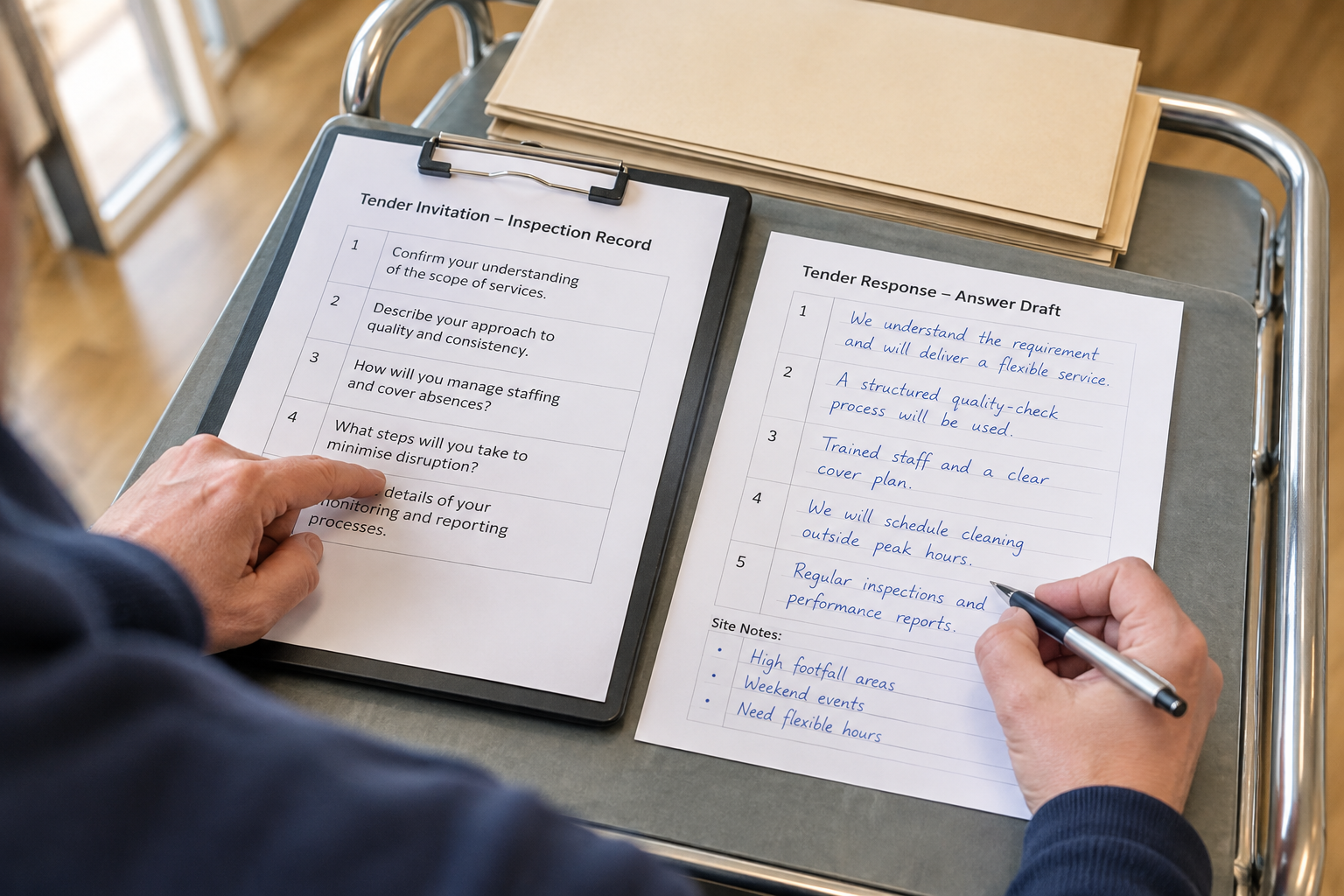
Where the invitation asks about supplier assurance or subcontractors, describe the checks you actually perform and how you manage any findings. Our UK supplier vetting checklist can help you think through the evidence a buyer may seek. Do not promise a check or monitoring process unless it is part of your proposed delivery.
Make the Price and Delivery Plan Agree
Complete the buyer’s pricing schedule in the format requested. Start with the stated scope, then work through the resources and costs needed to deliver it: labour, supervision, materials, travel, equipment, reporting and any other relevant items. The precise categories will depend on the contract. Include taxes or show them separately as the buyer instructs.
In the cleaning scenario, a mobilisation plan that promises extensive site preparation needs to be consistent with the price. So does a quality-control answer that proposes inspections and reporting. If the operations team describes activities the commercial team has not costed, resolve the discrepancy before submission.
Record assumptions internally and disclose them only where the buyer permits or asks for them. An assumption should not quietly replace a mandatory requirement. If the scope is unclear and a price depends on the answer, submit a clarification rather than making a guess that could leave the offer unworkable.
Check arithmetic, units and the period covered by each figure. Confirm whether the workbook calculates totals automatically and whether its formulas have been preserved. If alternative prices or variants are allowed, label them as instructed and make the differences clear. If they are not allowed, do not introduce an unsolicited alternative as though it were the compliant offer.
Finally, compare the price schedule, delivery method and contract response side by side. Someone independent of the original costing can look for omissions and contradictions. The aim is not simply to submit the lowest number; it is to make an offer your organisation understands and can deliver if accepted.

How Should You Review and Submit the Response?
Run a review against the buyer’s documents, not just against your own draft. A colleague who did not write the answer can act as a constructive challenger: identify unanswered question parts, vague commitments, unsupported claims and differences between the narrative and attachments. Give the reviewer access to the latest clarification responses as well as the original invitation.
For the hypothetical tender, the reviewer checks that the mobilisation answer addresses the requested start arrangements, the quality answer describes the proposed controls, the pricing workbook is complete and the insurance evidence matches the instruction. This is a review process, not an invented result: whether the submission is compliant depends on the actual documents and buyer assessment.
Use a final check before approval:
- Confirm that every question and mandatory declaration has an answer or required document.
- Check word limits, file names, formats and any instructions on signatures.
- Verify that claims, dates, contacts and evidence are accurate and approved for sharing.
- Reconcile the price with the scope, delivery plan and permitted assumptions.
- Have an authorised person approve the final offer and contract position.
- Upload each file to the correct place and check that the portal shows the intended documents.
- Complete the final submission step before the deadline and retain the confirmation provided.
Uploading a file is not always the same as submitting an offer. Follow the portal’s instructions and allow time to resolve access problems. If a mistake is found after submission, check whether the buyer’s process permits a replacement before the deadline; do not assume an email will override portal rules.
Keep a copy of the submitted version, supporting approvals and any submission receipt in line with your retention policy. These records help your team understand exactly what was offered and prepare for any permitted clarification or subsequent discussion. Our guide to writing a tender bid step by step covers further practical preparation.
Watch: Preparing a Tender Response
For a visual introduction, search for a practical demonstration of reading tender questions, organising evidence and checking a submission. Compare any advice with the actual instructions in your invitation.
Frequently Asked Questions
How long should a tender response be?
Follow the buyer’s stated word, page or character limits for each answer. Where no limit is given, write enough to answer every part of the question and support important claims, without adding unrelated company history. A concise, specific answer is easier to assess than a longer one that leaves the method unclear.
Can a smaller supplier respond without a large bid team?
Yes. The same principles apply whether one person coordinates the response or several teams contribute. Decide early who can provide technical, commercial and approval input, and use a simple matrix to track tasks. Bid only where you can meet the stated conditions and deliver the contract; the size of the writing team does not remove those obligations.
Should we reuse answers from an earlier bid?
Previous answers can be a starting point if they remain accurate and you have permission to reuse the material. Rewrite them for the new buyer’s question, scope and word limit. Check names, dates, proposed personnel and evidence carefully: an answer tailored to another contract can miss requirements or make commitments that do not fit the new offer.
Can AI write the response for us?
AI can help organise requirements, suggest a structure or identify gaps for review. It should not be trusted to invent experience, decide what your organisation can deliver or approve the final offer. Check its output against the buyer’s documents and your evidence, protect sensitive information, and have an accountable person review and authorise the submission.
What if we cannot meet a requirement exactly?
Check whether the requirement is mandatory and whether the buyer permits clarification, alternatives or exceptions. Ask through the stated channel before the clarification deadline if the position is unclear. Do not claim compliance where it is not true, and do not assume an alternative will be accepted. If you cannot meet a mandatory condition, reconsider whether to bid.
Want to make the process clearer for buyers and suppliers? Start a free tender with TenderLock and build a structured process from brief to award.