Tender Evaluation Criteria: 18 Practical Tips with a Quick-Reference Table
6 November 2026 · 15 min read

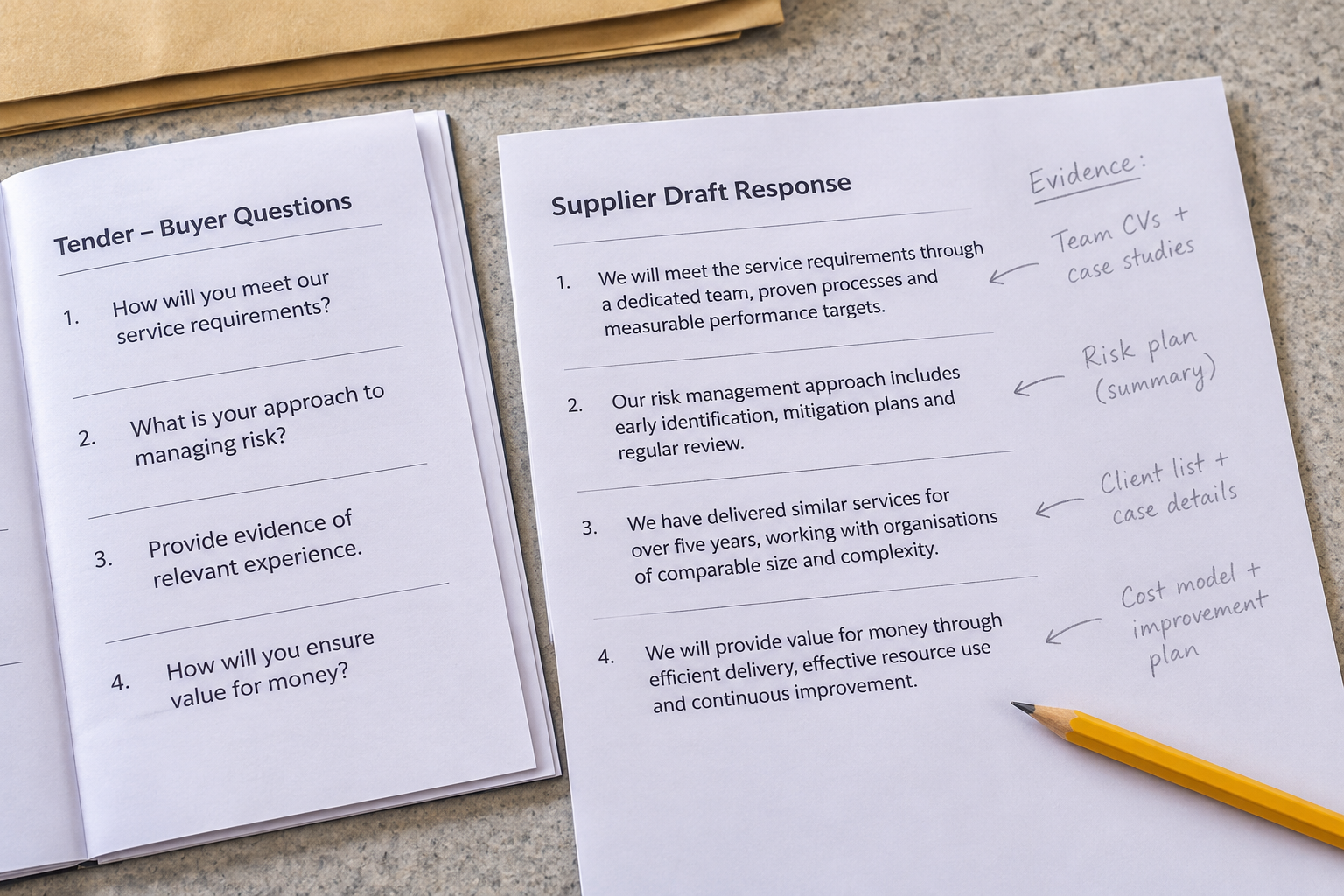
The fastest way to pick the right supplier is to define clear tender evaluation criteria, weight them sensibly, and collect verifiable evidence for each requirement. Decide outcomes first, translate them into scored questions, and lock your process so bids remain sealed and decisions traceable. This guide shows you how, with practical tips and a quick-reference table.
What Are Tender Evaluation Criteria and Why Do They Matter?
At their simplest, tender evaluation criteria are the structured rules you use to judge competing proposals. They make decision-making consistent, fair and explainable. Good criteria translate your outcomes into scored questions, balance quality and price with risk, and force suppliers to submit evidence you can actually verify. Done well, they protect you legally and ethically, reduce bias, and speed up your path to award.
In many teams, scoring rules evolve informally and creep over time. That’s risky. Unclear questions invite generic answers, vague weightings cause disputes, and missing audit trails leave buyers exposed. Using disciplined tender evaluation criteria helps you avoid these traps. You’ll define what “good” looks like in advance, lock your scoring grid, and require proof that maps to each requirement. You’ll also make it easier for suppliers to respond, because they’ll know exactly what counts.
Across sectors, regulators and auditors expect transparent, proportionate evaluation. Public buyers in the UK, for example, must demonstrate fairness and value for money across a traceable process. Even in private sector buying, shareholders and customers increasingly demand visible governance. A strong rule set is the foundation: if your questions are precise and your scoring is anchored to evidence, your decision is more resilient—and defensible when challenged.
Start with Outcomes: Define Success Before You Define Questions
Great scoring starts with outcomes. Before you draft a single question, state what success looks like for users, the business and governance. Imagine a 40-person firm migrating its CRM: outcomes could include zero data loss, user adoption within four weeks, and a predictable cost profile over 24 months. These aren’t features—they’re end states you can validate.
Turn each outcome into a small set of measurable acceptance statements. For “user adoption within four weeks,” you might specify 90% of named users complete role-based training by Week 3 and achieve 80% task completion by Week 4. Now ask yourself: what supplier evidence would convince us this will happen? Past training plans? Named instructors? Sample modules? References tied to similar rollouts?
From there, build questions that target proof, not promises. Instead of “Describe your training approach,” use “Provide a four-week role-based training plan, with sample modules and trainer CVs; show completion and task metrics achieved in two comparable rollouts.” Allocate points to completeness, relevance, and comparability. If an answer is guesswork, it shouldn’t score.
When you align outcomes to evidence-backed questions, your tender evaluation criteria become a map from need to proof. Suppliers see a fair pathway to score well, and evaluators understand exactly what “excellent” looks like before bids arrive. This also discourages padding and flowery narrative—your structure prioritises substance.

Which weightings actually drive fair value?
Weightings turn your priorities into numbers. If they’re off, you’ll reward the wrong things. A common trap is over-weighting price, which triggers a race to the bottom. Another is over-weighting narrative quality, which rewards style over substance. Strike balance by linking each weight to actual risk and impact on outcomes.
Start by listing your top five outcome risks: delivery delays, security breaches, user rejection, hidden costs, and dependency on a single specialist. Assign a notional impact (e.g., low/medium/high) and likelihood (e.g., rare/possible/likely). Now weight criteria proportional to the product of impact and likelihood. If user rejection is both possible and high impact, capability and approach to change management deserves meaningful weight.
Keep price influential, but not dominant unless your requirement is truly commodity-like. For strategic services or regulated environments, quality, security and resilience often warrant a larger share. Consider separating total cost of ownership from list price, so you can judge both the headline and the lifecycle exposure. Publish your scheme early and keep it stable; moving posts mid-process undermines trust and opens the door to challenge.
Finally, pilot your weighting model. Run a dry evaluation on two or three hypothetical supplier profiles—frugal but weak delivery, balanced performer, premium with gold-plated extras. If your scores reward over-specification or extreme under-pricing, adjust. A quick rehearsal often reveals distortions long before bids land.
How do you turn a plain-English brief into scored requirements?
Most briefs start as emails or slides. The job is to distil them into a set of unambiguous, testable requirements with clear scoring rules. Begin by listing user stories or tasks. For each, define acceptance criteria, then specify the evidence you’ll accept. Where possible, anchor to standards, published controls, or real artefacts (e.g., sample reports, named people, or system configurations).
Convert soft verbs into measurable actions. Change “robust security” to “meets CIS Critical Security Controls v8, with a mapping document and third-party attestation dated within 12 months.” Replace “flexible support” with “named service manager, 2-hour response SLA for P1 incidents, and a changelog of the last 6 months of resolved tickets for two similar clients.” Your tender evaluation criteria should leave little room for guesswork.
Lock the questions and scoring scale before you invite bids. For governance, store and time-stamp the final version. If you refine wording during clarification, update a single source of truth and notify all bidders equally. For complex briefs, a structured, AI-assisted editor can help surface ambiguities and duplicate requirements, and keep scoring grids aligned to your outcomes.
When everything is clear, publish your requirement list, scoring scale and weightings. Name evaluators in advance and define their roles, including who resolves ties and how conflicts are recorded. Now the rules—not personalities—run the process.
See a buyer’s checklist for drafting structured questions if you want a step-by-step starting point, from user stories to evidence prompts.
Start your first live tender free to turn a plain brief into a scored, auditable evaluation—no card needed.
Build a Balanced Scorecard: Quality, Price, Risk, and Evidence
A balanced scorecard grounds your decision across value dimensions. Quality confirms capability and fit. Price captures affordability over the lifecycle. Risk checks resilience: security, continuity, data protection, and operational stability. Evidence validates claims with artefacts anchored to the requirement. Balance isn’t symmetry: weights should reflect what actually drives outcomes and governance in your context.
Quality should test the “how” and the “who.” Look for named roles, CVs aligned to the work, method statements tailored to your environment, and a plan for knowledge transfer. Price should go beyond unit costs to include onboarding, training, integrations, change requests, and exit fees. Risk must probe real posture: certifications, independent assessments, and named controls with scope and dates. Evidence should be specific and checkable—documents, logs, configurations, and references with permission to contact.
To avoid style-over-substance scoring, calibrate with examples of excellent, adequate, and inadequate answers before evaluation starts. Agree what “full marks” looks like in advance, and document it. Store rationales centrally and link them to the requirement. Doing so not only smooths moderation; it also provides the audit trail you need if challenged later.
If you’d like a deeper dive into building a robust scoring model, our guide on setting evaluation rules step by step walks through practical templates and moderation tips used by real teams.

What makes evidence verifiable, auditable and supplier-friendly?
Evidence requests should be strict enough to prevent marketing fluff, yet fair enough for suppliers to comply without reams of bespoke paperwork. Make it verifiable by tying each request to a requirement and naming acceptable artefacts. Make it auditable by storing submitted files, time-stamping changes, and keeping rationale notes linked to scores. Make it supplier-friendly by signalling format, page limits, and redaction rules early.
For sensitive content, specify how confidential data will be handled and who can access it. Refer to recognised security and privacy frameworks where relevant, and only request personal data if you truly need it. The UK ICO provides guidance on data minimisation and lawful processing; see the ICO’s UK GDPR resources for organisations for pragmatic guardrails.
Use named people for demonstrations and Q&A, but keep parity. If you permit a demo for one bidder, offer it on the same terms to all. Record calls where legally permissible, and provide written summaries to eliminate unequal information. When your tender evaluation criteria require proof, ensure the evidence is stored alongside the score. If you later revisit a decision, you’ll have the artefacts and notes in one place.
Finally, fight ambiguity with structured prompts. Instead of “Provide case studies,” ask for two live clients of similar size, contactable references, the problem solved, the approach taken, and measurable outcomes. Suppliers appreciate clarity; it reduces the effort of guessing what you want.
Sealed, unbiased evaluation: processes that stop scope creep and leaks
Sealed bidding protects you from price-shopping, leaks, and informal pressure. It ensures commercial terms stay hidden until after qualitative scoring is complete, or at least until the deadline, depending on your policy. The process should lock submission windows, encrypt files, and record exactly who accessed what, and when. Your scoring grid should be frozen, too—so rules can’t drift mid-flight.
Name evaluators at the start, record conflicts of interest, and assign independent roles: technical reviewers score capability, commercial reviewers score price, and a chair adjudicates on ties using published rules. Keep a clear separation between clarifications and negotiations. Clarifications resolve ambiguity for all bidders equally; negotiations, if allowed, follow policy and are always documented.
Red Team reviews are invaluable. Before you publish, have a colleague who isn’t involved in writing the questions try to misread them. Wherever they can spin an answer without proving anything, tighten the wording. Doing this once can eliminate dozens of clarification emails later. Store the pre- and post-review versions—if challenged, you can show your diligence.
When your platform enforces sealed windows and evidence-linked scoring, bias shrinks and governance improves. It’s easier to justify results if every awarded point corresponds to a requirement and a stored artefact. It’s also faster to run debriefs, because you can walk suppliers through each scored question and the supporting rationale.

Practical tips for weighting price without creating a race to the bottom
Price matters, but over-weighting it can reward corner-cutting. To keep quality front and centre, cap the maximum price weight unless you’re buying a true commodity. Use a transparent scoring formula that penalises outliers and rewards value rather than raw cheapness. For example, normalise scores against the median or against a realistic target price range you publish in advance.
Decide whether you’ll use linear or curved price scoring. Linear methods are simple but can exaggerate tiny differences. Curved methods can compress outliers so a 2% gap doesn’t swamp quality. Whatever you choose, publish the formula. Also separate one-off and recurring costs, and include lifecycle items like onboarding, integrations, change requests, and exit fees. Ask suppliers to confirm what’s excluded, so surprises surface early.
Watch for unsustainably low bids. If a price is materially below others, request an explanation and assess risk. You can award on value even if a bid isn’t the cheapest—so long as your rules and justifications are clear. Protect yourself by testing price realism through scenario-based pricing: give a fixed workload and ask suppliers to price it. Finally, apply your tender evaluation criteria consistently across all bidders; if you flex rules for one, you’ll need to flex them for all.
Run discrimination checks, conflicts logs and supplier vetting early
Governance isn’t an afterthought. Before you publish, check your questions for inadvertent bias (e.g., brand-only phrasing, excluding SMEs). Run a conflicts-of-interest log and have evaluators sign it. Document how you’ll handle late submissions, clarifications, and tie-breaks. Pre-plan debriefs with templated feedback anchored to requirements and scores.
For supplier vetting, gather objective facts early: company registration, directors, financial health, insurance, and sanctions screens. In the UK, Companies House is a primary source for registration and filings—see Companies House guidance and services. Public buyers should align with applicable procurement regulations and principles of transparency; see public sector procurement guidance on GOV.UK for current policy context.
Ask only for checks proportionate to the risk. For a small SaaS tool, a light financial and security review might suffice. For critical infrastructure, you’ll need deeper due diligence and specific controls. Keep your rationale documented: why this check, for this risk, at this weight? Anchor it to your tender evaluation criteria so suppliers understand why it matters and where it fits in the decision.
For a comprehensive, step-by-step approach to due diligence, see our guide: Supplier Vetting Checklist UK: The 2026 Ultimate Guide. It outlines proportionate checks and practical templates teams can adopt quickly.

Red Team your questions, then pilot your scoring and moderation
Ambiguity is the enemy of fair scoring. After drafting, run a Red Team pass: have people who didn’t write the questions try to “game” them. Anywhere they can answer without giving proof, tighten the requirement or specify accepted evidence. Replace adjectives with artefacts. Where a policy is implied, cite it explicitly. Where a standard matters, name it with version and date.
Next, pilot your evaluation. Create three hypothetical supplier profiles that reflect common patterns (lean but risky; balanced and reliable; premium and over-specified). Score sample answers against your grid. If the premium vendor always wins on narrative flair despite weak fit, adjust. If the cheapest option dominates because of a brittle price formula, tweak the curve or re-weight quality. Document changes and reasons so your audit trail shows method, not whim.
Moderation is where bias can creep in. Before scores are visible, agree what “excellent,” “adequate,” and “insufficient” look like for each criterion. Use examples. During moderation, focus on the requirement text and the evidence submitted, not brand familiarity. Record rationales next to the score. Keeping resolutions linked to requirements adds integrity to your tender evaluation criteria and simplifies supplier debriefs.
If you’re new to structured debriefs, our article on running sealed, fair bidding with AI-assisted governance shows how teams structure clarifications, moderation and award steps while keeping bids locked until the deadline.
Quick-Reference Table: Ready-to-Use Criteria and Weightings
Use this starter table to shape your scoring grid. Adapt weights to your context, and make sure each question requests evidence you can verify. Keep your total at 100 and publish both the questions and the scoring scale. The mapping below also points to likely red flags to watch for during evaluation and moderation.
| Category | Example Scored Question | Suggested Weight | Accepted Evidence | Common Red Flags |
|---|---|---|---|---|
| Capability & Fit | Provide a method statement tailored to our environment, including roles, timelines and handover. | 20–30% | Method doc, RACI, sample plan, named CVs with relevant projects. | Generic boilerplate; unnamed team; missing handover. |
| Outcomes & Adoption | Show how you will achieve our adoption targets within four weeks, with metrics and milestones. | 10–15% | Training plan, sample modules, adoption metrics from similar clients. | Vague training; no metrics; no comparable references. |
| Security & Compliance | Demonstrate alignment to named controls (e.g., CIS v8) with a mapping doc and recent attestation. | 10–20% | Policy set, control mapping, audit letter < 12 months old. | Expired certs; scope mismatch; marketing-only claims. |
| Service & Support | Describe service levels for P1–P3 and escalation, including named service manager. | 8–12% | SLA doc, org chart, rota, ticket reports (redacted). | No named owner; unrealistic response times; no evidence. |
| Delivery Plan & Risk | Provide a timeline with dependencies, assumptions, and mitigation for top 5 risks. | 10–15% | Gantt/plan, risk register, mitigation details, prior lessons learned. | No dependencies; hand-waving mitigation; hidden third parties. |
| References & Track Record | Submit two similar engagements with contactable references and outcomes. | 5–10% | Case summaries, reference contact permission, outcomes with dates. | Non-comparable work; anonymous quotes; no permission to contact. |
| Commercials (TCO) | Give total cost of ownership for 24 months, itemised and inclusive of exit. | 15–25% | Pricing workbook, unit rates, assumptions, change rates, exit fees. | Hidden extras; missing assumptions; unrealistic discounts. |
| Innovation & Value Adds | Show tangible efficiencies or risk reductions relevant to our scope. | 3–6% | Proof of impact, playbooks, measured savings, pilots. | Speculative ideas; unrelated features; no evidence of impact. |
| Sustainability & ESG | Explain material environmental and social impacts and how you measure them. | 3–6% | Policies, scope, metrics, third-party verifications where available. | Policy-only answers; no data; irrelevant claims. |
To apply this, create one scored question per row, refine wording for your context, and attach explicit evidence requests. Publish your scoring scale (e.g., 0–5) with anchors for what earns a 5, 3, and 1. During evaluation, record rationales next to each score and keep artefacts linked. This strengthens your tender evaluation criteria and streamlines debriefs.

Governance essentials: audit trails, clarifications and debriefs that stand up
Governance is what makes good procurement repeatable and defendable. Keep a full audit trail: who drafted what, who changed what, and when. Record clarifications with complete question-and-answer threads available to all bidders, not just the one who asked. Time-stamp submissions and lock access logs. Name decision-makers and store their scores and rationales next to the requirement, not in scattered files.
Plan debriefs from the outset. Promise—and deliver—specific feedback for each scored question. Avoid comparative statements about competitors; instead, tie comments to the requirement and how the evidence met or missed the scoring anchors. Suppliers value clarity and can improve next time, and you reduce the risk of disputes.
For public sector teams, align your records with policy and audit guidance. The UK’s public procurement content on GOV.UK is a useful orientation for current principles and references. If you operate under strict regulations, agree a records retention policy and ensure secure storage aligned with your data protection obligations. Clear records also support internal learning: your next event will build from documented, known-good patterns.
Linking every point awarded to a requirement and a stored artefact is the practical test of robust tender evaluation criteria. If you can’t show the chain from question to evidence to score to award, you’ll struggle under scrutiny.
Frequently Asked Questions
How many criteria should we use for a typical SME procurement?
Focus on 8–12 scored questions grouped across quality, price and risk, plus a few pass/fail checks. Fewer, better-crafted questions reduce noise and speed evaluation. If the scope is complex, split into lots or phases, but keep each lot’s grid clear, with anchored scoring and named evidence.
What’s the best scoring scale for non-experts on the panel?
A 0–5 scale with anchors works well. Define what a 5, 3 and 1 look like for each question, then calibrate together with sample answers. Avoid ambiguous mid-points without descriptions. Provide examples and remind evaluators to score against the requirement, not the brand or relationship history.
Should we reveal weightings to suppliers before they bid?
Yes. Publishing weightings increases fairness and helps suppliers tailor relevant evidence. It also reduces clarification traffic, because bidders know what matters most. Keep the scheme stable; if you must change it, update the single source of truth and notify all bidders equally with a record of what changed.
How do we stop long narrative answers swamping the panel?
Use structured prompts and page limits per question, ask for specific artefacts, and set a standard attachment format. Calibrate upfront on what earns top marks. During moderation, focus on evidence linked to the requirement. If you’re still overloaded, trim questions or split evaluation roles across the panel.
What if the cheapest bid looks unsustainably low?
Seek clarification and assess realism. Compare to the market, check inclusions and exclusions, and review delivery assumptions. If risk is high, you can award to better value even if it isn’t the lowest price—provided your published rules and rationales support that decision. Document every step for your audit trail.
Ready to run a fair, auditable process? Start your first live tender free and turn your brief into a sealed, evidence-led evaluation today.